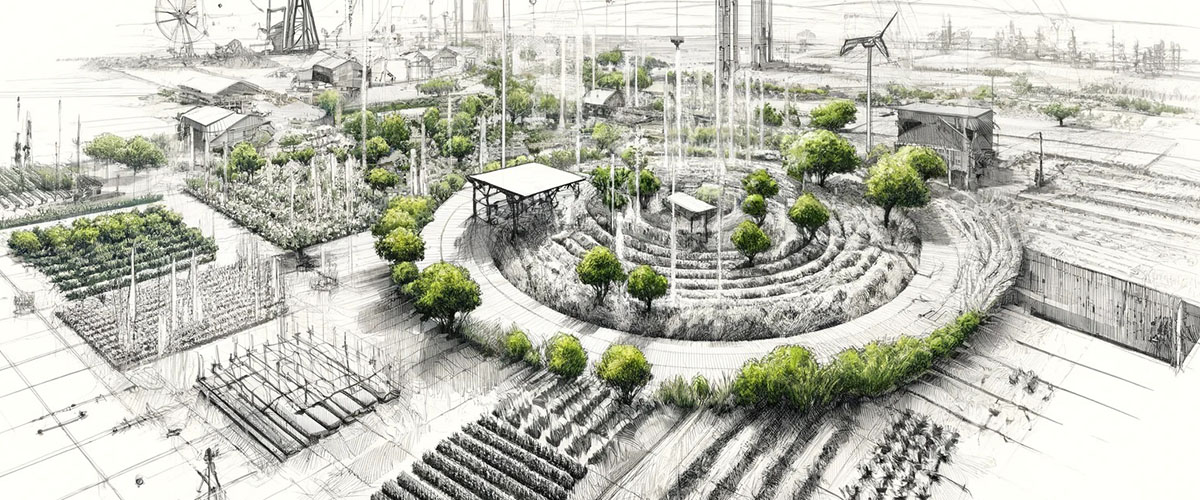
Principles of sustainable design applied to water conservation
Sustainable design for water conservation and reuse starts from an alarming fact: the building sector consumes 12% of all freshwater extracted globally, and in cities the proportion rises to 60-80% of the municipal supply (UN-Water, 2023). In Spain, average domestic consumption stands at 133 liters/person·day (INE, 2022), distributed as follows: toilet (30%, 40 l/day), shower and bath (26%, 35 l/day), washing machine (12%, 16 l/day), kitchen sink (10%, 13 l/day), cleaning (7%), irrigation (6%) and other (9%). Sustainable design intervenes in each of these flows through three hierarchical strategies: source reduction (efficient devices that decrease consumption without altering functionality), on-site reuse (treatment and recirculation of greywater and rainwater for non-potable uses) and resource recovery (extraction of energy and nutrients from wastewater). The combined application of these three strategies enables potable water consumption reductions of 40-70%.
Certification frameworks quantify these reductions with verifiable indicators. LEED v4.1 (Water Efficiency category, maximum 11 points) requires as a prerequisite a 20% reduction compared to the EPAct 1992 baseline and awards additional credits up to 50% reduction. BREEAM (Water category, weighting 6% of total) evaluates consumption through the Wat01 calculation, which establishes a baseline of 12.5 m³/person·year and rewards progressive reductions. The WELL v2 standard (feature W05: Water Quality) additionally requires that reuse water quality comply with EN 16941-1 for rainwater harvesting and EN 16941-2 for greywater recycling. In practice, buildings achieving the highest certifications demonstrate consumption of 60-90 liters/person·day, a reduction of 35-55% compared to equivalent conventional buildings. Sustainable water design is not an appendix to the project but an integrated system that must be planned from the earliest architectural concept phases.
Rainwater harvesting and integrated storage systems
Rainwater harvesting constitutes the first pillar of sustainable design for water conservation. A complete system comprises: collection surface (building roof, runoff coefficient 0.80-0.95 depending on material), conveyance (gutters and downpipes with leaf filter), first-flush diverter (device discarding the first 0.5-2 mm of rainfall, which is the most contaminated by atmospheric deposits), storage tank (underground or in basement, materials: concrete, HDPE or fiberglass), treatment system (filtration + UV disinfection for indoor uses) and dedicated distribution network (piping identified in purple per UNE-EN 806). Annual collection volume is calculated as V = P × A × Cr × η, where P is precipitation (mm/year), A is roof area (m²), Cr is the runoff coefficient and η is system efficiency (0.85-0.90). For a residential building with 500 m² of roof area in Madrid (precipitation 436 mm/year), the harvest is 167-186 m³/year.
Tank sizing depends on the seasonal rainfall pattern and the consumption profile. In Mediterranean climates, 80% of precipitation is concentrated between October and May, with 2-4 months of virtually dry summers. Tanks for 20 dwellings in Madrid are typically sized at 30-60 m³ (monthly simulation method per DIN 1989-1), covering 40-60% of non-potable water demand (toilets, washing machines, cleaning, irrigation). The cost of a rainwater harvesting system for a 20-unit multi-family building ranges from 15,000 to 35,000 EUR (tank: 8,000-18,000 EUR, treatment: 3,000-7,000 EUR, separate network: 4,000-10,000 EUR), with annual water bill savings of 2,000-5,000 EUR and a return on investment of 5-12 years. Spanish municipalities that offer tax incentives for rainwater harvesting — Barcelona (50% reduction on the sewerage charge), Vitoria-Gasteiz, Sant Cugat — reduce the payback period to 3-8 years. Standard UNE 149101:2015 establishes the technical requirements for design, installation and maintenance of rainwater harvesting systems in Spain.
Greywater recycling and treatment technologies
Greywater recycling represents the reuse strategy with the greatest savings potential in residential buildings. Greywater (from showers, basins, washing machines) accounts for 50-65% of domestic wastewater flow and carries contaminant loads 5-10 times lower than blackwater, simplifying treatment. Treatment systems are classified into three technology tiers: physical (membrane filtration without chemical reagents), biological (biofilm reactors, constructed wetlands) and combined (membrane bioreactor, MBR). Compact MBR systems, such as those manufactured by Hydraloop (Netherlands, model H300: 300 l/day, dimensions 64 × 61 × 183 cm, consumption 1.5 kWh/day, cost 4,000-5,000 EUR) achieve effluent qualities with turbidity < 1 NTU, BOD₅ < 5 mg/l and undetectable E. coli, comfortably meeting EN 16941-2 for reuse in toilets and washing machines.
At the multi-family building scale, centralized greywater recycling systems treat flows of 2,000-10,000 liters/day using SBR (sequencing batch reactor) or MBBR (moving bed biofilm reactor) technology. The Solcer House project (Cardiff University, 2015) demonstrated a 45% reduction in potable water consumption through greywater recycling and rainwater harvesting, at a treated water cost of 1.8 EUR/m³. The Bullitt Center (Seattle, 2013, Living Building Challenge certification) recycles 100% of its wastewater through a multi-stage treatment system including a constructed wetland and UV disinfection, achieving total water self-sufficiency. In Spain, Royal Decree 1620/2007 permits reclaimed water reuse for toilet flushing, private irrigation and industrial washing with required quality of: intestinal nematodes < 1 egg/10 l, E. coli < 200 CFU/100 ml, suspended solids < 20 mg/l and turbidity < 10 NTU. Greywater reuse reduces the building's water footprint by 25% to 40%, complementing rainwater harvesting to achieve total savings of 50-70%.
Efficient devices and integral water cycle design
Low-consumption devices constitute the most direct and economical intervention in sustainable design for water conservation. Faucets with aerators or flow restrictors limit flow to 5-6 l/min (compared to 12-15 l/min without a regulator) with no user-perceived comfort loss, according to studies by the Water Research Foundation (2016). Thermostatic showers with flow limiters at 7-9 l/min (compared to 15-20 l/min) reduce shower consumption by 40-55%; models with cold water recirculation (a recirculation pump that prevents wasting 5-15 liters while the water reaches the desired temperature) save 3,000-8,000 liters/person·year. Dual-flush toilets at 3/6 liters (compared to 9-12 liters in older models) reduce toilet consumption by 50-67%. Waterless urinals eliminate 55,000-170,000 liters/year per unit in office buildings.
Integral water cycle design in buildings requires hydraulic planning that connects all subsystems: potable supply network (minimized), separate rainwater and treated greywater network (purple color code, signage per EN 806-1), differentiated drainage network (grey vs. black), storage tanks with level and quality telemetry, and a control system that prioritizes alternative sources over mains supply. The most advanced projects integrate the water balance into the building's BIM model, calculating water demand and supply month by month and optimizing the sizing of tanks and treatment equipment. The One Angel Court building (London, renovation by Fletcher Priest Architects, BREEAM Outstanding certification) reduced its potable water consumption by 63% compared to the baseline through rainwater harvesting, greywater recycling and smart faucets, with an additional hydraulic installation cost of 8% and a return on investment of 6 years. Sustainable design for water conservation and reuse transforms the building from a passive consumer into an active manager of a resource whose scarcity already affects 2.3 billion people worldwide (UN-Water, 2023).
References
- [1]United Nations World Water Development Report 2023: Partnerships and Cooperation for WaterUNESCO / UN-Water. ISBN: 978-92-3-100576-3
- [2]Residential End Uses of Water, Version 2Water Research Foundation, Denver. ISBN: 978-1-60573-236-1
- [3]A Review of Greywater Characteristics and Treatment ProcessesWater Science and Technology, 67(7), 1403-1424.
- [4]Urban Rainwater Harvesting Systems: Research, Implementation and Future PerspectivesWater Research, 115, 195-209.
- [5]UNE 149101:2015 — Sistemas de aprovechamiento de agua de lluvia. Diseño, instalación y mantenimientoAsociación Española de Normalización.

Comments 0
No comments yet. Be the first!
Leave a comment