Greywater: definition, volumes, and quality parameters
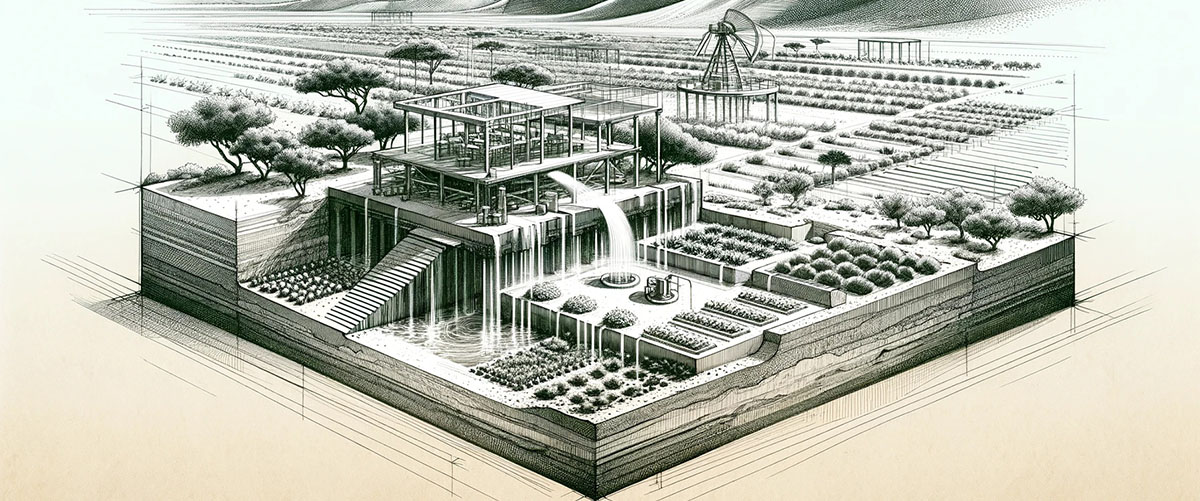
The benefits of greywater use and rainwater harvesting systems begin with understanding the resource itself. Greywater encompasses all domestic wastewater except toilet flushes and kitchen sinks heavily laden with grease: showers, handbasins, washing machines, and bathtubs. In a typical European dwelling, greywater accounts for 50-65% of the total domestic flow, translating to approximately 70-85 litres per person per day according to INE supply-and-sanitation statistics (2022). Capturing this stream diverts a substantial volume from the sewer network while providing a locally available source for non-potable applications such as toilet flushing, irrigation, and cooling-tower make-up.
Raw greywater quality varies with its origin. Shower and handbasin effluent typically registers BOD5 values of 50-200 mg/L, suspended solids (SS) of 50-100 mg/L, and faecal coliform counts of 10-10⁴ CFU/100 mL. Laundry effluent adds surfactants and higher pH (8-10). Spanish Royal Decree 1620/2007 establishes reuse quality thresholds: for urban landscape irrigation, SS must remain below 20 mg/L, turbidity below 10 NTU, and E. coli below 200 CFU/100 mL. Meeting these targets demands a treatment train whose complexity scales with the intended end use and the inlet load.
Treatment technologies: from simple filtration to membrane bioreactors
At the low-cost end, physical treatment combines coarse screening (1-2 mm mesh), sedimentation, and sand or multimedia filtration followed by UV or chlorine disinfection. These systems suit single-family homes where flow rates are under 500 L/day, investment stays below 3,000 EUR, and the target application is subsurface irrigation with relaxed turbidity limits. Maintenance consists of periodic filter backwashing and lamp replacement, with operating costs around 0.10-0.20 EUR/m³ of treated water.
For multi-dwelling buildings (20-40 units), membrane bioreactors (MBR) deliver superior effluent quality. An MBR combines activated-sludge biological degradation with ultrafiltration membranes (0.04 µm pore size), achieving BOD5 below 5 mg/L, SS below 1 mg/L, and near-complete pathogen removal in a single step. Capital expenditure for a 5-15 m³/day MBR plant ranges from 15,000 to 30,000 EUR, with operating costs of 0.30-0.60 EUR/m³ covering energy (0.8-1.5 kWh/m³), membrane replacement every 7-10 years, and chemical cleaning. The treated permeate meets all RD 1620/2007 urban-reuse categories and can supply toilet flushing throughout the building, displacing 25-35% of mains water.
Rainwater harvesting: collection, sizing, and storage
Rainwater harvesting (RWH) captures precipitation from roofs and impermeable surfaces, routes it through leaf screens and first-flush diverters, and stores it in underground or above-ground tanks for later non-potable use. The harvestable volume depends on the catchment area, local rainfall, and the runoff coefficient: pitched tiles yield C = 0.75-0.90, flat bituminous roofs 0.70-0.80, and green roofs 0.20-0.60, the lower values reflecting substrate absorption. For a 150 m² pitched roof in Madrid (annual rainfall ~440 mm, C = 0.85), the annual harvestable yield is approximately 56 m³, enough to supply toilet flushing for a four-person household year-round.
Tank sizing follows standardised methods. DIN 1989-1 uses a simplified yield-demand balance, while BS 8515:2009+A1:2013 applies a detailed daily time-step simulation over 20 years of rainfall data. Both approaches converge on tanks of 2,000-5,000 litres for single-family homes and 10,000-30,000 litres for multi-residential blocks. Underground HDPE or concrete cisterns require a calmed inlet, floating suction outlet, and overflow connected to the drainage network. Internal pipework must be clearly labelled as non-potable (coloured green per CTE DB-HS4), with air gaps preventing cross-connection to the mains supply (RD 140/2003 compliance).
Regulatory framework and local ordinances
Spain's principal regulation for water reuse is RD 1620/2007, which defines quality classes (1.1 residential, 1.2 urban services, 2 agricultural, 3 industrial, 4 environmental) and mandates monitoring frequencies. Greywater reuse within a single building falls into a regulatory grey area, as the decree primarily addresses centralised reclamation; however, Catalonia and the Balearic Islands have enacted complementary regional rules. Barcelona's Solar Thermal and Water-Saving Ordinance (2020 update) requires new buildings above 500 m² to install greywater or rainwater systems capable of meeting at least 30% of non-potable demand.
The CTE DB-HS4 (2019 revision) governs potable-water supply design and explicitly mandates anti-backflow measures where alternative water sources are present. RD 140/2003 sets drinking-water quality criteria, reinforcing the need for physical separation of potable and non-potable networks. At the European level, Regulation (EU) 2020/741 on minimum requirements for water reuse targets agricultural irrigation but signals a policy trajectory toward broader urban reuse. Designers must navigate this multi-layered framework, coordinating with the local health authority to obtain reuse permits and establishing operation-and-maintenance protocols that ensure continuous compliance.
Combined benefits: water savings, energy reduction, and certification credits
Integrating greywater reuse with rainwater harvesting achieves 40-60% reduction in mains water consumption, verified by pilot projects across Mediterranean climates. The corresponding energy saving is 0.5-1.5 kWh/m³ of displaced mains water, reflecting avoided pumping, treatment, and distribution energy at the utility scale. For a 30-dwelling building consuming 120 m³/month, a combined system displacing 50% of demand saves approximately 720 m³/year and avoids 360-1,080 kWh of upstream energy, equivalent to 100-300 kgCO₂/year at the Spanish grid emission factor.
Financial payback periods range from 5 to 10 years depending on local water tariffs, system complexity, and available subsidies. In Barcelona, where combined water-and-sewer tariffs exceed 4 EUR/m³ for high consumption brackets, payback can drop below 6 years. From a certification perspective, BREEAM awards up to 5 credits under Wat 01 (Water Consumption) for reducing potable-water demand by over 55%, and LEED v4.1 grants up to 4 points under WE Credit: Indoor Water Use Reduction for fixture-level and alternative-source strategies. Both frameworks reward metering and leak-detection provisions, incentivising a holistic water-management approach that combines efficiency, reuse, and monitoring.
References
- [1]Real Decreto 1620/2007: Régimen jurídico de la reutilización de aguas depuradasBOE.
- [2]BS 8515:2009+A1:2013 Rainwater harvesting systems — Code of practiceBritish Standards Institution. ISBN: 978-0-580-77498-6
- [3]Estadística sobre el suministro y saneamiento del agua — Año 2020INE.
- [4]Guía de reutilización de aguas grises en edificios residencialesFNCA.
- [5]CTE DB-HS4: Suministro de aguaGobierno de España.

Comments 0
No comments yet. Be the first!
Leave a comment