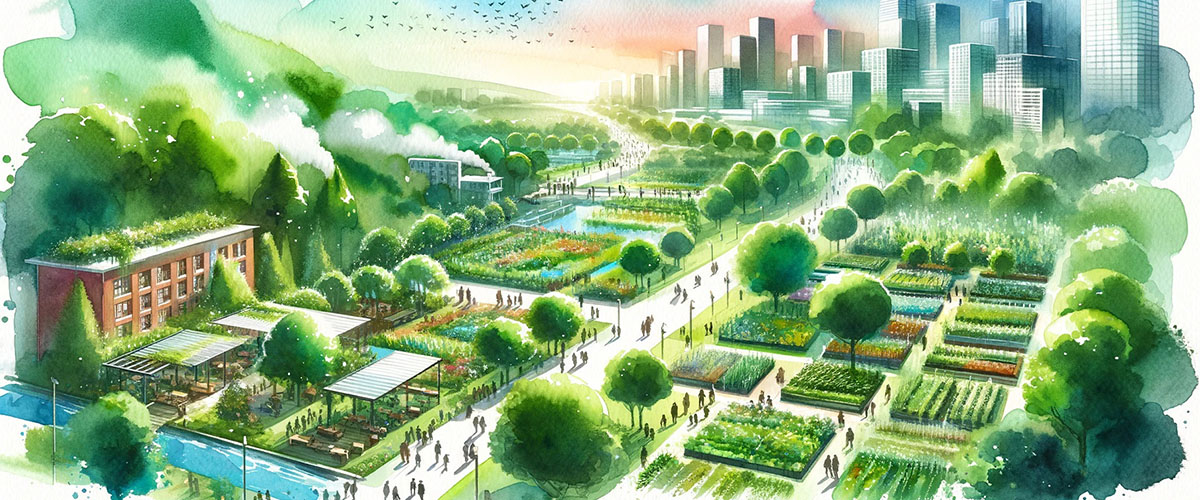
Urban heat island mitigation through vegetation
The environmental and social benefits of urban green spaces are most immediately felt through thermal regulation. The urban heat island (UHI) effect raises city-centre temperatures 2-8 °C above surrounding rural areas, driven by impervious surfaces that absorb shortwave radiation, anthropogenic heat from vehicles and HVAC systems, and reduced evapotranspiration (Oke et al., 2017). Strategically placed urban trees counteract UHI through shading and transpiration: a mature deciduous tree transpires 200-400 litres of water per day, consuming roughly 230-460 MJ of latent heat—equivalent to the cooling output of 5-10 domestic air-conditioning units running for 8 hours.
Microclimate modelling with tools such as ENVI-met allows designers to quantify cooling benefits at the neighbourhood scale. Santamouris (2020) reviewed 220 urban-greening projects worldwide and found that parks larger than 1 hectare reduce surrounding air temperatures by 1-3 °C up to 300 metres from the park boundary, while street-tree corridors lower pedestrian-level physiological equivalent temperature (PET) by 5-15 °C on summer afternoons. These thermal benefits translate directly into reduced cooling-energy demand: residential buildings adjacent to parks consume 15-35% less air-conditioning energy than comparable buildings in fully paved districts, yielding measurable savings on electricity bills and peak-grid stress.
Air-quality improvement and pollutant removal
Urban trees remove particulate matter and gaseous pollutants through dry deposition onto leaf surfaces and stomatal uptake. Nowak et al. (2014) estimated that a single urban tree captures 10-30 grams of PM10 per year, with broadleaf evergreens outperforming deciduous species due to year-round canopy presence and leaf surface roughness. At the city scale, Barcelona’s urban forest removes approximately 305 tonnes of pollutants annually, including 54 tonnes of PM10, 166 tonnes of ozone, and 45 tonnes of nitrogen dioxide, valued at 3.5 million EUR in avoided health costs.
Green facades and living walls provide concentrated air-quality benefits in street canyons where dispersion is constrained. Vegetation screens placed on building facades facing traffic corridors reduce local NO₂ concentrations by 15-40% and PM2.5 by 10-25%, depending on species density, leaf area index (LAI typically 3-8 for climbing species), and canyon geometry (height-to-width ratio). These performance figures, validated through CFD modelling and field monitoring campaigns in London and Madrid, justify the inclusion of green facades in low-emission-zone strategies and complement traffic-restriction measures where spatial constraints preclude conventional tree planting.
Mental health and well-being outcomes
Epidemiological evidence links urban greenery exposure to measurable reductions in mental-health disorders. Astell-Burt and Feng (2019), analysing a longitudinal cohort of 46,786 adults in Australia, found that residents with 30% or more tree canopy within 1.6 km of their home had 31% lower odds of psychological distress compared with those in areas with less than 10% canopy, after adjusting for age, income, education, and physical activity. The association was dose-dependent: each 10-percentage-point increase in canopy cover corresponded to a 7% reduction in distress prevalence.
The European PHENOTYPE study, spanning four cities (Barcelona, Doetinchem, Kaunas, and Stoke-on-Trent), reported that access to quality green space within 300 metres of the residence was associated with 8-12% lower perceived stress, 10% higher self-reported vitality, and improved social cohesion indicators. Mechanistic pathways include reduced cortisol levels (measured via salivary sampling), increased physical activity (averaging 30-50 additional minutes per week), and enhanced attention restoration consistent with Kaplan’s attention-restoration theory. These findings support the WHO recommendation of a minimum 0.5 hectares of public green space within 300 metres of every residence, a benchmark met by only 40-60% of European urban populations.
Biodiversity support and ecological connectivity
Urban green spaces serve as habitat patches within the broader urban matrix, supporting species assemblages that vary with patch size, connectivity, vegetation structure, and management intensity. Aronson et al. (2017) documented that cities harbour an average of 50-70% of regional native plant species and 30-50% of native bird species, with species richness positively correlated to total green-space area and structural heterogeneity. The City Biodiversity Index (Singapore Index) provides a standardised framework for municipalities to benchmark 23 biodiversity indicators across native species, ecosystem services, and governance.
Ecological connectivity—linking isolated patches through green corridors, tree-lined streets, and riparian buffers—amplifies biodiversity outcomes beyond what patch size alone predicts. Madrid’s Madrid Río project transformed 120 hectares of former motorway corridor into a linear park along the Manzanares River, restoring riparian habitats and establishing movement corridors for pollinator species, bats, and small mammals between the Casa de Campo (1,722 ha) and Retiro (125 ha) parks. Monitoring data after five years showed a 35% increase in recorded bird species and a doubling of butterfly species within the corridor, demonstrating that strategic green-infrastructure investment can meaningfully reverse urban biodiversity loss.
Property value uplift and economic return on investment
The economic case for urban green space rests on well-documented property-value premiums and broader ecosystem-service valuations. Hedonic pricing studies across European and North American cities consistently find that proximity to quality parks and green corridors increases residential property values by 5-20%, with the premium inversely proportional to distance: properties within 200 metres of a major park command the highest uplift. In Madrid, apartments overlooking or adjacent to Retiro Park carry a 12-18% premium over comparable units 500 metres away, according to idealista transaction data (2019-2023).
Public-sector return on investment extends beyond property taxes. A meta-analysis of UK green-infrastructure projects (Natural England, 2019) calculated that every 1 GBP invested in urban parks and green corridors generates 7-9 GBP in combined benefits spanning reduced healthcare costs, air-quality improvements, flood-risk attenuation, carbon sequestration, and recreational value. Municipal maintenance costs for urban parks in Spain average 3-8 EUR/m²/year, a figure that must be set against the multi-dimensional benefits. Decision-support tools such as i-Tree Eco and the B£ST (Benefits Estimation Tool) enable project-specific cost-benefit analyses that satisfy treasury appraisal requirements and strengthen the case for green-space allocation in urban master plans.
References
- [1]Urban ClimatesCambridge University Press. ISBN: 978-0-521-87535-4
- [2]Recent progress on urban overheating and heat island researchEnergy and Buildings.
- [3]Tree and forest effects on air quality and human health in the United StatesEnvironmental Pollution.
- [4]Association of urban green space with mental health and general health among adults in AustraliaJAMA Network Open.
- [5]Biodiversity in the city: key challenges for urban green space managementFrontiers in Ecology and the Environment.
Comments 0
No comments yet. Be the first!
Leave a comment