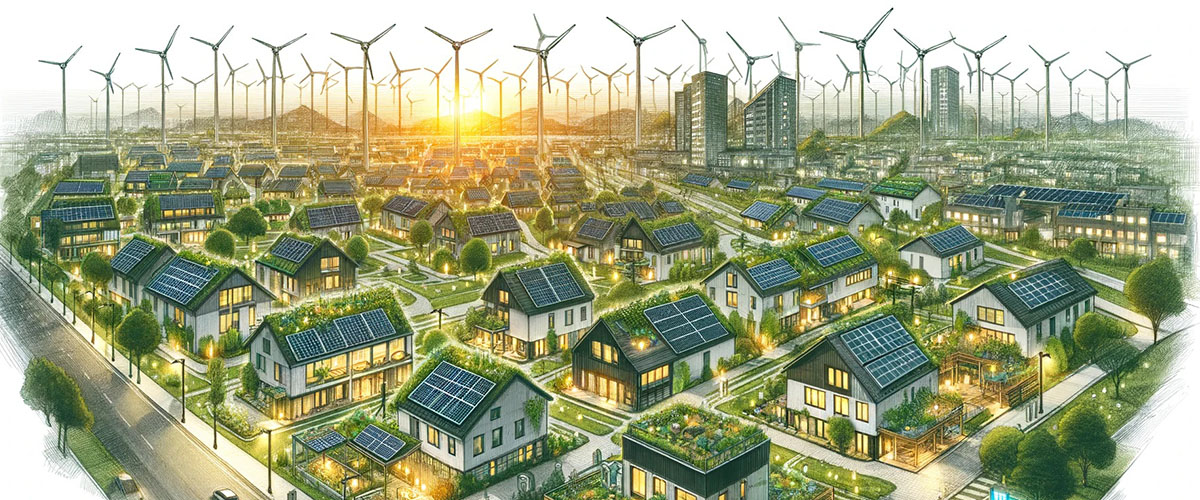
Building-Integrated Photovoltaic Generation: Output and Profitability
Solar photovoltaic energy is the renewable technology with the greatest potential for direct integration into the building stock. In Spain, average solar irradiation ranges from 1,400 kWh/m2 per year along the Cantabrian coast to 1,900 kWh/m2 per year in the southeastern peninsula, enabling a rooftop photovoltaic system of 3-5 kWp (equivalent to 15-25 m2 of monocrystalline panels with 20-22% efficiency) to generate between 4,200 and 7,500 kWh annually in a single-family home. According to data from IDAE (Institute for Energy Diversification and Saving, 2023), the average residential installation cost stands at 1,100-1,500 EUR/kWp, with payback periods of 6-9 years without subsidies and 4-6 years with Next Generation EU program grants (up to 600 EUR/kWp for residential self-consumption).
Building-Integrated Photovoltaics (BIPV) replaces conventional construction materials with generating modules: solar tiles with 15-17% efficiency, semi-transparent photovoltaic glass with 10-30% luminous transmittance, and ventilated facade panels that combine insulation and electricity production. The pilot project at the EREN Headquarters (Regional Energy Agency of Castilla y Leon, Leon) integrated 100 kWp of BIPV on the south facade, generating 115,000 kWh/year and covering 35% of the building's electricity demand. At the European scale, the Solar Power Europe report (2023) estimates a BIPV potential of 560 GWp on roofs and facades of the existing building stock, capable of producing 680 TWh/year, equivalent to 24% of total EU-27 electricity demand.
Aerothermal and Geothermal Energy: High-Efficiency Heat Pumps
Air-source heat pumps represent the fastest-growing HVAC technology in the European residential sector, with 3 million units sold in the EU in 2022 (a 38% increase over 2021, according to the European Heat Pump Association). Their operating principle allows heat to be transferred from outdoor air to the building interior with a seasonal coefficient of performance (SCOP) of 3.5-4.5 for heating and a SEER of 4.0-6.0 for cooling, meaning that for every kWh of electricity consumed, 3.5 to 6 kWh of thermal energy are produced. By comparison, a natural gas condensing boiler achieves a maximum efficiency of 109% based on the NCV (Net Calorific Value), while a direct electric radiator operates at 100%. The primary energy savings of air-source heat pumps versus natural gas stand at 50-65% when the electricity comes from renewable sources.
Low-enthalpy geothermal energy (closed-loop systems with vertical boreholes of 100-150 m depth or horizontal collectors) achieves higher seasonal efficiencies, with SCOP values of 4.5-5.5, by leveraging the stable underground temperature (12-16 C on the Iberian Peninsula). Its installation cost, however, is 15,000-25,000 EUR for a 150 m2 dwelling, compared to 6,000-12,000 EUR for an equivalent air-source system. The study by Blazquez et al. (2017) at the Polytechnic University of Valencia campus documented a geothermal installation with 18 boreholes of 50 m that supplies heating and cooling to 5,000 m2 of teaching space with an electricity consumption of 28 kWh/m2 per year, 62% lower than the previous conventional system based on a diesel boiler and water chillers.
High-Performance Thermal Envelope and Passive Design
A building's energy efficiency depends first and foremost on the quality of its thermal envelope: walls, roof, ground floor slab, window frames, and thermal bridges. The Passivhaus standard requires a maximum transmittance of 0.15 W/m2K for opaque elements (equivalent to 20-30 cm of insulation with conductivity of 0.035 W/mK) and 0.80 W/m2K for windows (triple glazing with thermally broken frames). These values compare with the requirements of the CTE DB-HE (2019) in Spain, which sets limiting transmittances of 0.35-0.56 W/m2K for walls and 1.80-2.30 W/m2K for openings, depending on the climate zone. The difference between strictly meeting the CTE and achieving the Passivhaus standard results in a heating demand reduction of 70-85%, dropping from 40-60 kWh/m2 per year to a maximum of 15 kWh/m2 per year.
Passive design strategies complement the high-performance envelope: south orientation with a compact form factor (envelope surface-to-volume ratio below 0.70 m-1), fixed or movable solar shading devices that reduce summer solar gains by 60 to 80%, natural cross-ventilation, and interior thermal mass (concrete, solid brick, rammed earth) with a storage capacity of 50-100 Wh/m2K. According to data from the Passivhaus Building Platform (PEP, 2023), Spain has more than 200 certified Passivhaus buildings, with an average cost premium of 5-10% over conventional construction and a payback period for the investment differential of 8-12 years at 2023 energy prices. The 48-unit social housing project (VPO) in Pamplona (2019, Passivhaus Classic certification) demonstrated a measured heating demand of 12.3 kWh/m2 per year, 78% lower than the average Spanish residential stock.
Renewable District Networks and Nearly Zero-Energy Buildings
District heating and cooling networks distribute thermal energy from centralized plants to multiple buildings, achieving overall efficiencies of 85-92% compared to 70-80% for individual boilers. In the EU, 13% of heating demand is met through district heating (Euroheat & Power, 2023), with penetration rates reaching 60-65% in Denmark, Sweden, and Finland. The transition toward renewable sources is accelerating: the Copenhagen district network (CTR + VEKS, 1.1 million users) reached 80% renewable and residual origin in 2023, through the integration of biomass (40%), waste incineration heat (30%), large-scale heat pumps (7%), and geothermal energy (3%). In Spain, the Districlima district network (Barcelona, Forum and 22@ zones) supplies cooling and heating to 100 buildings with a capacity of 146 MWt and 106 MWf, using natural gas cogeneration, seawater heat pumps, and free cooling with seawater.
The Nearly Zero-Energy Building (NZEB) concept integrates all the above strategies within a mandatory regulatory framework. European Directive 2010/31/EU (EPBD, recast in 2024) requires all new buildings to be NZEB from 31 December 2020 (public buildings from 2018). The Spanish definition (RD 732/2019) establishes that an NZEB must comply with the CTE DB-HE and cover a minimum fraction of energy demand with on-site or nearby renewables. Data from the Housing and Land Observatory (MITMA, 2023) indicate that 45% of newly permitted dwellings in Spain in 2022 achieved an energy rating of A, compared to only 8% in 2015. Nevertheless, the retrofitting of the existing stock — where 80% of buildings hold an E, F, or G rating — constitutes the main challenge: the energy retrofitting rate in Spain stands at 0.12% per year of the total stock, when the Long-Term Renovation Strategy roadmap (ERESEE 2020) sets a target of 2-3% per year to achieve decarbonization of the stock by 2050.
References
- [1]Guía Profesional de Tramitación del Autoconsumo — Actualización 2023Instituto para la Diversificación y Ahorro de la Energía, MITERD.
- [2]EU Solar Rooftops and BIPV Market Outlook 2023-2027Solar Power Europe, Brussels.
- [3]European Heat Pump Market and Statistics Report 2023EHPA, Brussels.
- [4]Analysis and study of different ground thermal conductivity testing proceduresRenewable Energy, 103, 462-469.
- [5]Passive House Database — Building Statistics and Performance MonitoringPassive House Institute, Darmstadt.



Comments 0
No comments yet. Be the first!
Leave a comment