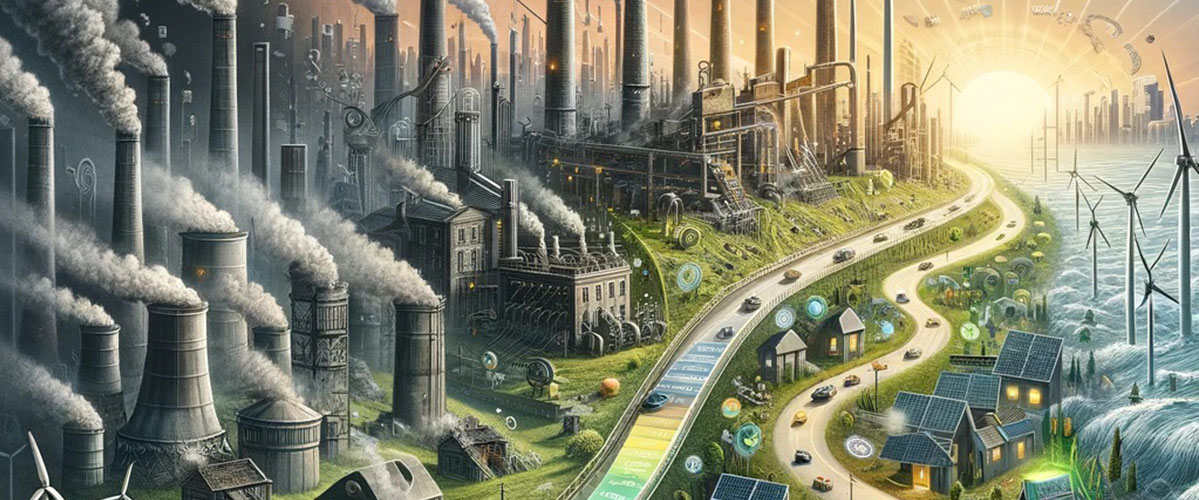
Origins: efficiency before the word efficiency
The history and evolution of energy efficiency begins before the concept was formalized. Vernacular architecture across all civilizations incorporated empirical climate responses: Inuit igloos achieve indoor temperatures of 15-20°C with exterior temperatures of -40°C, thanks to their hemispherical form (minimum surface per volume), snow insulation (thermal conductivity lambda = 0.10-0.50 W/m·K), and occupant metabolic heat (75-100 W per person). Roman houses with hypocaust (radiant floor heating) achieved thermal efficiencies of 50-60%, superior to many pre-industrial open fireplaces (10-15% efficiency).
James Watt's steam engine (1769), with its separate condenser, doubled the efficiency of Newcomen's engine from 1% to 2-5%. This leap, although modest in absolute terms, inaugurated the era of conscious energy optimization. In the late 19th century, Nicolas Leonard Sadi Carnot (1824) established the thermodynamic maximum efficiency limit for a heat engine: eta = 1 - T_cold/T_hot, a principle that remains the theoretical foundation of all energy efficiency engineering.
The 1973 oil crisis: the turning point
The OPEC oil embargo in October 1973 quadrupled oil prices (from $3/barrel to $12/barrel in three months) and transformed energy efficiency from an academic concern to a political priority. The United States responded with the Energy Policy and Conservation Act (EPCA, 1975), establishing the first efficiency standards for appliances and creating the CAFE vehicle efficiency program. In the same period, Denmark initiated its mass housing insulation program, reducing per capita heating consumption by 30% between 1975 and 1990.
The second oil crisis (1979, Iranian revolution) consolidated the trend. In 1978, Sweden approved the first building regulations with strict energy requirements (SBN 1975, updated 1980). Germany published the Warmeschutzverordnung (WSchVO) of 1977, the first building thermal regulation, establishing maximum wall U-values of 1.45 W/m²K (a level we would consider unacceptable today, but representing a revolutionary advance against the total absence of prior regulation).
1980s-1990s: from energy saving to sustainability
In 1987, the Brundtland Report expanded the concept of energy efficiency into the broader framework of sustainable development. In 1988, Wolfgang Feist and Bo Adamson developed the Passivhaus concept at Lund University (Sweden), and in 1991 the first Passivhaus dwelling was built in Darmstadt-Kranichstein (Germany): 4 terraced houses with measured heating demand of 10 kWh/m²/year, when the German average exceeded 200 kWh/m²/year.
In 1990, the Building Research Establishment (BRE) launched BREEAM, the world's first green building certification system. In 1998, the USGBC published LEED 1.0. These systems transformed energy efficiency from an isolated technical objective to a component within a comprehensive sustainability framework including water, materials, indoor quality, and transport. Simultaneously, lighting technology advanced: T8 fluorescent tubes with electronic ballasts (1981) consumed 35% less than T12s, and the first compact fluorescent lamps (CFLs) reached the market in 1985 at 45-60 lm/W, versus 12-15 lm/W for incandescent bulbs.
2000-2010: the era of mandatory regulation
The European Energy Performance of Buildings Directive (EPBD, 2002/91/EC) marked a milestone: for the first time, supranational legislation required mandatory energy certification and minimum efficiency requirements for new buildings and major renovations. Its transposition in Spain materialized as CTE DB-HE (2006) and Royal Decree 47/2007 on energy certification. The directive was strengthened with the EPBD recast (2010/31/EU), introducing the nearly zero-energy building (nZEB) concept as an obligation for 2021.
During this period, photovoltaic technology reduced its cost from $4.00/W (2006) to $0.50/W (2015), an 87% drop that made mass solar integration in buildings viable. Commercial LEDs went from 30 lm/W (2005) to 120 lm/W (2015), surpassing all prior technologies. Air-to-water heat pumps reached COPs of 3.5-4.5 (for every 1 kWh electrical, they provide 3.5-4.5 kWh thermal), becoming the most efficient alternative to gas boilers (90-95% efficiency).
2010-present: nearly zero-energy buildings and beyond
The EPBD required all new buildings to be nZEB from January 1, 2021 (public buildings from 2019). The nZEB definition varies by country: in Spain, CTE DB-HE 2019 sets maximum non-renewable primary energy consumption of 40-65 kWh/m²/year depending on climate zone and use. In Germany, the GEG (Gebaudeenergiegesetz, 2020) sets 75 kWh/m²/year primary energy. France requires its RE2020 standard (2022) with a maximum of 50 kWh/m²/year and for the first time includes embodied carbon limits.
The EPBD 2024/1275 (approved April 2024) goes further: it mandates all new buildings be zero-emission from 2028 (public) and 2030 (private), and requires progressive retrofit of existing stock to eliminate energy classes G (2030), F (2033), and E (2035). The market sees the first energy-positive buildings: Powerhouse Brattorkaia in Trondheim (Norway) (Snohetta, 2019) generates 485 MWh/year and consumes 240 MWh/year, producing a net surplus of 245 MWh exported to the grid and neighboring buildings.
Technologies that will define the next decade
Ground-source heat pumps now achieve COPs of 5.0-6.0, and prototype heat pumps with natural refrigerants (CO₂, propane) eliminate the global warming potential of HFC refrigerants. Seasonal thermal storage via borehole thermal energy storage allows transferring summer solar surplus to winter, as demonstrated by Drake Landing Solar Community in Okotoks (Canada), which covers 97% of heating demand for 52 homes with seasonally stored solar energy.
Electrochromic glass, phase change materials (PCMs) integrated into plasterboard, building-integrated photovoltaics (BIPV) with efficiencies exceeding 20%, and digital twins for real-time operational optimization configure a landscape where the carbon-negative building (capturing more CO₂ than it emits throughout its entire life cycle) is technically achievable with available technology.
References
- [1]Directive (EU) 2024/1275 on the energy performance of buildings (recast)Official Journal of the EU.
- [2]Re-inventing air heating: Convenient and comfortable within the frame of the Passive House conceptEnergy and Buildings, 37(11), 1186-1203.
- [3]Net Zero by 2050: A Roadmap for the Global Energy SectorIEA.
- [4]Codigo Tecnico de la Edificacion - DB HE (2019 update)Gobierno de Espana.
- [5]Powerhouse Brattorkaia: The world's northernmost energy-positive buildingSnohetta.


Comments 0
No comments yet. Be the first!
Leave a comment