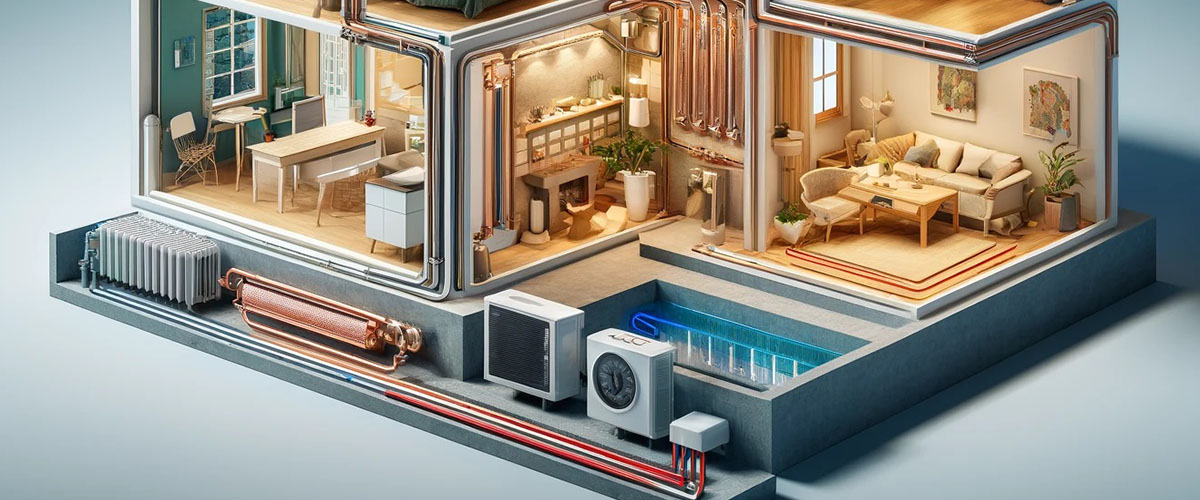
Energy weight of HVAC systems and the installed stock
Building heating and cooling consume 50% of final energy in the EU building sector, equivalent to 20% of total European final energy consumption: 2,600 TWh/year out of a total 13,000 TWh/year (European Commission, Heating and Cooling Strategy, 2016; 2022 update). Of that figure, space heating absorbs 64% (1,664 TWh), domestic hot water 15% (390 TWh), and cooling 21% (546 TWh), a share that grows every year. The EU's stock of heat generators includes approximately 110 million boilers, of which 60% are more than 15 years old and 22% are over 25 years old. Conventional boilers (atmospheric, natural draft) deliver seasonal efficiencies of 65-78% on NCV, meaning that 22% to 35% of fuel energy is lost through flue gases, radiation, and start/stop cycling. Replacing this equipment with current technologies (condensing boilers, heat pumps) would yield energy savings of 600-800 TWh/year across the EU, equivalent to the annual emissions of 150 million vehicles (European Heating Industry, 2022).
Building cooling is the fastest-growing segment: the IEA projects that global cooling demand will triple by 2050, rising from 2,000 TWh in 2020 to 6,200 TWh in 2050 (IEA, The Future of Cooling, 2018). In southern Europe (Spain, Italy, Greece, Portugal), cooling demand is growing by 3-5% annually, driven by global warming (an increase of 1.5°C in average summer temperatures since 1980), urbanization (urban heat island effect of 2-6°C), and rising comfort expectations. In Spain, residential electricity consumption for cooling quadrupled between 2000 and 2020, rising from 1.8 TWh to 7.2 TWh (IDAE, 2022). The installed air conditioning units in Spain total 28 million, with an average cooling capacity of 3.5 kW and an average seasonal energy efficiency ratio (SEER) of 3.2, far below the 6.0-8.5 of current A+++ class units. Upgrading this stock would reduce cooling electricity consumption by 50-60%.
High-efficiency heating technologies
Heat pumps are the benchmark technology for efficient heating. Their thermodynamic principle (reversed Carnot cycle) enables heat transfer from a cold source (outdoor air, water, or ground) to the building interior with efficiencies exceeding 100% of electrical energy consumed. Performance is measured by the SCOP (Seasonal Coefficient of Performance): air-to-water heat pumps achieve SCOPs of 3.0-4.5 in temperate climate zones (average winter temperature 5-12°C), meaning that for every 1 kWh of electricity consumed they deliver 3.0-4.5 kWh of thermal energy. Ground-source heat pumps (water-to-water or ground-to-water) achieve SCOPs of 4.0-5.5 thanks to the stable ground temperature (12-16°C at 2-3 m depth in the Iberian Peninsula), with initial investments of 15,000-25,000 EUR for a 150 m² home versus 5,000-10,000 EUR for air-source systems (IDAE, 2021). Heat pumps using R-290 refrigerant (propane, GWP = 3) are replacing units using R-410A (GWP = 2,088), in compliance with the revised F-Gas Regulation (2024) that bans refrigerants with GWP > 150 in new split units from 2027.
Condensing gas boilers achieve seasonal efficiencies of 92-98% on GCV (gross calorific value), recovering the latent heat from flue gases by condensing water vapor at return temperatures below 55°C. Their peak efficiency is achieved with low-temperature emitters: underfloor heating (30-40°C), oversized radiators (45-55°C), or fan-coils (40-50°C). The Ecodesign Directive (2015/1189) has prohibited the sale of boilers with efficiency below 86% on GCV since 2015, effectively removing atmospheric boilers from the European market. Combining a condensing boiler with solar thermal (hybrid system with a 40-60% solar fraction for DHW and 15-25% for space heating) reduces gas consumption by 30-45%. Heat recovery systems in mechanical ventilation with enthalpy exchangers achieve efficiencies of 75-95% and reduce heating demand by 20-35% in airtight buildings (n₅₀ ≤ 1.0 ach). The cost of a heat recovery unit for a single-family home ranges from 2,500 to 5,000 EUR, with payback periods of 4-7 years in CTE climate zones D and E.
High-efficiency cooling technologies
Vapor-compression cooling systems dominate the market with 97% of installations, but efficiency differences between units are enormous. An A+++ class split unit achieves a SEER of 8.5, while a class B unit delivers a SEER of only 4.4: the difference means 48% lower electricity consumption for the same cooling capacity. State-of-the-art VRF (Variable Refrigerant Flow) systems achieve SEERs of 6.5-9.0 in cooling mode and SCOPs of 4.0-5.5 in heating mode, with capacities of 14-170 kW from a single outdoor unit serving up to 64 indoor units with simultaneous heat recovery between zones (simultaneous production of cooling and heating with combined COP > 7.0). Inverter technology (continuous modulation of compressor speed) reduces consumption by 25-40% compared to on-off technology by avoiding start-up current peaks (6-8 times rated current) and operating continuously at the point of maximum efficiency.
Alternatives to the compression cycle include evaporative cooling (adiabatic cooling), which consumes 0.1-0.3 kWh of electricity per kWh of cooling (EER = 3-10) versus 0.15-0.35 kWh for compression (EER = 3-7), but requires climates with relative humidity < 60% and consumes water (2-5 liters/kWh of cooling). In hot-dry areas of Spain (Central Plateau, Ebro Valley, inland Levante), evaporative cooling reduces air temperature by 8-15°C with 70-80% less electricity consumption than a compression system. Free-cooling systems harness nighttime outdoor temperatures (< 18-20°C) to directly cool the building through mechanical ventilation, eliminating compressor consumption for 1,000-2,500 hours/year in climate zones with daily temperature swings > 12°C. Absorption systems (LiBr-water or ammonia-water), powered by waste heat or solar thermal energy at 80-180°C, achieve COPs of 0.7-1.4 and are viable in installations with cogeneration or solar concentration, where the available thermal energy is free or low-cost.
Regulation, system integration, and the decarbonization horizon
The European regulatory framework is driving the electrification and decarbonization of HVAC. The recast Energy Performance of Buildings Directive (EPBD, 2024) requires all new buildings to be zero-emission from 2030, which implies eliminating fossil fuel boilers in new construction. The ban on gas boilers in new buildings is already in effect in the Netherlands (since 2018), Denmark (since 2013), and several regions of Germany, France, and Austria. The Spanish CTE, in its 2019 update (DB HE), establishes a minimum renewable energy contribution of 60-70% for DHW and caps non-renewable primary energy consumption at 32-80 kWh/m²·year depending on climate zone, effectively favoring heat pumps (which count as 60-75% renewable in their thermal output when SCOP ≥ 2.5). REPowerEU (2022) sets the target of 60 million heat pumps installed in the EU by 2030, up from 20 million in 2022.
Optimal HVAC system integration requires a holistic approach that first minimizes demand (high-performance envelope, solar shading, natural ventilation) and then meets the residual demand with the most efficient combination. A building with a heating demand of 15 kWh/m²·year (Passivhaus level) can dispense with a conventional distribution system (radiators, underfloor heating) and heat via the post-heating coil of the mechanical ventilation with heat recovery, reducing HVAC investment by 20-30%. Building energy management systems (BEMS) with predictive control based on weather forecasts and actual occupancy save an additional 10-25% over conventional thermostat-based control (Afram and Janabi-Sharifi, 2014). The HVAC decarbonization trajectory in the EU requires replacing 3-4 million fossil boilers per year (3-4% of the stock), installing 4-6 million heat pumps annually, and increasing renewable district heating capacity fivefold (currently 60 TWh/year renewable out of 500 TWh/year total). Energy efficiency in heating and cooling is not a secondary goal: it is the central pillar of the energy transition in the building sector.
References
- [1]An EU Strategy on Heating and Cooling — COM(2016) 51 finalEuropean Commission.
- [2]The Future of Cooling: Opportunities for Energy-Efficient Air ConditioningIEA. ISBN: 978-92-64-30634-4
- [3]Guía Técnica de Bombas de CalorMinisterio para la Transición Ecológica y el Reto Demográfico.
- [4]Theory and Applications of HVAC Control Systems — A Review of Model Predictive Control (MPC)Building and Environment, 72, 343-355.
- [5]The Heating Market Report 2022EHI.


Comments 0
No comments yet. Be the first!
Leave a comment