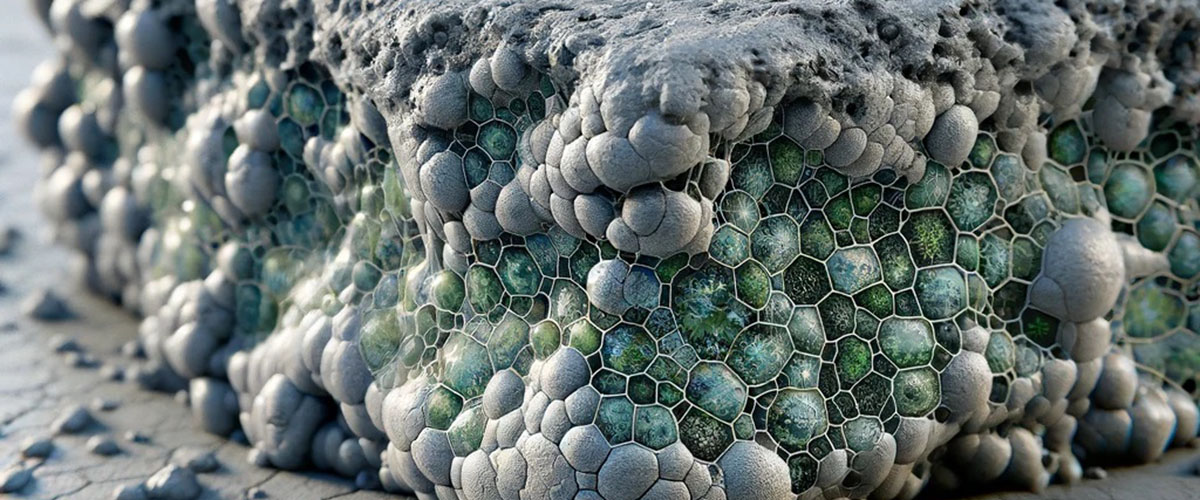
Biology enters the construction materials engineering domain
The notion of concrete that breathes and bricks that grow is no longer science fiction but applied engineering. Living Building Materials (LBMs) incorporate biological organisms — bacteria, fungi, algae, cyanobacteria — as functional agents that confer properties impossible to achieve with conventional inorganic chemistry: self-healing of cracks, CO2 capture during the service life, directed growth of structures, and regulation of air quality. The field has matured rapidly: the number of scientific publications on living building materials grew from 12 in 2015 to more than 180 in 2023 (Scopus), and the first commercial applications are now scaling from laboratory prototypes toward industrial production. The convergence of synthetic biology, materials science, and civil engineering is producing a fundamentally new category of construction products that blur the boundary between the built and the living.
The environmental motivation is clear: the manufacture of Portland cement generates 8% of global CO2 emissions (2,700 MtCO2 per year), and the building sector consumes 40% of extracted natural resources. Living materials propose a radical alternative: instead of heating limestone to 1,450 degrees C to produce clinker, they employ biological processes that operate at ambient temperature and atmospheric pressure, and that in many cases absorb CO2 rather than emit it. The transition is in its early stages, but the data emerging from prototypes and pilot projects are sufficiently promising to warrant a detailed technical assessment of the principal technologies, their current performance thresholds, and the engineering challenges that remain before widespread adoption becomes feasible.
Self-healing concrete: bacteria that seal cracks
Self-healing concrete incorporates spore-forming bacteria — principally Bacillus pseudofirmus, B. cohnii, and B. alkalinitrilicus — encapsulated within the concrete during mixing. When a crack forms and water infiltrates, the spores germinate, metabolise an encapsulated nutrient (calcium lactate), and precipitate calcite (CaCO3) that seals the crack. Jonkers et al. (2010) demonstrated at TU Delft that this process seals cracks up to 0.8 mm wide within 28 days, with a sealing efficiency of 90-100% for cracks narrower than 0.5 mm. The restoration of impermeability reaches 85-95% of the original value. This biological repair mechanism operates autonomously without any human intervention, activating precisely when and where damage occurs — a capability that no conventional repair material can replicate.
Encapsulation is the key technical challenge: the spores must survive the pH 12-13 of fresh concrete and the mechanical forces of mixing. Solutions include: expanded clay microcapsules (particles of 1-4 mm with spores and nutrient within their porous interior), hydrogel encapsulation (calcium alginate), and hollow fibres of glass or polymer. The most advanced commercial product is Basilisk (Netherlands, spin-off from TU Delft): a liquid admixture for concrete containing Bacillus spores, applicable via standard dosing equipment like any other admixture. The cost premium is 10-30% above conventional concrete, but this is offset by the reduction in maintenance costs: crack repairs account for 50% of the maintenance expenditure on concrete structures (RILEM, 2020), at an average cost of 50-150 EUR per linear metre of repaired crack. For infrastructure assets with design lives of 50-100 years, the lifetime cost reduction from eliminating preventive crack repairs makes self-healing concrete economically advantageous despite its higher initial price.
Mycelium bricks: structures that grow in days
Mycelium bricks are manufactured by cultivating the root network (mycelium) of fungi — typically Ganoderma lucidum or Pleurotus ostreatus — on a substrate of agricultural waste (wheat straw, rice husks, sugarcane bagasse). The mycelium colonises the substrate in 5-7 days at 25-30 degrees C, forming a natural fibrous matrix that acts as a biological binder. After growth, the material is dried (deactivating the fungus) to yield a block with a density of 60-180 kg/m3, thermal conductivity of 0.040-0.060 W/m K (comparable to mineral wool), and compressive strength of 0.1-0.5 MPa — sufficient for insulation applications and non-load-bearing interior partitions. The entire manufacturing process requires no kiln, no hydraulic press, and no synthetic binder, using only biological growth at room temperature.
The company Ecovative Design (USA) leads commercialisation with its Myco Composite product, used in the Hy-Fi project (MoMA PS1, New York, 2014): a 12-metre tower constructed from 10,000 mycelium bricks that was fully composted at the end of the exhibition. Grown.bio (Netherlands) produces mycelium panels for interior applications at industrial scale (50,000+ units per year). The energy consumption of manufacturing is 0.5-2.0 MJ/kg — an order of magnitude lower than fired ceramic brick (3.0-5.0 MJ/kg). The principal limitation is moisture resistance: without hydrophobic treatment, mycelium absorbs water and loses its properties. Bio-based coatings (beeswax, shellac, linseed oil) extend durability to 20-30 years in interior applications. Current research at several European universities is focused on developing mycelium composites with improved compressive strength through hybrid substrates that combine agricultural waste with mineral fillers, potentially opening the door to semi-structural applications within the next decade.
Bioconcrete with carbon capture: concrete that absorbs CO2
The bioconcrete developed by Heveran et al. (2020) at the University of Colorado Boulder uses photosynthetic cyanobacteria (Synechococcus) that capture CO2 and precipitate calcium carbonate within a matrix of sand and hydrogel. The resulting material has a compressive strength of 2-5 MPa (comparable to adobe) and the capacity to regenerate: when a block is split in two and provided with nutrients and light, the bacteria grow and fuse the halves in 6-8 hours. Each generation of blocks can produce 2-3 replicas before the bacterial population declines, with a capture efficiency of 3-8 kgCO2/m3 during the mineralisation process. While this material is not yet suitable for structural applications in conventional buildings, it demonstrates a proof of concept for biologically manufactured construction components that sequester carbon during production.
Bioreceptive surfaces represent another pathway: concretes designed to be colonised by microalgae, lichens, and mosses that capture CO2 throughout the building's service life. The research group at UPC Barcelona (Universitat Politecnica de Catalunya, Manso et al., 2020) has developed concrete panels with adjusted pH (7-9, compared with the 12-13 of conventional concrete) and controlled surface roughness that facilitate biological colonisation. Bioreceptive panels capture 3-5 kgCO2/m2 per year and improve local air quality by absorbing NOx and particulate matter. The BIQ House (Hamburg, 2013) incorporates a 200 m2 facade with microalgae bioreactors that produce biomass and heat, reducing the building's energy demand by 30-40%. These biologically active surfaces represent a paradigm in which buildings transition from passive consumers of energy and emitters of pollution to active participants in urban ecological cycles, filtering air and sequestering carbon as an integral function of the facade.
References
- [1]Application of bacteria as self-healing agent for the development of sustainable concreteEcological Engineering, 36(2), 230-235.
- [2]Biomineralization and Successive Regeneration of Engineered Living Building MaterialsMatter, 2(2), 481-494.
- [3]Bioreceptivity of concrete for biological colonization as a new functionality for energy saving in buildingsConstruction and Building Materials, 237, 117594.
- [4]Self-Healing Phenomena in Cement-Based Materials — State-of-the-Art Report, TC 253-MCISpringer. ISBN: 978-3-030-33845-5
- [5]Myco Composite: Technical Specifications and Lifecycle AssessmentEcovative Design LLC.
- [6]TX Active: Photocatalytic Cement for Air Purification — Technical DocumentationItalcementi Group.

Comments 0
No comments yet. Be the first!
Leave a comment