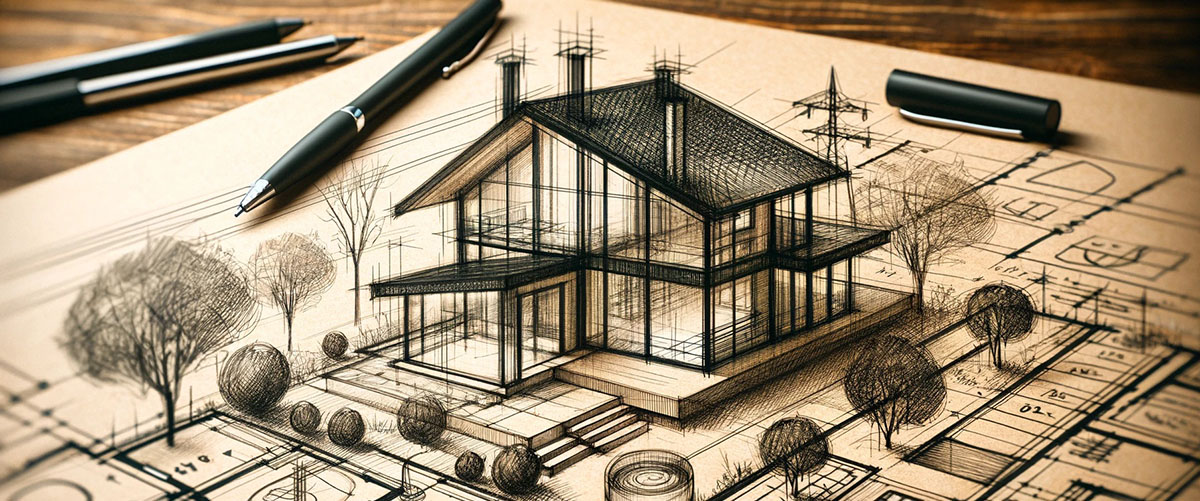
What sustainable design really means
Sustainable design is neither an aesthetic label nor a set of good intentions. According to ISO 15392:2019 (Sustainability in buildings and civil engineering works — General principles), sustainability in building is articulated around nine general principles: continual improvement, equity, global thinking and local action, holistic approach, involvement of interested parties, long-term consideration and resilience, responsibility, risk management, and transparency.
These principles translate into concrete technical objectives that the designer must quantify from the earliest design stages. Charles J. Kibert, in his reference work Sustainable Construction: Green Building Design and Delivery (Wiley, 5th ed., ISBN 978-1119706458), organizes them into six areas: energy efficiency, water management, material selection, indoor environmental quality, site integration, and life-cycle management.
Objective 1: Reduce operational energy consumption
Buildings account for approximately 36% of global energy consumption and 37% of energy-related CO₂ emissions, according to the Global Status Report for Buildings and Construction 2022 by the Global Alliance for Buildings and Construction (GlobalABC/UNEP). Reducing this consumption is the first measurable objective of sustainable design.
Strategies are divided into passive and active approaches. Passive strategies include building orientation to maximize solar gains in winter and minimize them in summer, thermal insulation of the envelope (with U-values below 0.15 W/m²K under the Passivhaus standard), thermal mass to dampen temperature swings, and natural cross-ventilation. Active strategies include high-efficiency HVAC systems, LED lighting with occupancy sensors and daylight harvesting, and integration of renewable sources such as photovoltaics or geothermal energy.
The Passivhaus standard sets a maximum heating demand of 15 kWh/m²·year. Spain's Technical Building Code (CTE), through its Basic Document HE on Energy Savings (updated in 2019), establishes energy consumption limits that vary by climate zone, progressively converging toward nearly zero-energy buildings (nZEB).
Objective 2: Minimize embodied carbon
Embodied carbon is the CO₂ footprint associated with the extraction, manufacturing, transport, installation, and end-of-life of construction materials. According to the WorldGBC, embodied carbon accounts for up to 11% of global greenhouse gas emissions and nearly 50% of a new building's total carbon footprint over its life cycle.
The European standard EN 15978 (Sustainability of construction works — Assessment of environmental performance of buildings) defines the methodology for building Life Cycle Assessment (LCA), dividing emissions into modules: A1-A3 (product), A4-A5 (construction), B1-B7 (use), and C1-C4 (end of life). Designing with low embodied carbon means selecting materials with verified Environmental Product Declarations (EPDs), prioritizing local, recycled, or bio-based materials (FSC/PEFC certified timber, bamboo, cork), and designing for disassembly and reuse.
Objective 3: Optimize water management
Sustainable design aims to reduce potable water consumption and manage stormwater at source. Strategies include low-flow fixtures (taps at ≤ 6 l/min, dual-flush toilets at ≤ 4.5/3 l), rainwater harvesting systems for irrigation and cisterns, greywater reuse after treatment, and permeable surfaces designed according to Sustainable Urban Drainage Systems (SUDS) principles.
LEED v4.1, in its Water Efficiency category, requires as a prerequisite a minimum 20% reduction in indoor water consumption compared to the baseline and awards up to 11 additional points for greater reductions.
Objective 4: Ensure indoor environmental quality
A sustainable building does not merely consume less: it must be healthy for its occupants. Indoor Environmental Quality (IEQ) encompasses air quality (CO₂ concentration, volatile organic compounds or VOCs, particulates), thermal comfort (per ISO 7730 and the adaptive model in EN 15251), visual comfort (illuminance, glare, access to daylight), and acoustic comfort.
The WELL Building Standard, developed by the International WELL Building Institute, specifically evaluates the building's impact on occupant health across ten categories: air, water, nourishment, light, movement, thermal comfort, sound, materials, mind, and community. Integrating WELL criteria with energy efficiency objectives represents one of the current challenges of sustainable design, as higher ventilation rates improve IEQ but increase energy consumption.
Objective 5: Integrate the building with its surroundings
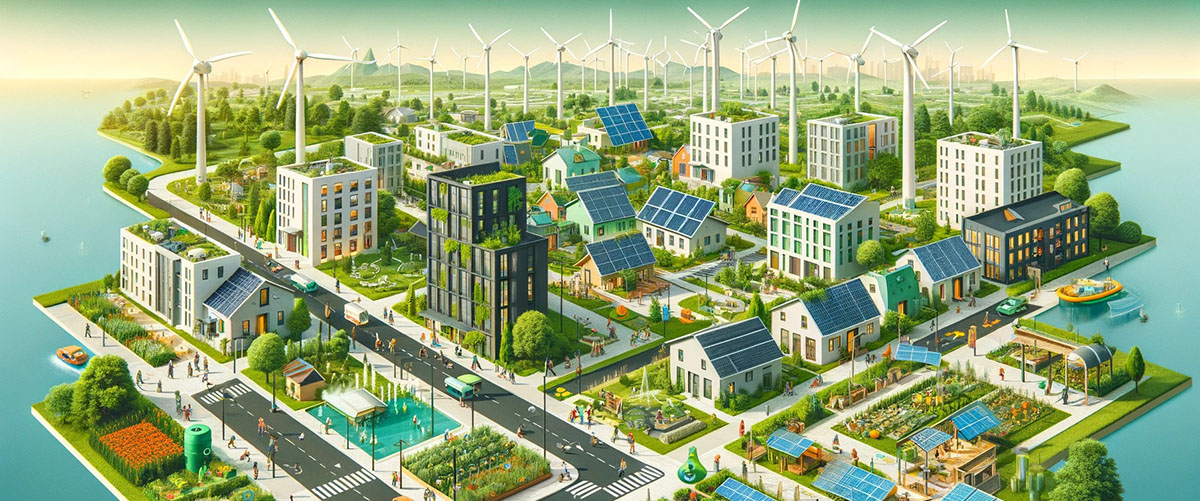
Sustainable design extends beyond the isolated building. Site selection, public transport connectivity, biodiversity preservation, and urban heat island reduction are objectives that transcend the plot boundary. LEED dedicates its Sustainable Sites category to these issues, while the SITES (Sustainable Sites Initiative) system provides a specific framework for evaluating landscape and outdoor space sustainability.
Cases such as the Vauban district in Freiburg (Germany) demonstrate the comprehensive application of these principles: 42 Passivhaus buildings (heating demand below 15 kWh/m²·year), 100 plus-energy homes, biomass cogeneration covering 65% of electricity demand, motorized traffic restrictions, and 5,000 residents in a verified sustainable mobility model.
Objective 6: Design for the full life cycle
The final objective of sustainable design is to consider all phases of a building's life cycle: design, construction, use, maintenance, renovation, and end of life. ISO 15686 (Buildings and constructed assets — Service life planning) provides the framework for service life planning, while Life Cycle Costing (LCC) methodology enables the long-term economic assessment of design decisions.
The concept of Design for Disassembly (DfD) proposes that buildings be conceived as material banks, facilitating recovery and reuse at end of life. Projects such as ABN AMRO's Circl Pavilion in Amsterdam (2017), designed by de Architekten Cie., apply these principles: a demountable structure, materials with material passports (Madaster), and a facade built from reclaimed window frames.
How these objectives are measured
Certification systems provide quantifiable evaluation frameworks. LEED v4.1 (U.S. Green Building Council) uses a 110-point scale with four levels: Certified (40-49), Silver (50-59), Gold (60-79), and Platinum (80+). BREEAM (Building Research Establishment) uses percentages with levels from Pass to Outstanding (≥85%). Passivhaus focuses on strict energy metrics: heating demand ≤ 15 kWh/m²·year, cooling demand ≤ 15 kWh/m²·year, primary energy demand ≤ 120 kWh/m²·year, and airtightness n50 ≤ 0.6 air changes/hour.
The current trend points toward integrating whole life-cycle carbon metrics, as required by the latest versions of LEED (v5, launched in 2024) and the European Level(s) framework, which establishes a common set of sustainability indicators for buildings in the EU.
References
- [1]A safe operating space for humanityNature, 461, 472-475.
- [2]Bringing Embodied Carbon Upfront: Coordinated action for the building and construction sector to tackle embodied carbonWorld GBC.
- [3]2022 Global Status Report for Buildings and ConstructionUnited Nations Environment Programme. ISBN: 978-92-807-3984-8
- [4]RIBA 2030 Climate Challenge: Targets and MetricsRoyal Institute of British Architects.
- [5]Level(s) — A common EU framework of core sustainability indicators for office and residential buildingsEuropean Commission, DG ENV.
Comments 0
No comments yet. Be the first!
Leave a comment