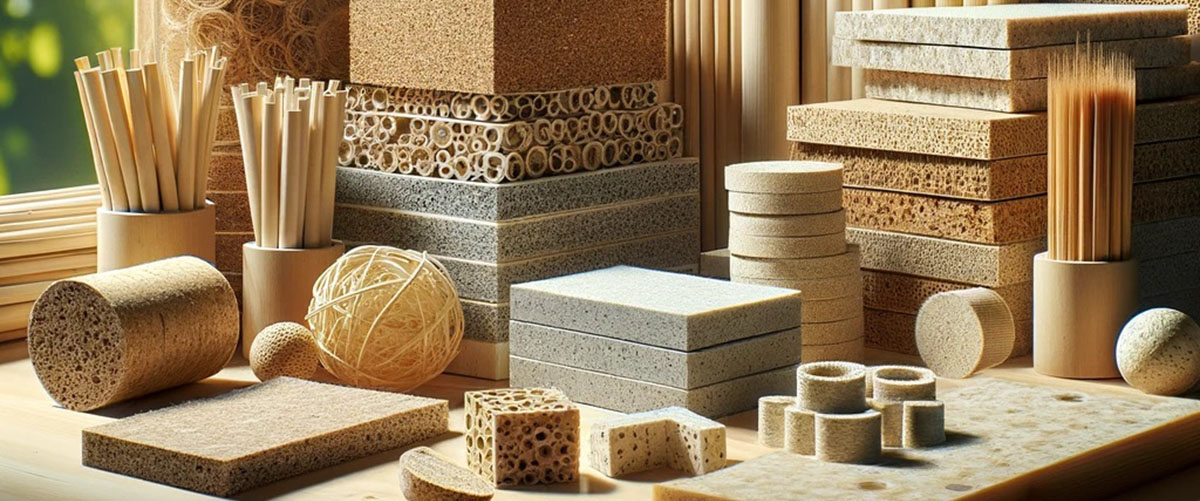
Bio-materials: biology as a production system for construction
Bio-materials represent the fusion of biology and construction through a fundamental paradigm shift: moving from extracting and processing mineral resources to cultivating, growing, and harvesting building materials. Bio-materials are defined as materials derived wholly or partially from living organisms — plants, fungi, bacteria, algae — or from biological processes, and they are characterised by three differential properties compared with conventional materials: biogenic carbon capture during production (photosynthesis absorbs CO2 and fixes it in biomass), low processing energy (organisms perform molecular assembly at ambient temperature), and biodegradability at end of life (returning nutrients to natural cycles). These three properties collectively invert the environmental logic of construction, turning buildings from carbon sources into potential carbon sinks.
The global market for bio-materials in construction reached 82 billion USD in 2023, with a growth rate of 11% annually (Grand View Research, 2024). Timber in all its forms (sawn, laminated, CLT, LVL) dominates with 85% of the market, but emerging materials — hempcrete, mycelium, nanocellulose, bioplastics, chitin — are growing at rates of 15-25% annually. The biology of construction has progressed from a research curiosity to an industry with established manufacturers, certification pathways, and completed projects at full scale. This transition is accelerated by the increasing recognition among regulators and investors that embodied carbon in materials constitutes a significant and previously underaddressed portion of the construction industry's total climate impact.
Engineered timber: CLT, GLT, and LVL as structural alternatives
Cross-laminated timber (CLT) is the most advanced and most widely adopted bio-material for structural use. Composed of alternating layers of boards glued at 90 degrees, with panel thicknesses of 60-300 mm, CLT achieves bending strengths of 24-30 MPa and elastic moduli of 11,000-12,500 MPa (per EN 16351). Its carbon balance is exceptional: -500 to -700 kgCO2eq/m3 including biogenic carbon credit (compared with +240 to +440 kgCO2eq/m3 for reinforced concrete). Global CLT production grew from 0.6 million m3 in 2015 to more than 3 million m3 in 2023, with Austria (55% of European production), Germany, Italy, and Sweden as the principal manufacturers. This fivefold production increase in under a decade reflects both regulatory acceptance and demonstrated commercial viability in an expanding range of building typologies.
CLT buildings are setting records: Mjostarnet (Brumunddal, Norway, 2019) reaches 85.4 metres and 18 storeys with an entirely timber structure, and HoHo Wien (Vienna, 2020) stands at 84 metres with a hybrid timber-concrete structure. The fire resistance of CLT exceeds expectations: the charring rate is 0.65 mm/min (EN 1995-1-2), enabling fire resistance ratings from R60 to R120 with appropriate thicknesses. A CLT panel of 180 mm maintains its load-bearing capacity for 90-120 minutes of fire exposure, meeting the requirements of most building codes for mid-rise construction. Glue-laminated timber (GLT) and laminated veneer lumber (LVL) complement CLT for beams and columns, with bending strengths of 28-40 MPa (GLT GL28-GL32) and clear spans of up to 40-50 metres without intermediate supports. These engineered timber products have expanded the structural design space to a point where timber can compete directly with steel and concrete across most building typologies except the very tallest.
Hempcrete: hemp-lime concrete with a negative carbon balance
Hempcrete (hemp-lime) is a biocomposite combining industrial hemp fibre (Cannabis sativa L. — the woody core of the stem, known as shiv or hurd) with a binder of natural hydraulic lime (NHL 3.5 or NHL 5 per EN 459-1) and water. The result is a material with a density of 300-450 kg/m3, thermal conductivity of lambda = 0.06-0.09 W/m K, and compressive strength of 0.5-1.0 MPa — it is not structural, but rather an insulating infill material that is cast or sprayed into formwork around a load-bearing timber frame. Its carbon balance is negative: a hempcrete wall of 30 cm thickness sequesters -35 to -60 kgCO2/m2 (Ip and Miller, 2012), effectively converting the building into a net carbon sink over its lifecycle. This carbon-negative performance is unique among walling materials and positions hempcrete as a strategic material for meeting net-zero embodied carbon targets.
The hygrothermal properties of hempcrete are exceptional: it absorbs and releases moisture, regulating indoor relative humidity between 40% and 60% without interstitial condensation, thanks to its high vapour permeability (mu = 5-8, compared with 30-70 for concrete). This natural regulation reduces the need for mechanical ventilation and improves indoor comfort. The Flat House project (Cambridgeshire, UK, 2019, Practice Architecture) is a cluster of 6 dwellings built with hempcrete and timber frame, achieving a heating consumption below 25 kWh/m2 per year without significant thermal bridges. In France, the company IsoHemp and the association Construire en Chanvre have developed professional guidelines for hemp-lime construction, and more than 5,000 buildings have been built or retrofitted with hempcrete across Europe. The growing body of monitored performance data from these completed projects is enabling refinement of design methods and is beginning to influence building code provisions, particularly in France, Belgium, and the United Kingdom.
Nanocellulose: the high-performance bio-material
Cellulose nanocrystals (CNC) and cellulose nanofibres (CNF) are the bio-materials with the highest known mechanical performance. CNC (crystals of 5-20 nm diameter and 100-500 nm length, extracted from wood pulp by acid hydrolysis) exhibits a Young's modulus of 130-150 GPa (comparable to Kevlar at 130 GPa) and a theoretical tensile strength of 7,500 MPa (far exceeding structural steel at 400-550 MPa). Its density of just 1.5 g/cm3 gives it an exceptional strength-to-weight ratio that surpasses virtually all conventional engineering materials. Global nanocellulose production reached 50,000 tonnes in 2023 and is projected to reach 250,000 tonnes by 2030 (TAPPI, 2023), reflecting rapidly scaling industrial interest across multiple sectors including construction, automotive, and packaging.
In construction, nanocellulose is applied as: a concrete additive (0.1-0.5% CNF by mass improves concrete flexural strength by 15-30% and reduces water permeability by 20-40%, according to Cao et al., 2015), a reinforcement for biocomposites (replacing glass fibres in facade panels), transparent films (as a substitute for glass in low-load applications — optical transmittance exceeding 80% with barrier properties), and nanocellulose aerogels (thermal insulators with lambda = 0.018-0.025 W/m K, biodegradable and from renewable sources). The fusion of biology and construction reaches its most sophisticated expression here: an industrial-performance nanomaterial derived from a renewable resource (wood) through a low-temperature chemical process. While current production costs remain higher than those of conventional alternatives, the projected fivefold increase in production capacity by 2030 is expected to drive costs to competitive levels, particularly for high-value applications where the unique properties of nanocellulose justify a price premium.
References
- [1]Life cycle greenhouse gas emissions of hemp-lime wall constructions in the UKResources, Conservation and Recycling, 69, 1-9.
- [2]The influence of cellulose nanocrystal additions on the performance of cement pasteCement and Concrete Composites, 56, 73-83.
- [3]Buildings as a global carbon sinkNature Sustainability, 3, 269-276.
- [4]Manufacturing of Large-Scale Functional Objects Using Biodegradable Chitosan BioplasticMacromolecular Materials and Engineering, 299(8), 932-938.
- [5]The wood from the trees: The use of timber in constructionRenewable and Sustainable Energy Reviews, 68, 333-359.
- [6]Nanocellulose: Global Production, Applications and Market Forecast 2023-2030TAPPI Press.


Comments 0
No comments yet. Be the first!
Leave a comment