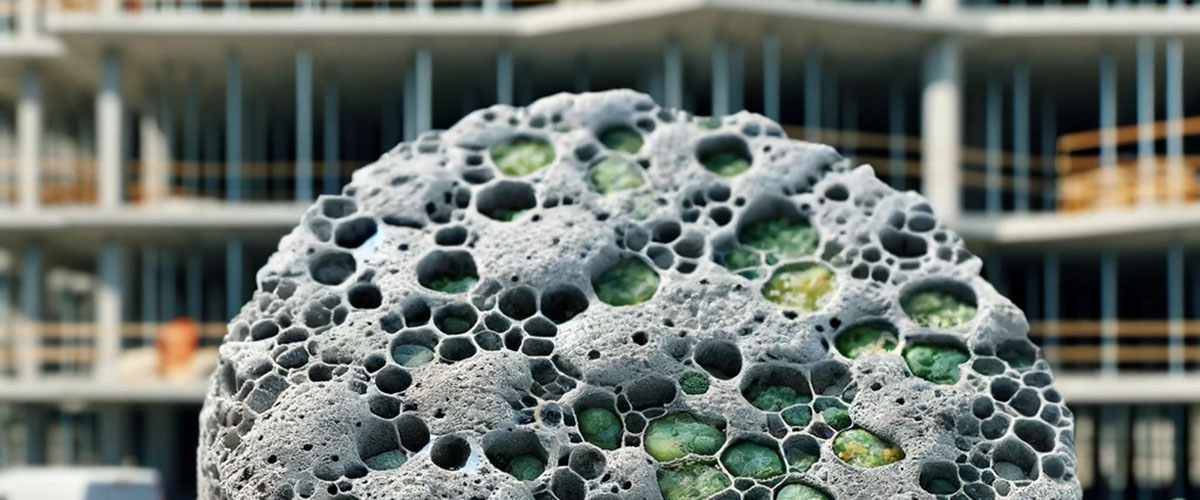
Nanotechnology in construction: from molecular scale to global impact
The impact of nanotechnology on construction materials operates at an invisible scale, 1-100 nanometres (where 1 nm equals 10 to the power of minus 9 metres), yet delivers macroscopic consequences that are measurable and significant. Nanomaterials modify the properties of conventional construction materials (concrete, steel, glass, coatings) by improving their mechanical strength, durability, functionality, and energy efficiency. The global market for construction nanomaterials reached 8.2 billion USD in 2023, with projections of 18 billion USD by 2030 at a growth rate of 12% per year (MarketsandMarkets, 2024). Adoption is no longer experimental: more than 150 commercial construction products incorporate nanomaterials as a functional component, from high-performance cements to self-cleaning paints and anti-fog glass coatings.
The physico-chemical principles that explain the efficacy of nanomaterials in construction are threefold. First, the high surface-area-to-volume ratio: a 10 nm nanoparticle has a specific surface area 1,000 times greater than a 10 micrometre particle of the same mass, maximising reactivity and interaction with the host matrix. Second, the nucleation effect, which accelerates cement hydration and produces a denser microstructure with fewer capillary pores. Third, quantum effects (in materials such as quantum dots and carbon nanotubes) that generate electrical, optical, and mechanical properties absent at the macroscopic scale. These three mechanisms, operating individually or in combination, explain why additions measured in fractions of a per cent by weight can yield performance improvements measured in tens of per cent.
Nano-silica: the benchmark nanometric additive for concrete
Nano-silica (nS), consisting of amorphous SiO2 particles of 5-50 nm diameter with a specific surface area of 200-600 m2/g (compared with 15-25 m2/g for conventional silica fume), is the most studied and widely used nanomaterial in concrete. Its addition at 1-3% by cement weight produces quantified improvements: a 15-25% increase in 28-day compressive strength (Singh et al., 2013), a 20-30% reduction in total porosity (through combined nucleation and pozzolanic reaction), and a 30-50% reduction in water permeability. Carbonation resistance improves by 40-60%, which extends the service life in aggressive environments (exposure classes XC3-XC4 per EN 206) from 50 to 75-100 years without a significant increase in reinforcement cover depth.
The mechanism of action is dual: nano-silica acts as a crystallisation nucleus for cement hydration products (C-S-H gel), accelerating early reactions and producing a denser, more homogeneous C-S-H; and as a highly reactive pozzolan, consuming portlandite (Ca(OH)2, the weakest hydration product) and generating additional C-S-H. Commercial products include Elkem Microsilica 940U (colloidal nS suspension at 50% concentration), Wacker HDK (fumed silica), and the Nanocem European research consortium. The cost premium for nano-silica is 3-8 EUR/kg (versus 0.05-0.10 EUR/kg for cement), but the low dosage (1-3%) keeps the concrete cost increase at 5-12%, offset by superior durability and the potential to reduce cement content by 10-15% while maintaining equivalent performance.
Photocatalytic nano-TiO2: facades that clean the air
Nanometric titanium dioxide (nano-TiO2) in its anatase crystalline form (particle size 10-30 nm) is a photocatalyst that, under UV radiation (wavelength below 388 nm), generates hydroxyl radicals and superoxide species capable of oxidising organic and inorganic contaminants on the material surface. In concrete, morite, and ceramic facades, nano-TiO2 produces two simultaneous effects: self-cleaning (decomposition of organic soiling, prevention of biological staining) and air decontamination (degradation of NOx, SOx, VOCs, and organic particulates). The combination of these effects means that a photocatalytic facade is not merely passive but actively contributes to improving local air quality, a benefit of particular relevance in dense urban environments with high traffic-related pollution.
The benchmark commercial product is TX Active (Italcementi/Heidelberg Materials): a cement with integrated nano-TiO2 used in concrete, mortars, and paints. The field trial on Via Borgo Palazzo in Bergamo (Italy, 2006) documented a 26% reduction in NOx concentration relative to a control street, measured over 18 months under real traffic conditions. The Church of Dives in Misericordia in Rome (Richard Meier, 2003) used white concrete with TX Active that has maintained its appearance for more than 20 years without washing, verifying the durability of the self-cleaning effect. Nano-TiO2 dosage is 3-5% by cement weight, at a material cost premium of 15-30%. Photocatalytic efficacy depends on UV light availability, which limits performance on north-facing facades and permanently shaded surfaces, though visible-light-active formulations using nitrogen-doped TiO2 are under development to broaden the application range.
Carbon nanotubes, graphene, and functional nanocoatings
Carbon nanotubes (CNTs), cylinders of rolled graphene with a diameter of 1-50 nm and a length-to-diameter ratio exceeding 1,000, possess exceptional mechanical properties: a Young's modulus of 1 TPa (1,000 GPa, 5 times that of steel), tensile strength of 50-100 GPa (100 times that of steel), and electrical conductivity comparable to copper. Their addition to concrete at dosages of 0.05-0.5% by cement weight improves flexural strength by 20-40%, fracture toughness by 200-400% (a 3-5 times multiplier), tensile strength by 15-30%, and electrical conductivity (enabling concrete to function as a strain sensor or as a heating element via Joule effect). Graphene oxide (GO), graphene sheets functionalised with oxygen-containing groups and soluble in water, is easier to disperse in the cementitious matrix than CNTs. A dosage of 0.01-0.05% GO improves compressive strength by 10-15%, flexural strength by 20-30%, and impermeability by 40-60% (Lv et al., 2013). Companies such as First Graphene (Australia) and Applied Graphene Materials (UK) now commercialise GO for the construction industry. The cost of CNTs (50-500 EUR/kg depending on quality and volume) and GO (30-200 EUR/kg) currently constrains dosage levels, but production scale is reducing prices by 15-20% annually, opening the path to multifunctional concretes that are simultaneously structural, sensing, and thermally active.
Beyond matrix reinforcement, nanocoatings of silica or fluorosilane (thickness 50-500 nm) applied to stone, brick, concrete, and timber create superhydrophobic surfaces (contact angle exceeding 150 degrees) that reduce water absorption by 85-95% without altering vapour permeability (critical for porous materials that need to breathe). The product Protectosil (Evonik) has demonstrated in field tests of over 15 years that it reduces freeze-thaw degradation by 70-80% and biological colonisation (moss, algae) by 90% on limestone. Anti-ice (icephobic) nanocoatings with low-surface-energy nanostructures reduce ice adhesion to below 50 kPa (compared with 200-500 kPa on untreated surfaces), facilitating natural removal by gravity or wind. Antimicrobial coatings with nanoparticles of silver (Ag), copper (Cu), or zinc (Zn) inhibit bacterial and fungal growth on contact surfaces in hospitals, laboratories, and industrial kitchens, with silver nanoparticles at 0.1-1.0% by weight reducing bacterial viability by 99.9% for E. coli and S. aureus (Rai et al., 2009). The COVID-19 pandemic accelerated adoption: the antimicrobial coatings market for construction grew by 35% between 2020 and 2022 (Grand View Research). Nanotechnology enables the functionalisation of building surfaces beyond their structural or aesthetic role, transforming them into active interfaces that clean air, repel water, resist biological colonisation, and maintain hygiene at the molecular scale.
References
- [1]Beneficial role of nanosilica in cement based materials — A reviewConstruction and Building Materials, 47, 1069-1077.
- [2]Effect of graphene oxide nanosheets of microstructure and mechanical properties of cement compositesConstruction and Building Materials, 49, 121-127.
- [3]TX Active: Photocatalytic Cement for Air Purification — Technical DocumentationItalcementi Group.
- [4]Silver nanoparticles as a new generation of antimicrobialsBiotechnology Advances, 27(1), 76-83.
- [5]Nanotechnology innovations for the construction industryProgress in Materials Science, 58(7), 1056-1102.
- [6]Nanotechnology: Advantages and drawbacks in the field of construction and building materialsConstruction and Building Materials, 25(2), 582-590.



Comments 0
No comments yet. Be the first!
Leave a comment