
Fundamentals of multimodal transport applied to sustainable construction
Multimodal transport in sustainable construction involves the planned combination of two or more transport modes (road, rail, maritime, inland waterway) within a single logistics chain to move construction materials from their origin to the building site, simultaneously optimizing costs, timelines and greenhouse gas emissions. The construction industry moves 15 billion tonnes of materials annually worldwide (Global Alliance for Buildings and Construction, 2022), generating approximately 6% of global CO₂ emissions associated with freight transport. Specific emissions per transport mode vary by an order of magnitude: road transport emits 62 to 107 g CO₂/tkm (tonne-kilometer), rail 15 to 30 g CO₂/tkm, short-sea shipping 10 to 25 g CO₂/tkm and inland waterway 8 to 20 g CO₂/tkm (European Environment Agency, 2023). The intelligent combination of these modes enables emission reductions of 30% to 65% compared to road-only transport, provided total distances exceed 300 km and intermodal infrastructure is available.
The European regulatory framework actively promotes multimodal transport as a decarbonization tool. Directive 92/106/EEC on combined transport offers tax exemptions and traffic restriction waivers for road legs that form part of a multimodal chain. The European Green Deal (2019) sets the goal of shifting 75% of inland road freight to rail and waterways by 2050, which means increasing the rail modal share from the current 18% to 45%. In Spain, the Rail Freight Transport Stimulus Plan 2022-2030 provides for investments of 8.6 billion EUR to double the rail share from 5% to 10% by 2030. For sustainable construction, multimodal application is particularly effective for transporting heavy and bulky materials such as cement (density of 1,500 kg/m³), aggregates (1,600 kg/m³), steel (7,850 kg/m³) and structural timber (400 to 600 kg/m³), whose transport cost represents between 15% and 40% of the final price delivered to site.
Transport modes and their technical characteristics for construction materials
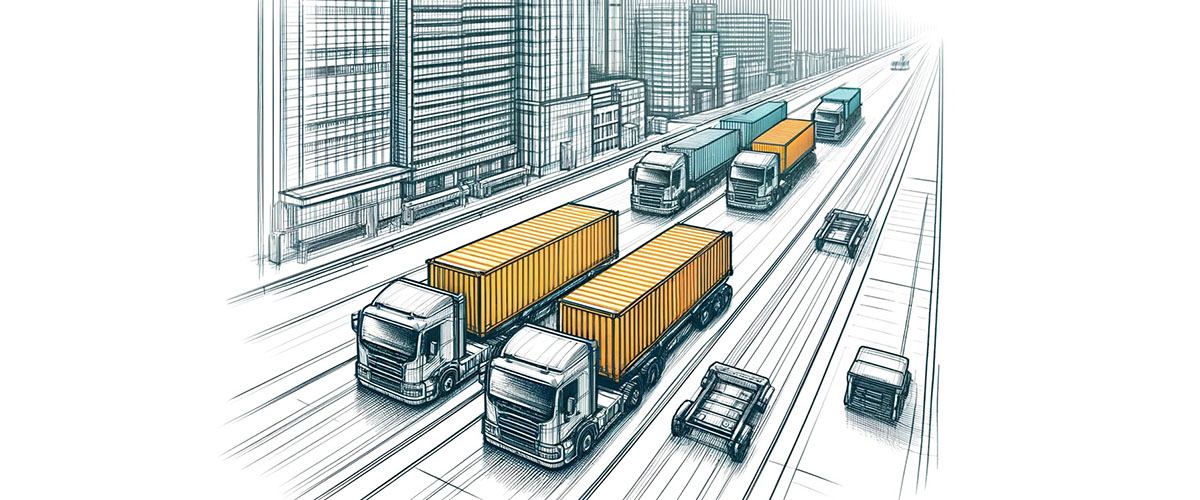
Road transport is the dominant mode in the last mile of the construction logistics chain, accounting for 85% to 95% of total tonnage in most European countries. A standard 40-tonne GVW (gross vehicle weight) articulated truck carries between 24 and 26 tonnes of payload with a fuel consumption of 30 to 38 liters of diesel per 100 km, equivalent to 80 to 100 g CO₂/tkm. Its advantage is door-to-door flexibility, but for distances exceeding 300 km it loses competitiveness against rail and maritime on both cost (0.04 to 0.08 EUR/tkm by road versus 0.02 to 0.04 EUR/tkm by rail) and emissions. Rail transport of construction materials uses flat wagons (capacity of 60 to 70 tonnes per wagon), hopper wagons for aggregates and cement (55 to 65 tonnes) and container wagons accommodating standard 20-foot and 40-foot containers. A 750-meter train (the European standard for the Trans-European Transport Network) carries 1,600 to 2,400 tonnes, equivalent to 60 to 90 trucks, with an energy consumption of 10 to 20 kWh/tkm under electric traction.
Maritime transport is optimal for construction materials on international or coastal routes. A 5,000 to 15,000 deadweight tonne vessel (coaster or handysize class) operates with emissions of 10 to 25 g CO₂/tkm and costs of 0.005 to 0.015 EUR/tkm, the lowest across all modes. In Spain, the short-sea shipping fleet connects 46 commercial ports and can replace road flows exceeding 500 km with emission reductions of 50% to 75%. Inland waterway transport, available on major European rivers such as the Rhine (190 million tonnes/year), the Danube (33 million tkm) and the Seine (25 million t), uses barges of 1,500 to 3,000 tonnes with emissions of 8 to 20 g CO₂/tkm. The intermodal terminal is the key infrastructure linking the modes: Europe has 400 rail-road intermodal terminals and 85 active inland ports. A material such as structural steel produced in Sagunto (Valencia) can reach a construction site in Berlin (2,100 km) via short-sea shipping to Hamburg and then rail for the final leg, with total emissions of 25 g CO₂/tkm compared to 85 g CO₂/tkm for road-only transport.
Multimodal logistics planning for sustainable construction projects
Multimodal logistics planning in sustainable construction requires integrating site supply needs with the capacities and constraints of each transport mode. The fundamental tool is the Site Logistics Management Plan, which quantifies material flows by type, volume, weight, frequency and delivery time window. A residential building project of 100 dwellings generates logistics flows of approximately 25,000 to 35,000 tonnes of incoming materials and 3,000 to 5,000 tonnes of outgoing waste over an execution period of 18 to 24 months. Materials suitable for multimodal transport account for 60% to 80% of the total tonnage: foundations and structure (ready-mix concrete, reinforcing bars, structural steel, precast elements), enclosures (bricks, blocks, windows, panels) and heavy finishes (ceramic flooring, sanitary ware, elevators). Just-in-Time (JIT) planning reduces on-site stockpiling needs (which occupy between 15% and 30% of the plot area and generate storage costs of 2 to 5 EUR/m²·day) by coordinating deliveries with execution schedules, with tolerances of ±2 days for rail materials and ±5 days for maritime.
Construction material consolidation centers (Construction Consolidation Centres, CCC) represent the most effective logistics innovation for implementing multimodal transport in dense urban areas. The London Construction Consolidation Centre (operational since 2005) demonstrated reductions of 68% in truck movements to central London construction sites, a 75% decrease in NOx emissions and a 40% improvement in delivery productivity by eliminating on-site waiting times. The center receives materials from multiple suppliers, groups them by site and destination, and makes consolidated deliveries during nighttime windows (22:00 to 6:00) using electric or compressed natural gas vehicles. In Stockholm, the Stockholm Construction Logistics Centre manages 15,000 deliveries annually for more than 50 concurrent sites, with a logistics surcharge of 3% to 5% offset by savings on crane waiting times (valued at 80 to 150 EUR/hour of idle crane) and a reduction in material damage from 8% to 1.5%.
Success cases and environmental quantification of multimodal transport in construction
Documented cases of multimodal transport in sustainable construction confirm significant reductions in the logistics carbon footprint. The construction of the Crossrail line in London (2009-2022, budget of 18.7 billion GBP) used Thames river transport to remove 6 million tonnes of excavated material and deliver 2 million tonnes of concrete and aggregates, avoiding 150,000 truck trips through London's streets and reducing the project's transport emissions by 55%. In Spain, the construction of the Sagrada Familia in Barcelona receives Montjuic stone and masonry materials via combined rail-road transport, reducing heavy vehicle traffic in the Eixample neighborhood by 80 trucks/month. The Panama Canal expansion project (2007-2016, 5.25 billion USD) transported 4.4 million m³ of concrete and 240,000 tonnes of steel using a combination of maritime, rail and road that reduced the logistics carbon footprint by 42% compared to the road-only reference scenario.
Quantification of emission reductions from multimodal transport in sustainable construction is carried out using standard EN 16258:2012 (Methodology for the calculation and declaration of energy consumption and GHG emissions in transport services). A life cycle analysis of transporting 1,000 tonnes of structural steel from a steel mill in Duisburg (Germany) to a construction site in Madrid (1,800 km) yields the following results: by road only, 153 tonnes of CO₂ (85 g CO₂/tkm x 1,800,000 tkm); by a combination of Rhine barge to Rotterdam + maritime Rotterdam-Bilbao + rail Bilbao-Madrid, 54 tonnes of CO₂ (30 g CO₂/tkm weighted average), a reduction of 65%. The logistics cost drops from 72,000 EUR (0.04 EUR/tkm by road) to 48,000 EUR (0.027 EUR/tkm multimodal average), a saving of 33%, although delivery time extends from 3 to 8 days, requiring advance planning to compensate for the reduced temporal flexibility. Logistics emissions calculators such as EcoTransIT World (developed by the Institute for Energy and Environmental Research of Heidelberg) allow real-time comparison of multimodal scenarios and selection of the optimal combination for each material flow.
References
- [1]2022 Global Status Report for Buildings and ConstructionUNEP, Nairobi.
- [2]Transport and Environment Report 2023 — Decarbonising Road Freight in EuropeEEA, Copenhagen.
- [3]Construction Logistics and Community Safety (CLOCS) StandardTransport for London.
- [4]Understanding Construction Logistics in Urban Areas and Lowering Its Environmental Impact: A Focus on Construction Consolidation CentresSustainability, 11(21), 6118.
- [5]EcoTransIT World — Ecological Transport Information Tool: Methodology ReportIFEU, Heidelberg.


Comments 0
No comments yet. Be the first!
Leave a comment