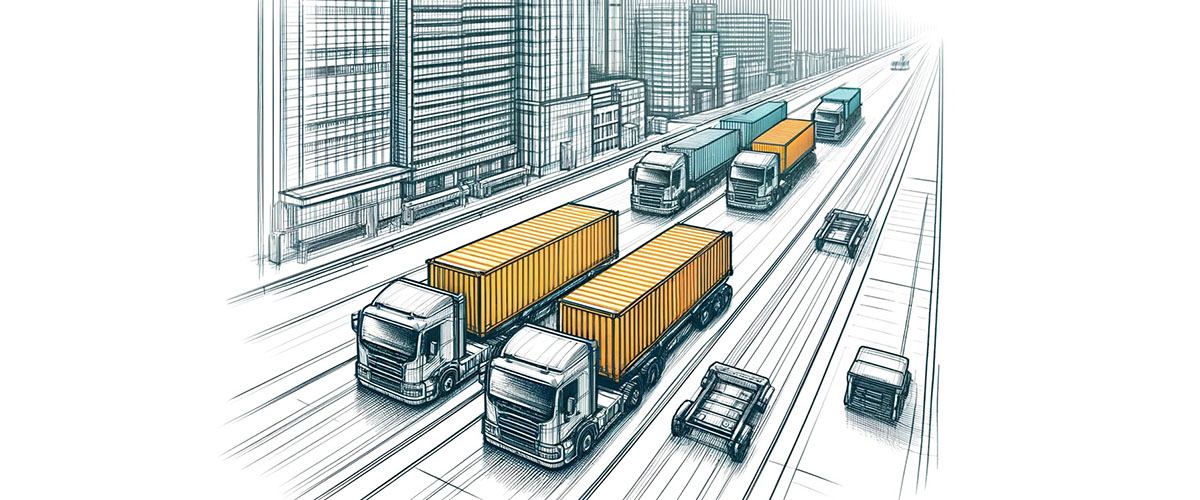
Transport as the hidden factor in the environmental impact of construction
The impact of transport on construction is quantified in module A4 of the standard EN 15978:2011 (transport of materials from factory to site) and partially in module A2 (transport of raw materials to factory). Although frequently minimised relative to manufacturing (modules A1-A3), transport can represent between 2% and 15% of the total Global Warming Potential (GWP) of a building over its lifecycle — and up to 30% for heavy materials transported over long distances. The emission factors by transport mode are well established: articulated truck (0.06-0.15 kgCO2/t-km depending on payload, topography, and Euro emission standard), rail freight (0.02-0.04 kgCO2/t-km), maritime shipping (0.008-0.020 kgCO2/t-km), and air freight (0.50-1.00 kgCO2/t-km — marginal in mainstream construction but relevant for luxury imported finishing materials). These factors mean that the mode of transport can alter the carbon footprint of a material by a factor of ten or more for the same distance covered.
The volume of materials transported for construction is immense. A residential building of 5,000 m2 requires 5,000-10,000 tonnes of materials, with concrete accounting for 60-70% of total mass, steel 5-8%, brick and ceramics 10-15%, and insulation and finishes 10-20%. At the sectoral level, the transport of construction materials represents 30-40% of road freight traffic in the EU (Eurostat, 2021) and 25-30% of rail freight tonnage. In Spain, 94% of construction material transport occurs by road (compared to a 66% European average), which maximises the carbon footprint per tonne transported. This heavy dependence on road haulage is not an immutable geographic constraint but a consequence of infrastructure investment patterns, rail network gauge incompatibilities, and logistics planning habits that could be systematically addressed through policy intervention and industry coordination.
Quantification by material: where transport weighs most
The impact of transport is proportional to the mass-to-value ratio of the material and the distance travelled. For materials of high mass and low value — aggregates (price: 8-15 EUR/tonne, density: 1,500-1,800 kg/m3), ready-mixed concrete (60-100 EUR/m3, 2,400 kg/m3), sand (10-20 EUR/tonne) — transport beyond 50-100 km by road doubles or triples the delivered cost of the material. A study by ANEFA (Asociacion Nacional de Empresas Fabricantes de Aridos) documented that the average transport radius for aggregates in Spain is 30-50 km, and that each additional 10 km increases the delivered cost by 6-8%. For 1 m3 of concrete transported 200 km by truck, module A4 generates 30-70 kgCO2, equivalent to 10-20% of manufacturing emissions (A1-A3: 300-400 kgCO2/m3). In regions where aggregate quarries have been exhausted or restricted by environmental regulations, transport distances are growing, further amplifying both cost and carbon impacts.
For materials of high value and low mass — glass (50-200 EUR/m2), insulation (10-30 EUR/m2, density 15-200 kg/m3), aluminium joinery (200-500 EUR/m2) — the economic weight of transport is smaller (2-5% of material cost) but the environmental weight can be significant when materials originate from distant sources. Chinese-extruded aluminium transported 20,000 km by sea plus 500 km by truck accumulates 0.5-1.0 kgCO2/kg in module A4 alone, equivalent to 5-10% of the manufacturing emissions of primary aluminium. Imported ornamental natural stone — Carrara marble from Italy, granite from Brazil, slate from China — carries module A4 values of 0.1-0.5 kgCO2/kg from combined maritime and road transport, which can equal or exceed the emissions from extraction and cutting at the quarry. For architects specifying materials on international projects, these transport-related carbon costs are increasingly visible in whole-building LCA calculations and must be weighed against aesthetic or performance preferences.
Reduction strategies: proximity, intermodality and logistics 4.0
The most effective strategy is proximity: using materials sourced within a radius of 100-200 km reduces module A4 by 60-90%. The regional materials credits in LEED v4.1 (sourced within 160 km) and public procurement policies that assign weight to the carbon footprint of transport in tender evaluations both incentivise this practice. The second strategy is intermodality: shifting freight from road to rail or waterway. Rail transport emits 60-80% less than road haulage per tonne-kilometre, and maritime transport emits 80-90% less. In Spain, the Strategy for Safe, Sustainable and Connected Mobility 2030 (MITMA) aims to increase the rail share of freight from the current 6% to 15% by 2030 — a shift that would significantly reduce emissions from heavy material transport. Similar modal shift targets exist across the EU, with the European Commission's Sustainable and Smart Mobility Strategy targeting a 50% increase in rail freight by 2030 and a doubling by 2050.
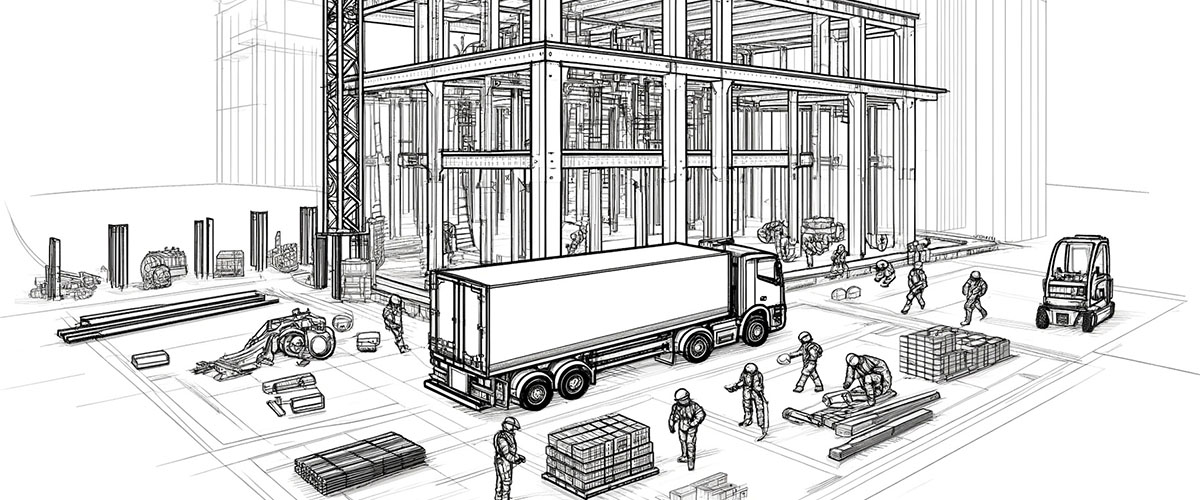
Logistics 4.0 optimises routes, loads, and delivery frequencies using digital tools. AI-powered fleet management systems — real-time route optimisation, load consolidation, elimination of empty return runs — reduce emissions per tonne transported by 15-25% (DHL, 2022). Just-In-Time delivery to site reduces the total number of trips by delivering materials in the sequence required for installation rather than in bulk stockpiles, and urban consolidation centres aggregate deliveries from multiple suppliers at a location near the construction site, distributing to site in smaller vehicles at full load. The FORS (Fleet Operator Recognition Scheme, UK) programme documented that accredited operators reduce their transport emissions by 20-30% compared to non-accredited conventional operators. These logistical improvements require no new materials technology or regulatory change — they deploy existing digital infrastructure to eliminate the inefficiencies that currently inflate both the cost and the carbon footprint of construction material transport.
Transport as a material selection criterion
Incorporating module A4 into material selection from the design stage is the most efficient practice for reducing the impact of transport. LCA tools such as One Click LCA and eLCA allow designers to input actual transport distances for each material, calculating total GWP (A1-A5) with precision rather than relying on default generic values. An illustrative example: a brick wall using bricks manufactured 50 km from the site has a total GWP (A1-A4) of 65-85 kgCO2eq/m2; the same wall using bricks imported from 500 km away rises to 80-110 kgCO2eq/m2 — an increase of 20-30% attributable entirely to transport. The alternative of specifying locally produced ceramic blocks or compressed earth blocks manufactured on or near the site reduces the module A4 contribution to effectively zero, while also supporting local manufacturing economies and reducing exposure to supply chain disruption.
The impact of transport on construction is a factor frequently underestimated in practice yet one that offers significant reduction opportunities using tools and strategies available today: preference for local materials, specification of material origin in procurement documents, use of intermodal transport for bulk materials, logistics optimisation through digital platforms, and explicit valuation of module A4 in design decisions. The forthcoming EPBD recast (2024), which will require the calculation of GWP across the entire lifecycle including module A4 for new buildings above certain size thresholds, will transform material proximity into a measurable competitive factor in every EU member state. Designers and contractors who integrate transport impact into their standard workflows now will hold a decisive advantage as this regulatory requirement comes into force, particularly in markets where the current reliance on long-distance road haulage creates the greatest potential for optimisation.
References
- [1]EN 15978:2011 — Sustainability of construction works — Assessment of environmental performance of buildings — Calculation methodEuropean Committee for Standardization.
- [2]Informe Estadístico Anual 2022: Sector de Áridos en España — Transporte y LogísticaAsociación Nacional de Empresas Fabricantes de Áridos.
- [3]Road freight transport statistics — Goods transported by typeEuropean Commission / Eurostat.
- [4]Estrategia de Movilidad Segura, Sostenible y Conectada 2030Ministerio de Transportes, Movilidad y Agenda Urbana, Gobierno de España.
- [5]DHL Logistics Trend Radar 2022: AI Route Optimization and Carbon ReductionDeutsche Post DHL Group.
- [6]Building houses with local materials: means to drastically reduce the environmental impact of constructionBuilding and Environment, 36(10), 1119-1126.


Comments 0
No comments yet. Be the first!
Leave a comment