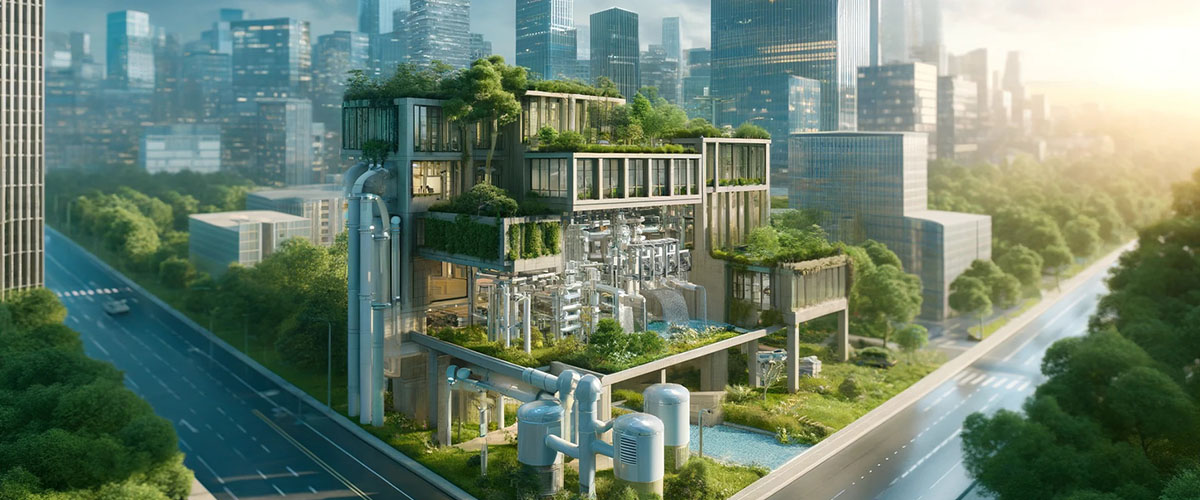
Water Consumption in Buildings: Diagnosis and Reduction Potential
Innovative technologies for water management in buildings address a quantifiable challenge: a conventional office building consumes 50-100 liters/person·day (washrooms, kitchens, irrigation, HVAC), while a residential building in Spain consumes 130-160 liters/person·day (INE, 2022). Of total consumption, only 30-40% requires potable quality (drinking, cooking, personal hygiene); the remaining 60-70% (toilet cisterns, irrigation, cleaning, evaporative cooling) can be satisfied with recycled or rainwater of non-potable quality.
The water footprint of a building includes operational water (daily use) and embodied water (material manufacturing): producing 1 m³ of concrete requires 150-200 liters, 1 tonne of steel 20,000-50,000 liters and 1 m² of float glass 30-50 liters. Reducing operational consumption by 40-70% relative to the reference building is achievable through the combination of efficient fixtures + rainwater harvesting + greywater recycling + smart irrigation. The LEED WE (Water Efficiency) certification awards up to 11 points for indoor water consumption reductions of 25-50% relative to the baseline (EPA Act 1992/ASME A112.19.2). The BREEAM Wat 01 standard awards up to 5 credits for reductions of 12.5-55% of calculated consumption.
Low-Flow Fixtures, Efficient Toilets and Appliances
Low-flow fixtures deliver the highest immediate return: aerators/flow restrictors reduce the flow rate from 12-15 l/min (conventional tap) to 4-6 l/min without perceived pressure loss, saving 50-65% of water per use. The cost of an aerator is 3-10 EUR/unit with a payback of less than 3 months. Low-flow showerheads with air-injection technology (Hansgrohe EcoSmart, Grohe Tempesta) reduce flow from 12-18 l/min to 6-9 l/min while maintaining the sensation of abundant flow. The WaterSense certification (EPA, USA) limits the maximum flow rate to 7.6 l/min for lavatory faucets and 9.5 l/min for showerheads.
Dual-flush toilets (3/4.5 liters or 3/6 liters) reduce consumption by 40-60% compared to the conventional 9-12 liter single-flush toilet. Vacuum toilets (Evac system, Jets) use only 0.5-1.2 liters per flush through pneumatic suction, saving 85-95% of water — a technology adopted at Changi Airport (Singapore) and Schiphol Airport (Amsterdam). Waterless urinals (Falcon Waterfree, Villeroy & Boch ProDetect) eliminate urinal water consumption (savings: 55,000-150,000 liters/year per urinal) through cartridges with biodegradable barrier liquid. Complete replacement of conventional sanitary fixtures with efficient models in an office building of 500 occupants saves 2,000-4,000 m³/year of water (30-50% of total consumption), with an investment of 15,000-30,000 EUR and a payback of 2-4 years.
Rainwater Harvesting and Reuse
Rainwater harvesting systems (SUDS/rainwater harvesting) capture rainfall on the building roof, filter it and store it for non-potable uses. The capture potential depends on rainfall and roof area: in Madrid (precipitation 400-450 mm/year), a 500 m² roof captures 160,000-180,000 liters/year (runoff coefficient 0.80-0.85 for a waterproofed flat roof). In Bilbao (1,200 mm/year), the same roof captures 480,000-510,000 liters/year — sufficient to cover 50-80% of the irrigation and cistern demand of a 50-dwelling building.
The typical system includes: (1) first-flush diverter that discards the first 0.5-1.0 mm of rainfall (which washes dirt from the roof), (2) particle filter (50-100 μm, self-cleaning), (3) underground or basement storage tank (polyethylene, concrete or fiberglass, volume 5,000-50,000 liters), (4) pressure booster set with variable frequency drive (0.5-1.5 kW), (5) optional UV treatment (254 nm, dose 40 mJ/cm²) if destined for washing machines or cleaning. The cost of the complete system ranges from 3,000-15,000 EUR for domestic installations to 15,000-80,000 EUR for tertiary buildings, with payback periods of 5-12 years depending on the local water tariff. The standard UNE-EN 16941-1:2018 (Rainwater harvesting installations — Planning and design) and the DB HS-5 of the CTE regulate the installation in Spain. The Bullitt Center (Seattle, 2013) collects 570 m³/year of rainwater that, after filtration and treatment, supplies 100% of the building's needs — including potable water under special permit from the Department of Health.
Greywater Recycling and On-Site Treatment
Greywater — from showers, washbasins and washing machines (excluding toilets and kitchens) — represents 50-60% of the volume of domestic wastewater and has a low pollutant load (BOD₅: 50-150 mg/l, compared to 200-400 mg/l for blackwater). Recycling greywater for toilet cisterns and irrigation reduces potable water consumption by 30-40% and discharge to the sewer network by 30-40%.
On-site greywater treatment systems include: (1) membrane bioreactors (MBR) — combining aerobic biological treatment with membrane ultrafiltration (pore size 0.01-0.04 μm), producing an effluent with turbidity < 1 NTU, BOD₅ < 5 mg/l and E. coli < 10 CFU/100 ml, suitable for cisterns and unrestricted irrigation; (2) constructed wetland systems — gravel filters with macrophyte plants (Phragmites, Typha) that purify water through natural biological processes with efficiencies of 85-95% in BOD₅ and 95-99% in suspended solids, with zero electrical consumption; (3) filtration + UV disinfection systems — more compact (0.5-2 m² per dwelling), with multilayer filters (sand, activated carbon, zeolite) and 254 nm UV lamp. The cost of an MBR system for a 50-dwelling building is 25,000-60,000 EUR (500-1,200 EUR/dwelling), with savings of 1,500-3,000 m³/year of potable water and a payback of 6-10 years. Spanish regulations (RD 1620/2007 on reuse of treated water) establish quality criteria for each use: garden irrigation (E. coli < 200 CFU/100 ml), toilet flushing (E. coli < 0 CFU/100 ml).
Green Roofs, Smart Irrigation and Runoff Management
Green roofs combine water management with thermal and ecological benefits. An extensive green roof (substrate 60-150 mm, sedum/grass plants) retains 50-70% of annual precipitation; an intensive green roof (substrate 200-1,000 mm, shrubs and trees) retains 70-90%. This retention reduces peak runoff flow by 60-85% (Mentens et al., 2006), relieving the sewer network and reducing the risk of urban flooding. The cost of an extensive green roof is 40-80 EUR/m² (substrate + waterproofing + drainage + vegetation), and that of an intensive green roof 100-300 EUR/m².
Smart irrigation systems with soil moisture sensors (capacitive or TDR, accuracy ±2-3% volumetric water content), weather stations (ET₀ — reference evapotranspiration) and IoT controllers (Hunter Hydrawise, Rain Bird ESP-TM2) adjust irrigation to the actual plant demand, saving 30-50% of water compared to timer-programmed irrigation. Drip irrigation (flow rate 2-8 l/h per emitter) reduces consumption by 40-60% compared to conventional sprinkler irrigation by eliminating evaporation and wind drift losses. Permeable pavements (draining block pavers, porous concrete, stabilized gravel) infiltrate 200-800 l/m²·hour, reducing surface runoff by 80-100% and recharging the local aquifer. The integration of green roof + rainwater harvesting + smart irrigation + permeable pavement constitutes a complete Sustainable Urban Drainage System (SUDS) that Spanish regulations (DB HS-5, municipal ordinances in cities such as Vitoria, Barcelona, Madrid) progressively require in new construction.
References
- [1]Choice of plant species and their impact on the thermal and hydrological performance of green roofsBuilding and Environment, 41(4), 401-408.
- [2]WaterSense Specification for Lavatory Faucets (Version 1.2)U.S. Environmental Protection Agency.
- [3]UNE-EN 16941-1:2018 — On-site non-potable water systems: Systems for the use of rainwaterAsociación Española de Normalización.
- [4]Real Decreto 1620/2007, de 7 de diciembre, por el que se establece el régimen jurídico de la reutilización de las aguas depuradasBOE núm. 294, de 08/12/2007.
- [5]Potential for potable water savings by using rainwater and greywater in a multi-storey residential building in southern BrazilBuilding and Environment, 42(7), 2512-2522.
Comments 0
No comments yet. Be the first!
Leave a comment