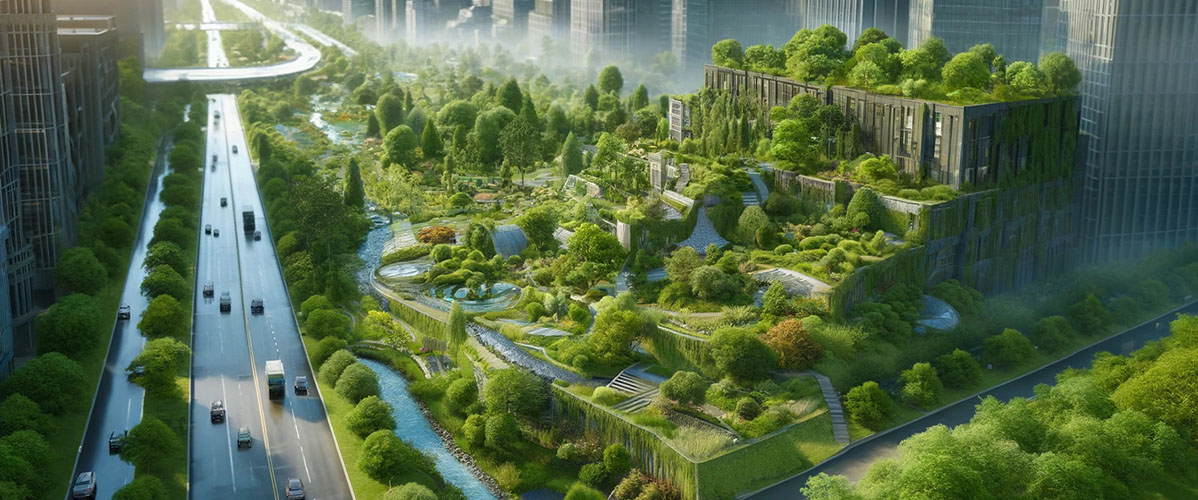
Vegetation as natural water infrastructure
The role of vegetation and landscaping in efficient water management transcends the decorative function to constitute a green infrastructure with measurable capacity for urban water cycle regulation. Vegetated surfaces intercept, store, filter and infiltrate rainwater, reducing surface runoff and the contaminant load reaching sewer networks and receiving watercourses. A mature tree with a dense canopy (Quercus ilex, Platanus hispanica) intercepts between 15% and 40% of annual precipitation in its crown (Xiao et al., 2000), with values of up to 4,000-8,000 liters/year per specimen in Mediterranean climates. Evapotranspiration from a well-designed urban garden returns 400 to 800 mm/year of infiltrated water to the atmosphere, equivalent to 50-80% of annual precipitation in temperate zones. The European Commission estimates that implementing green infrastructure across 10% of Europe's impervious urban surface area would reduce stormwater runoff volume by 25-30% and stormwater management costs by 2.5 to 5 billion EUR/year (Science for Environment Policy, 2012).
Sustainable Urban Drainage Systems (SuDS) integrate vegetation as a functional component of stormwater management. The main vegetated SuDS include: green swales (vegetated channels with 1-4% gradient, width 1-3 m, depth 0.3-0.5 m, that convey and filter runoff at velocities of 0.3-0.5 m/s), rain gardens (depressions of 15-30 cm depth planted with hydrophilic species that infiltrate flows at 25-100 mm/h), bioretention zones (filter beds of 60-120 cm depth with draining substrate, geotextile and drainage pipe) and vegetated retention ponds (permanent water surface with aquatic plants that treat water through biological processes). The British standard CIRIA C753 (SuDS Manual, 2015), the international reference for SuDS design, establishes sizing criteria, plant selection and maintenance guidelines that ensure reproducible hydraulic and water quality performance.
Xeriscaping and low water consumption landscaping
Xeriscaping (from the Greek xeros, dry) applies landscape design principles that minimize or eliminate the need for supplemental irrigation by selecting species adapted to the local climate, improving soil and applying surface mulch. The 7 principles of xeriscaping formulated by the Denver Water Department (1981) are: planning and design, soil improvement, selection of adapted plants, zoning by water needs, mulching, efficient irrigation and proper maintenance. In a Mediterranean climate, a well-designed xeriscape consumes between 1 and 3 liters/m²·day during summer months, compared to 6-10 liters/m²·day for a conventional lawn garden (Costello et al., WUCOLS IV, 2014). The reduction in irrigation consumption reaches 50-75%, equivalent to savings of 150-400 liters/m²·year in regions with dry summers lasting 3-5 months.
Native Mediterranean species offer the best performance for xeriscapes in Spain. Shrubs such as Rosmarinus officinalis (rosemary, water requirement 200-350 mm/year), Lavandula angustifolia (lavender, 250-400 mm/year), Cistus ladanifer (rockrose, 150-300 mm/year) and Nerium oleander (oleander, 200-400 mm/year) survive on natural rainfall in areas with 400+ mm/year and require minimal supplemental irrigation in drier zones. Ornamental grasses such as Stipa tenacissima (esparto grass), Festuca glauca and Pennisetum alopecuroides provide texture and movement with consumption of 1-2 liters/m²·day. Lawn alternatives as ground covers — Thymus serpyllum, Frankenia laevis, Lippia nodiflora — maintain green coverage with 70-80% less water than conventional Lolium perenne (ryegrass) or Festuca arundinacea. Mineral mulch (gravel, pine bark: layer of 5-10 cm) reduces soil evaporation by 25% to 50% (Chalker-Scott, 2007) and suppresses weeds, reducing maintenance.
Bioretention and vegetated systems for water quality
Bioretention systems combine the filtration capacity of the substrate with the biological processes of vegetation to treat urban stormwater runoff, which carries significant contaminants: total suspended solids (50-500 mg/l), heavy metals (zinc: 0.05-2 mg/l, copper: 0.01-0.2 mg/l, lead: 0.01-0.3 mg/l), nutrients (total nitrogen: 1-5 mg/l, total phosphorus: 0.1-1 mg/l), hydrocarbons (0.5-10 mg/l) and pathogens (10³-10⁵ CFU/100 ml). A typical bioretention system consists of a depression 0.6-1.2 m deep with successive layers of: surface mulch (5-10 cm), sand-compost filter substrate (50-80 cm, hydraulic conductivity 25-150 mm/h), gravel transition layer (10-15 cm) and underdrain. The bioretention surface is sized at 5-10% of the impervious area drained.
Removal efficiencies documented across more than 200 studies compiled by the International Stormwater BMP Database (Wright Water Engineers / Geosyntec, 2020) are: suspended solids 60-95% (median 82%), zinc 60-90% (median 77%), copper 40-80% (median 60%), total phosphorus 40-70% (median 53%), total nitrogen 30-65% (median 42%) and hydrocarbons 80-95%. Plant selection directly influences performance: species with deep and dense root systems (Carex, Juncus, Iris pseudacorus, Panicum virgatum) maintain long-term substrate permeability, prevent clogging and provide rhizodegradation of organic contaminants. Constructed wetlands with subsurface flow vegetated with Phragmites australis achieve removal rates of 90-98% for BOD₅ and 95-99% for suspended solids with retention times of 3-7 days and areas of 2-5 m²/population equivalent. Vegetation in water management is not ornament but applied biological engineering.
Integration of water-sensitive landscaping in building projects
Integrating landscaping into efficient water management requires coordination among architects, hydraulic engineers, landscape designers and botanists from the preliminary design phase. The Stormwater Management Plan, mandatory in many jurisdictions for new developments, establishes quantitative targets: on-site retention of 80-95% of runoff for storms with a return period ≤ 2 years (precipitation of 25-40 mm in Spain), 80% reduction in the suspended solids contaminant load, and limiting peak discharge to the pre-development equivalent. The costs of vegetated SuDS are competitive with conventional grey infrastructure: a bioretention trench costs 30-80 EUR/m², compared to 200-500 EUR per linear meter for a buried DN600 concrete sewer pipe. The Augustenborg project (Malmo, Sweden, 32 hectares, 1998-2002 renovation) transformed a neighborhood with recurring flooding into a stormwater management model using SuDS: green roofs on 30% of roof surface area, 6,000 m² of vegetated swales, 10 retention ponds and open channels that reduced runoff discharged to the sewer by 50%.
Green roofs represent a strategic opportunity for water management in urban buildings with limited ground-level space. An extensive green roof with 8-12 cm of substrate retains between 40 and 80 liters/m² of water per rainfall event, reducing annual runoff volume by 40-60% and peak flow by 60-85% (Mentens et al., 2006). Intensive green roofs (25-100 cm of substrate) retain 100-300 liters/m² and support functional gardens with small trees. In Spain, Barcelona has required since 2010 that new buildings with flat roofs exceeding 600 m² install a green roof or equivalent stormwater retention system. Madrid included in its Water Use and Efficiency Ordinance (2020) a 50% reduction in the sewerage charge for buildings with SuDS that retain at least 60% of annual runoff. The role of vegetation and landscaping in efficient water management delivers multiple simultaneous benefits: runoff reduction, water quality improvement, urban heat island mitigation (2-5°C surface temperature reduction), increased urban biodiversity and improved resident well-being.
References
- [1]A New Approach to Modeling Tree Rainfall InterceptionJournal of Geophysical Research, 105(D23), 29173-29188.
- [2]The SuDS Manual C753Construction Industry Research and Information Association, London. ISBN: 978-0-86017-760-9
- [3]WUCOLS IV — Water Use Classification of Landscape SpeciesUniversity of California Cooperative Extension / California Department of Water Resources.
- [4]Nature-Based Solutions for Climate Adaptation and Water Management — Green Roof Study BrusselsLandscape and Urban Planning, 77(3), 217-226.
- [5]Impact of Mulches on Landscape Plants and the Environment — A ReviewJournal of Environmental Horticulture, 25(4), 239-249.

Comments 0
No comments yet. Be the first!
Leave a comment