
Construction Robots: From Laboratory to Job Site
Construction robotics has transitioned from experimental prototypes to commercial operational systems in less than a decade. The Hadrian X robot, developed by Australian company FBR (Fastbrick Robotics), lays concrete blocks at a rate of 200 blocks/hour, compared to 40-60 blocks/hour by a skilled mason, and has completed its first 180 m2 dwelling in 3 days of robotic work versus the 4-6 weeks of conventional envelope construction. The system uses an articulated arm with a 30-meter reach mounted on a vehicle that places pieces with a precision of plus or minus 0.5 mm, eliminating the need for scaffolding and reducing cutting waste by 85% thanks to algorithmic optimization of the cutting layout. In Europe, ETH Zurich developed the DFAB HOUSE system (2019), a 200 m2 dwelling built by combining 4 robotic techniques: robotic slip forming (Mesh Mould), additive manufacturing of complex floor slabs, automated timber frame assembly, and robotic facade application. The material consumption of the Mesh Mould slab was 50% lower than that of a conventional slab of the same load-bearing capacity, by distributing concrete only where the structure requires it.
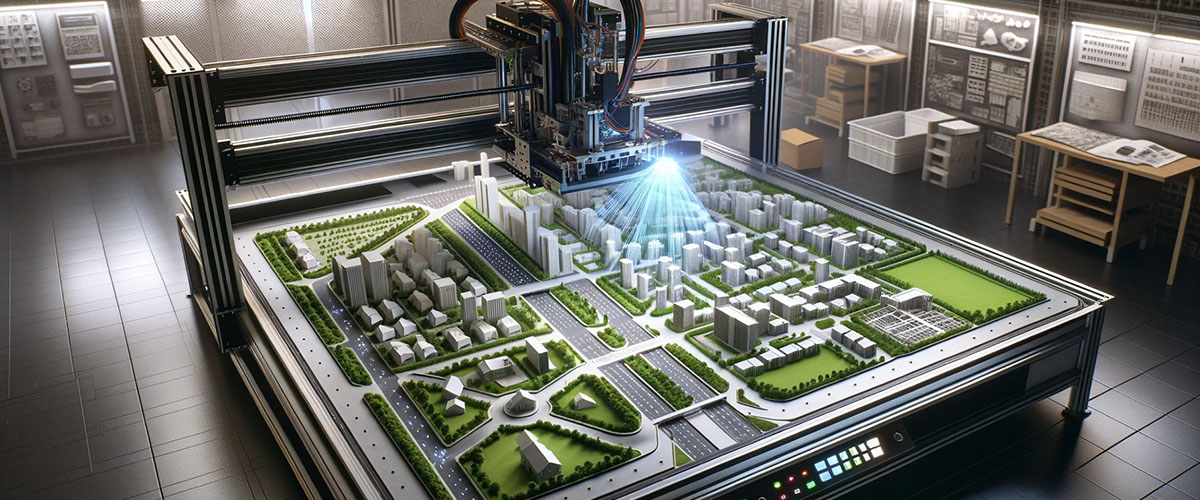
3D concrete printing has reached industrial scale. Danish company COBOD has printed more than 100 structures in 12 countries with its BOD2 printer, capable of extruding concrete at a rate of 1 m3/hour in layers of 30 mm in height and 50-100 mm in width. The TECLA project in Massa Lombarda, Italy (2021), designed by Mario Cucinella Architects, built a 60 m2 dwelling using 350 layers of locally sourced clay printed by two simultaneous robotic arms, producing zero formwork waste and 60% less concrete than an equivalent ceramic block construction, by employing a double-dome geometry that optimizes the strength-to-material ratio. In Spain, the company Hyperion Robotics and the IAAC (Institute for Advanced Architecture of Catalonia) have developed 3D printing prototypes with low-carbon mixtures incorporating up to 30% fly ash and 10% recycled aggregate, reducing the material's carbon footprint by 40% compared to conventional CEM I concrete. The global 3D printing in construction market grew from 14 million USD in 2018 to 380 million USD in 2024, with a projection of 4.2 billion USD by 2030 (Grand View Research, 2024).
Drones for Building Inspection, Monitoring, and Maintenance
Unmanned aerial vehicles (UAVs) have established themselves as a standard tool for the inspection of sustainable buildings. A drone equipped with a 640x512 pixel FLIR thermal camera and multispectral sensor can inspect the complete envelope of a 10-story building in 45-90 minutes, compared to the 3-5 days required with scaffolding or an aerial work platform, reducing inspection costs by 70-85%. Aerial thermography detects thermal bridges, insulation defects, water infiltration, and defective photovoltaic panels with a thermal resolution of 0.03 degrees C, enabling the identification of energy losses equivalent to 5-15 kWh/m2/year that are not visible in conventional inspections. According to a study by Rakha and Gorodetsky (2018), published in Automation in Construction, thermographic drone inspection of 76 residential buildings in Boston identified insulation defects in 62% of the properties, with estimated energy losses of 1,200 USD/year per dwelling that could be corrected with investments of 3,000-8,000 USD.
Beyond one-time inspection, drones enable periodic monitoring of building conservation status. Companies such as Flyability (Switzerland) have developed indoor drones with protective cages that inspect confined spaces such as ventilation ducts, roof plenums, and rainscreen facade air cavities without the need for disassembly. The predictive maintenance program at the Hospital Universitario La Paz in Madrid (2022) uses biannual drones to inspect 45,000 m2 of flat roof and 12,000 m2 of ventilated facade, detecting 23 incipient leak points in the first year that were repaired preventively, avoiding estimated structural damage of 180,000 EUR. In the maintenance of rooftop photovoltaic arrays, drones with thermal cameras identify hot-spot cells and defective strings with a productivity of 5 MW inspected per hour, compared to 0.5 MW/hour for manual inspection with a portable camera. Spanish drone regulations (Royal Decree 517/2024) govern operations in the specific category for flights over urban environments, requiring operator certification, liability insurance, and AESA authorization for flights within 50 m of buildings.
Exoskeletons and Collaborative Robotics on the Sustainable Job Site
Industrial exoskeletons for construction reduce workers' biomechanical load and improve productivity in repetitive material handling tasks. The Ekso EVO exoskeleton, used by contractors such as Skanska and BAM, reduces shoulder fatigue by 60% and allows an operator to hold tools weighing 5-15 kg in an elevated position for extended periods without musculoskeletal injury. A study by Kim et al. (2021), published in the Journal of Construction Engineering and Management, evaluated 3 models of passive exoskeleton in overhead drywall installation tasks and documented a 17% increase in productivity and a 42% reduction in trapezius muscle activation. The incidence of musculoskeletal disorders in Spanish construction is 12.3 cases per 1,000 workers per year (Ministry of Labor, 2023), twice the industrial average, representing a cost of 1.8 billion EUR per year in sick leave and treatment. Exoskeletons could reduce this incidence by 30% to 50%, but their adoption in Spain is limited to 150 operational units in 2024, concentrated among major contractors.
Collaborative robotics (cobots) complements autonomous robots in tasks requiring human-machine interaction. The nLink autonomous ceiling drilling system positions and drills 400 holes/day with millimetric precision according to the BIM plan, compared to 80-120 holes/day by a manual installer, and reduces positioning error from plus or minus 10 mm to plus or minus 2 mm, avoiding rework that generates waste and consumes time. In sustainability terms, robotic precision directly translates into waste reduction: conventional construction generates between 80 and 120 kg of waste/m2 built (Eurostat, 2022), and robotized processes document reductions of 30-60% in waste generation thanks to the elimination of cutting errors, optimized material layouts, and the removal of disposable formwork. The HEPHAESTUS demonstration project, funded by Horizon 2020 (2017-2021) with 7.8 million EUR, developed a robotic prefabricated facade installation system that reduced assembly time by 50%, installation waste by 40%, and workplace accidents by 55% compared to the conventional manual process.
Adoption Outlook and Sector Transformation in Spain
The construction sector in Spain faces a dual pressure that favors robotic adoption: a shortage of skilled labor and increasing sustainability demands. According to the National Construction Confederation (2024), the sector needs to incorporate 700,000 workers over the next 5 years to execute planned works, but the average age of operatives is 47 years and new recruits cover only 40% of retirements. Robotics does not replace the worker but amplifies their capacity: a BCG study (2023) projects that the automation of 20-25% of construction tasks by 2030 would increase sector productivity by 50-60%, closing the productivity gap that has kept construction as the only industrial sector whose hourly productivity has not improved in 30 years. Construction productivity in Spain stands at 28 EUR/hour worked, compared to 52 EUR/hour in manufacturing (INE, 2023).
Barriers to large-scale adoption include investment cost (a bricklaying robot costs 400,000-800,000 EUR, an industrial 3D printer 500,000-1,500,000 EUR), the need to redesign construction processes to accommodate robotized production, and labor and safety regulations that must be updated to incorporate human-robot coexistence on site. The Spain Digital Plan 2026 includes a 150 million EUR funding line for digitalization of the construction sector but does not specifically address on-site robotics. The European construction robotics market is forecast to reach 12.8 billion EUR by 2030 (Mordor Intelligence, 2024), with Spain representing 8-10% of the total thanks to its volume of new construction and European-funded rehabilitation. The convergence of robotics, 3D printing, prefabrication, and BIM configures an industrialized and sustainable construction model that can simultaneously reduce construction timelines by 30-50%, waste by 40-60%, and CO2 emissions by 25-40% compared to conventional artisanal construction.
References
- [1]3D Printing Construction Market Size, Share & Trends Analysis Report, 2024-2030Grand View Research.
- [2]Review of Unmanned Aerial System (UAS) Applications in the Built Environment: Towards Automated Building Inspection Procedures Using DronesAutomation in Construction, 93, 252-264.
- [3]Assessing the Influence of a Passive, Upper Extremity Exoskeleton on Overhead WorkJournal of Construction Engineering and Management, 147(4), 04021009.
- [4]Productivity of Digital Fabrication in Construction: Cost and Time Analysis of a Robotically Built WallAutomation in Construction, 92, 297-311.
- [5]Highly Automated Physical Achievements and Performances Using Cable Robots Unique for Building and Constructions Applications: Final ReportHorizon 2020 Programme, Grant Agreement No. 732513.


Comments 0
No comments yet. Be the first!
Leave a comment