
Computational Parametric Design in the Service of Sustainability
Parametric design allows the geometry and properties of a building to be defined through mathematical relationships between variables, so that modifying one parameter automatically propagates changes throughout the entire model. When these variables include environmental performance indicators (energy demand, daylighting, CO2 emissions), parametric design becomes a sustainable optimization tool. The Grasshopper platform for Rhino, combined with the Ladybug Tools plugins (climate and energy simulation) and Honeybee (connection with EnergyPlus, Radiance, and OpenStudio simulation engines), enables the evaluation of the energy performance of 1,000 design variants in 2-4 hours, compared to the 2-3 weeks needed to analyze 5 variants with conventional tools. A study by Shi et al. (2020), published in Renewable and Sustainable Energy Reviews, analyzed 127 research studies on multi-objective parametric optimization in architecture and found that optimized solutions reduced energy demand by 18% to 42% compared to architects' initial designs, by exploring combinations of form, orientation, window-to-wall ratio, glass type, and solar protection configurations that exceeded human analytical capacity.
The maturity of these tools has enabled their integration into professional practice. Foster + Partners uses a proprietary parametric design system that evaluates 50,000 facade configurations before finalizing the design, as documented in the Apple Park headquarters project in Cupertino (2017), whose curved glass facade spanning 4.5 km was parametrically optimized to maximize daylighting and minimize solar gain, achieving that 75% of the office area operates without artificial lighting during working hours. Zaha Hadid Architects (ZHA) created in 2007 the ZHA CODE group (Computation and Design) with 30 specialists dedicated to parametric design, and their London Aquatics Centre project (2012) optimized the 160 m free-span roof using genetic algorithms that minimized steel weight by 22% compared to conventional structural design, saving 800 tonnes of steel and 1,600 tonnes of CO2 in embodied carbon. In Spain, the studio Selgascano and ETH Zurich collaborated on the Serpentine Gallery Pavilion (2015), whose ETFE and polycarbonate structure was parametrically optimized to maximize light transmission at 90% transparency while minimizing structural weight to 18 kg/m2.
BIM-LCA Integration: Automated Real-Time Life-Cycle Analysis
The integration between BIM (Building Information Modeling) models and LCA (Life Cycle Assessment) tools enables the automatic and continuous calculation of a building's embodied carbon footprint throughout the design process. Tools such as One Click LCA, Tally, and EC3 (Embodied Carbon in Construction Calculator) connect directly to Revit, ArchiCAD, or IFC models to extract material quantities and calculate environmental impacts in accordance with standard EN 15978. One Click LCA, used in more than 170 countries and with a database of 70,000 EPDs, can evaluate a building's carbon footprint in 4-8 hours of work, compared to the 80-120 hours of a manual LCA performed with generic software such as SimaPro or GaBi. A study by Hollberg et al. (2020), published in Automation in Construction, documented that BIM-LCA integration in early design phases (concept and schematic design) enables decisions that reduce embodied carbon by 20-35% at no additional cost, because these phases define the structural system, primary materials, and massing that determine 70-80% of life-cycle emissions.
The automation of compliance checking (automatic verification of regulatory compliance) represents another significant advance. Platforms such as Solibri Model Checker and IFC validation servers can automatically verify whether a BIM model meets CTE requirements, the demands of certifications like BREEAM or LEED, and the thresholds of the EU green taxonomy. The Singapore government implemented in 2008 the CORENET e-Submission system, which automatically verifies compliance with 2,300 regulatory clauses from the BIM model, reducing license approval time from 26 days to 10 days. In Europe, the ACCORD project, funded by Horizon Europe (2022-2025) with 6.5 million EUR, is developing an automatic compliance verification system for the EPBD and national building codes from BIM-IFC models, with pilots in Spain, Finland, and Estonia. The European Commission estimates that automatic verification could reduce administrative costs for permit issuance by 25-40% and average processing time by 30-50%.
Direct Digital Fabrication: From Model to Component Without Intermediaries
The chain of parametric design to BIM model to digital fabrication enables the production of building components directly from the design file, eliminating drawing interpretation errors and on-site adaptation waste. CNC (Computer Numerical Control) fabrication of CLT (Cross-Laminated Timber) structures achieves precisions of plus or minus 0.1 mm and generates machining waste below 3% of the material volume, compared to 10-15% for conventional carpentry. The Austrian company Stora Enso produces CNC-machined CLT panels for 8,000 dwellings/year at its plant in Ybbs (Austria), with on-site assembly times of 3-5 days per floor for buildings up to 18 stories. The Mjostaarnet project in Brumunddal, Norway (2019), at 85.4 m in height and 18 stories, is the world's tallest timber building and was digitally fabricated with 2,600 m3 of glued laminated timber and CLT, sequestering 1,800 tonnes of CO2 in its structure compared to the 2,500 tonnes that an equivalent reinforced concrete structure would have emitted.
Robotic cutting of natural stone with a 6-axis anthropomorphic arm enables the production of facade pieces with complex geometries impossible to execute manually, such as the 4,500 panels of variable-geometry limestone on the Guggenheim Museum Bilbao, which if built today would be robotically cut in one third of the time and with half the waste compared to the manual cutting technique used in 1997. In the field of modular facades, the Katerra platform (before its liquidation in 2021) demonstrated the concept of complete off-site fabrication of facade modules with integrated insulation, windows, finishes, and wiring, produced on an industrial line with a cycle time of 45 minutes per module and a defect rate of 0.3% compared to 5-8% for in-situ construction. Active companies such as Volumetric Building Companies (VBC) and Autovol in the United States produce complete volumetric modules of 12x4x3 m on robotized lines with a productivity of 15 modules/day, sufficient for a complete multifamily dwelling every 2-3 days of factory production.
Integrated Platforms and the Future of Architectural Automation
The converging trend is the emergence of design platforms that integrate BIM modeling, energy simulation, life-cycle analysis, regulatory verification, and digital fabrication file generation within a single environment. Autodesk Forma (launched in 2023) combines solar, wind, noise, and energy potential analysis in the early design stages, processing hourly climate data for 8,760 hours/year and generating performance reports in minutes. The open-source Hypar platform enables architects to create parametric design functions in C# that run in the cloud and generate IFC models with integrated environmental performance data. McNeel & Associates anticipates that Rhino 8 and Grasshopper 2 will incorporate native energy analysis and LCA capabilities without external plugins, which will lower the barrier to entry for Rhino's 1.2 million active users worldwide (McNeel, 2024).
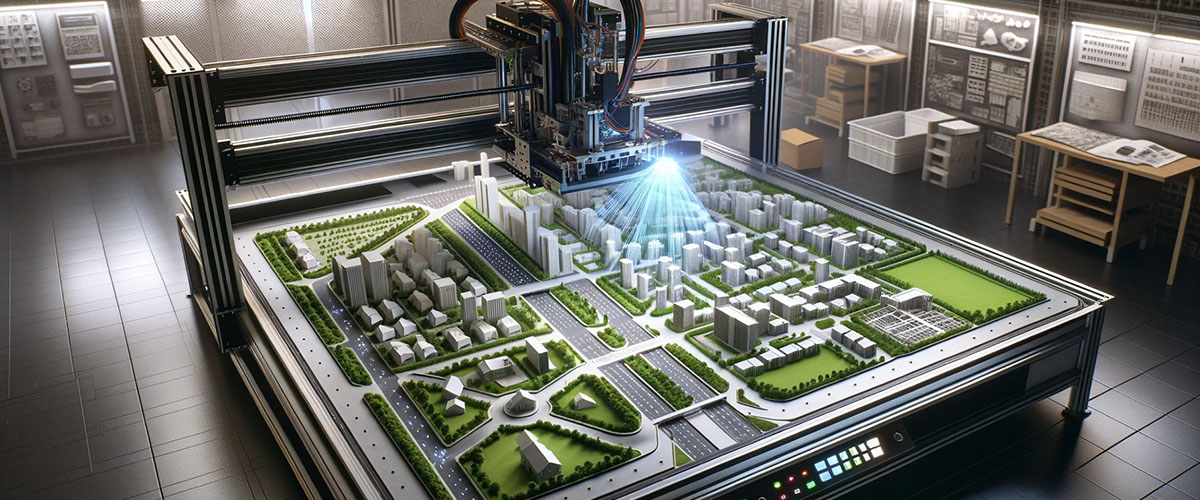
On the 2025-2035 horizon, the automation of sustainable architecture will benefit from three advances. First, multimodal language models (such as those already integrated by Autodesk in its platforms) will allow architects to describe design requirements in natural language and receive optimized parametric models in response, democratizing access to computational design. Second, digital twins of entire cities (such as Virtual Singapore, operational since 2018 with data from 5 million m2 of buildings) will enable the evaluation of each new building's impact on the neighborhood's microclimate, mobility, and energy consumption before construction. Third, the convergence of additive manufacturing (3D printing), subtractive manufacturing (CNC), and robotic assembly in flexible production cells will enable the fabrication of complete buildings with an automation level exceeding 80%, compared to the current 15-25%. The World Economic Forum (2023) estimates that the full adoption of these technologies could reduce the construction sector's CO2 emissions by 30-40%, waste by 50-70%, and costs by 20-30% compared to current conventional practice.
References
- [1]A Review on Building Energy Efficient Design Optimization from the Perspective of ArchitectsRenewable and Sustainable Energy Reviews, 65, 872-884.
- [2]Evaluation of BIM-Based LCA Results for Building DesignAutomation in Construction, 109, 102972.
- [3]Shaping the Future of Construction: An Action Plan for the IndustryWEF.
- [4]Interactive Vault DesignInternational Journal of Space Structures, 27(4), 219-230.
- [5]Automated Compliance Checks for Construction in a Digital Building Permit ProcessHorizon Europe Programme, Grant Agreement No. 101056973.


Comments 0
No comments yet. Be the first!
Leave a comment