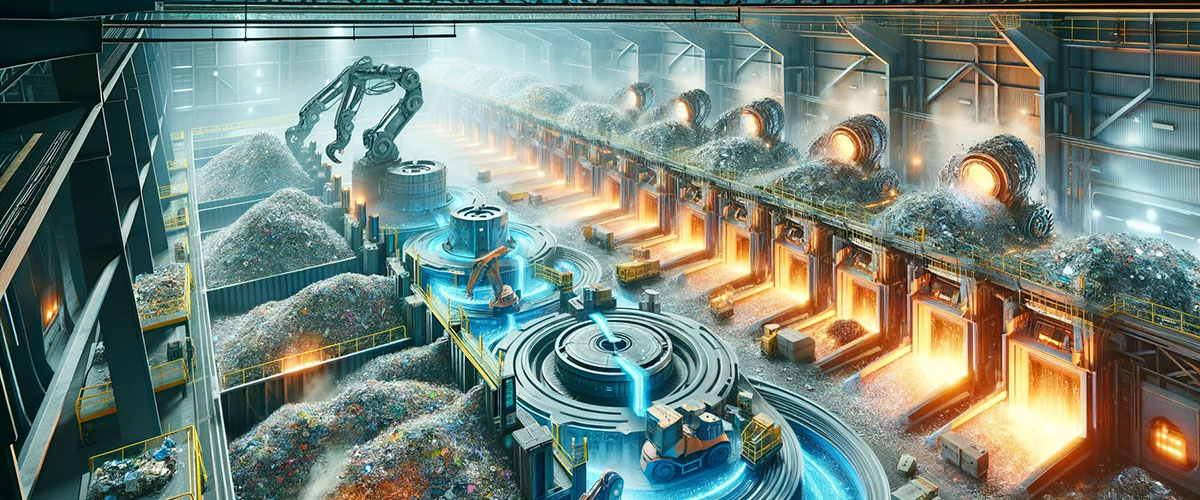
The recycling frontier: when waste becomes a building resource
The extreme recycling of materials created from unexpected waste represents a frontier in the circular economy applied to construction, going far beyond the conventional recycling of concrete, steel and timber. Every year the world generates 2.010 billion tonnes of municipal solid waste (World Bank, 2018), of which only 13.5% is recycled and 5.5% composted, while 33% ends up in landfills and 40% in uncontrolled dumpsites. Simultaneously, construction consumes 40,000-50,000 billion tonnes/year of materials (UNEP, 2019), making it the sector with the greatest demand for material resources on the planet. The convergence of these two realities — excess waste and massive material demand — has driven research that transforms previously worthless discards into functional building components with mechanical, thermal and acoustic performance verified in laboratories and, in some cases, in real-scale pilot projects.
The technical viability of these materials created from unexpected waste is assessed against three criteria: mechanical performance (compressive, flexural and tensile strength), durability (freeze-thaw resistance, carbonation, sulphate attack) and health safety (leachate contamination, VOC emissions, chemical reactivity). A meta-analysis published in the Journal of Cleaner Production (Tam et al., 2018) reviewed 387 studies on the incorporation of unconventional waste into construction materials and concluded that 72% of the materials assessed met code mechanical requirements for non-structural applications, and 34% for structural applications, confirming that extreme recycling is not a laboratory curiosity but a technically viable pathway toward circularity in the construction sector.
Organic and sanitary waste: diapers, cigarette butts and rice husks in construction
A study by Kitakyushu University (Siswanti Zuraida et al., 2022) published in Scientific Reports demonstrated that disposable diapers — 6 billion units/year discarded in Japan alone — can be shredded, washed and sterilised to replace up to 8% of fine aggregate in structural concrete (compressive strength > 17.5 MPa at 28 days, sufficient for load-bearing elements of up to 3 storeys under Indonesian standard SNI 2847:2019) and up to 27% in non-structural mortars. The cellulosic component of the diaper (40-60% of its mass) acts as a dispersed fibre reinforcement that improves indirect tensile strength by 5-12%, while the superabsorbent polymer (SAP, 5-10%) functions as an internal curing agent. Globally, disposable diapers represent 2-5% of municipal solid waste, and diverting them into construction material production would prevent 15-30 million tonnes/year of waste from reaching landfill.
Cigarette butts — 4.5 trillion units/year discarded globally, the most abundant solid waste item on the planet according to Ocean Conservancy (2020) — contain cellulose acetate, a thermoplastic polymer with binding properties. Research by Mohajerani et al. (2016) at RMIT University (Melbourne) demonstrated that incorporating 1% by weight of cigarette butts into the ceramic mix for bricks reduces firing energy by 58% (due to combustion of the organic material during firing at 1,050°C), decreases brick density by 8-10% (improving thermal insulation by 20-30%) and maintains compressive strength above the regulatory threshold of 25 MPa. Rice husk ash (RHA) — obtained from the controlled combustion at 500-700°C of the 150 million tonnes/year of rice husks generated globally — contains 85-95% reactive amorphous silica, a natural pozzolan that replaces 10-20% of Portland cement with durability improvements documented by Mehta (1992) and confirmed in over 200 subsequent studies.
Transformed industrial waste: glass, plastic and tyres as building materials
Recycled glass ground to a particle size below 75 μm (glass powder) exhibits pozzolanic activity comparable to fly ash, enabling the replacement of 20-30% of Portland cement with emission reductions of 18-25%. A study by Shayan and Xu (2006) at the ARRB Group (Australia) documented that mortars with 30% glass powder achieve compressive strengths of 45-55 MPa at 90 days, equivalent to the control mix without substitution. At coarser particle sizes (1-10 mm), crushed glass replaces natural aggregates in concrete with density reductions of 5-10%; the risk of alkali-silica reaction (ASR) — the main technical concern — is mitigated by controlling particle size (< 300 μm eliminates expansion) or using low-alkali cements. Each tonne of recycled glass incorporated into concrete avoids the extraction of 1.2 tonnes of virgin raw materials and reduces production energy consumption by 30% compared to manufacturing new glass.
End-of-life tyres (ELT) — 1.5 billion units/year generated globally, 300,000 tonnes/year in Spain — are transformed into crumb rubber (1-5 mm) which, incorporated into concrete as partial replacement of fine aggregate (5-20%), produces what is known as elastomeric or rubberised concrete. This material exhibits lower compressive strengths (15-30 MPa versus 25-40 MPa for conventional concrete at 10-20% replacement levels), but gains energy absorption capacity (30-60% increase in toughness), acoustic damping (10-15 dB improvement in impact sound insulation) and crack resistance from shrinkage (40-70% fewer cracks). According to Thomas and Gupta (2016), optimal applications include flexible pavements, seismic protection elements, acoustic barriers and levelling layers, where compressive strength is not the critical parameter. Recycled plastic (PET, HDPE, PP) is incorporated as reinforcement fibre (0.5-1.5% by volume), improving concrete tensile strength by 10-25% and reducing shrinkage cracking by 50-80%, with a potential consumption of 20-40 kg of recycled plastic per m³ of concrete.
Industrial viability and regulatory frameworks for extreme recycling in construction
The transition from laboratory to industry requires overcoming three barriers: standardisation (materials with unexpected waste lack harmonised EN or ASTM standards, forcing each manufacturer to obtain an ETA — European Technical Assessment — at a cost of 50,000-150,000 € per product), supply logistics (ensuring a continuous and homogeneous flow of waste as secondary raw material, with variability below 10% in composition) and market perception (the reluctance of specifiers and developers to prescribe materials with names that evoke waste). The European Construction Products Regulation (CPR, 2024 revision) introduces the concept of declared recycled content, which will incentivise the incorporation of secondary raw materials by requiring transparency without penalisation, levelling the playing field with virgin materials.
Successful industrialisation cases demonstrate viability: Envision Plastics (USA) produces plastic lumber from ocean-sourced recycled HDPE with over 100 million kg processed since 2008; Stonecycling (Netherlands) manufactures facade bricks from blends of ceramic waste, glass and crushed concrete with over 50 completed projects; and ByFusion (USA) produces construction blocks from unsorted mixed plastic — including plastics not recyclable by conventional methods — through steam compression, with a production rate of 1,500 blocks/day per machine. Extreme recycling of unexpected waste will not replace conventional materials, but it has the potential to divert 200-500 million tonnes/year of waste from landfill into construction applications with low and medium mechanical requirements, simultaneously contributing to reduced extraction of virgin resources and addressing the global waste management crisis.
References
- [1]A review of recycled aggregate in concrete applications (2000-2017)Construction and Building Materials, 172, 272-292.
- [2]Application of disposable diaper waste as partial sand replacement in concrete mixScientific Reports, 12, 7181.
- [3]A practical proposal for solving the world's cigarette butt problem: Recycling in fired clay bricksWaste Management, 52, 228-244.
- [4]Rice husk ash — a unique supplementary cementing materialProceedings of the International Symposium on Advances in Concrete Technology, CANMET/ACI, Athens, 407-430.
- [5]Performance of glass powder as a pozzolanic material in concrete: A field trial on concrete slabsCement and Concrete Research, 36(3), 457-468.
- [6]A comprehensive review on the applications of waste tire rubber in cement concreteRenewable and Sustainable Energy Reviews, 54, 1323-1333.
Comments 0
No comments yet. Be the first!
Leave a comment