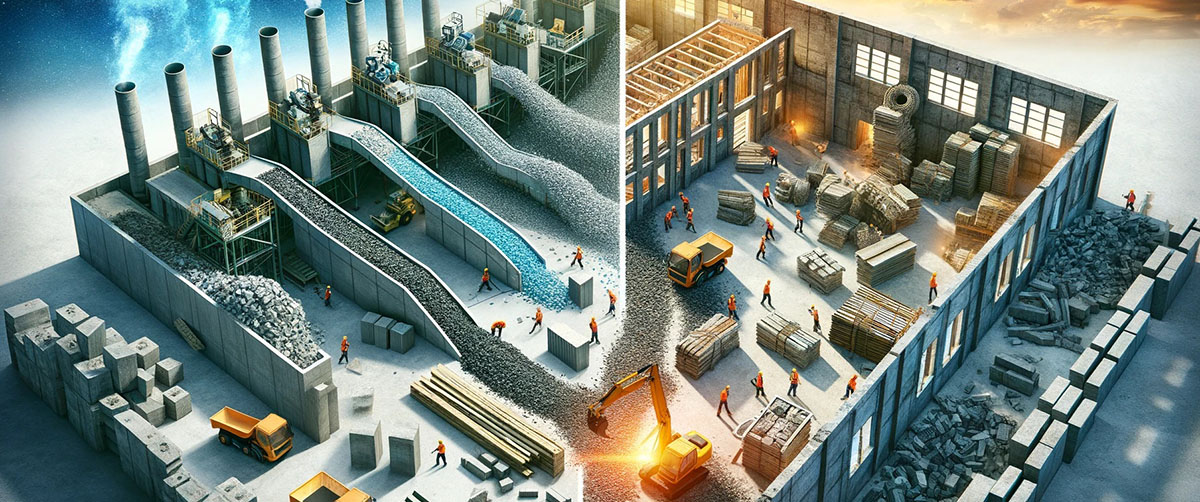
Waste hierarchy and the conceptual framework of the debate
The EU Waste Framework Directive (2008/98/EC, revised in 2018) establishes a 5-level hierarchy: prevention, preparation for reuse, recycling, energy recovery, and disposal. This hierarchy reflects a thermodynamic principle: each additional processing step consumes energy and generates emissions. Reusing a building element — a steel beam, a solid brick, a timber door — preserves virtually all of the original embodied energy, estimated at 5-15 GJ/tonne for structural steel, 1.5-3 GJ/tonne for bricks, and 8-12 GJ/m³ for sawn timber (Hammond and Jones, 2011). Recycling, by contrast, requires crushing, melting, reprocessing, or chemical transformation that consumes between 10% and 70% of the primary production energy depending on the material. The EU generated 374 million tonnes of construction and demolition waste (CDW) in 2020, accounting for 37.5% of the Union's total waste (Eurostat, 2023). The material recovery rate reached 89%, but 85% of that figure corresponds to low-value backfill and recycled aggregates, while direct component reuse accounts for only 1-3% of the total.
The conceptual difference between reuse and recycling lies in the preservation of original function. An IPE 300 steel profile extracted from a demolished building and reinstalled as a beam in another building is reuse: it retains its shape, mechanical properties (yield strength 275-355 MPa), and structural function. That same profile melted in an electric arc furnace at 1,600°C to produce new steel is recycling: the material is recovered but the product is destroyed. Steel recycling consumes 8-12 GJ/tonne (electric arc furnace with 100% scrap), compared to 20-25 GJ/tonne for primary production from iron ore in a blast furnace (World Steel Association, 2022). Reusing the same profile consumes only 0.5-1.5 GJ/tonne for dismantling, transport, cleaning, and inspection. The relationship is clear: reuse saves 85-95% of production energy, while recycling saves 50-65%. This difference translates directly into CO₂ emissions: reusing one tonne of structural steel avoids 1.4-1.8 tCO₂, while recycling it avoids 0.7-1.0 tCO₂ compared to primary production (SteelConstruction.info, 2023).
Environmental impact comparison by material type
Concrete constitutes 60-70% by weight of CDW and presents the greatest asymmetry between reuse and recycling. Conventional concrete recycling — crushing to 0-40 mm to obtain recycled aggregate — saves 30-40% of emissions compared to natural quarry aggregate, but the resulting aggregate has a water absorption of 5-12% (versus 0.5-2% for natural aggregate), which limits its use in structural concrete to 20-30% replacement according to the Spanish EHE-08. Reusing precast concrete elements (hollow-core slabs, prestressed beams, columns) preserves the original strength (30-50 MPa) and avoids 80-90% of new concrete emissions (200-350 kgCO₂/m³). The Rebirth project (Denmark, 2020) demonstrated the feasibility of reusing hollow-core floor slabs that were 30 years old: load tests confirmed 95% of the original load-bearing capacity, and the intervention reduced emissions by 88% compared to new slabs. Solid clay bricks are another material with high reuse potential: the company Gamle Mursten (Denmark) has processed more than 8 million recovered bricks since 2011, with an 85% recovery rate and a 96% emissions reduction compared to new bricks.
Structural timber presents a particular case. Direct reuse of solid timber beams from demolition is feasible if the residual cross-section (after removing areas damaged by wood-boring insects or rot) retains at least 80% of the original section and the mechanical properties are verified through non-destructive testing (ultrasound velocity ≥ 4,500 m/s for softwoods, resistograph). Recycled wood is classified into 4 grades according to EN 15347: grades A and B (untreated) can be converted into particleboard or pellets, avoiding 0.5-0.8 tCO₂/tonne of wood compared to incineration; grades C and D (treated with CCA, creosote) require controlled incineration at authorized facilities. Aluminum presents the greatest relative advantage for recycling: remelting consumes only 5% of primary production energy (0.8 GJ/t versus 170 GJ/t through electrolysis), but reusing aluminum window frames, when dimensions match, avoids even that 0.8 GJ/t and preserves the anodized or powder-coated finish valued at 15-25 EUR/m². Recycled flat glass reduces the melting temperature from 1,500°C to 1,300°C (energy savings of 25-30%), but contamination from PVB interlayers in laminated glass limits closed-loop recycling to monolithic float glass.
Practical barriers and emerging solutions
Construction material reuse faces 4 main barriers. The first is information: 95% of existing buildings lack documentation on the composition, age, and properties of their materials (Adams et al., 2017). Material passports and material databanks (such as Madaster, operational in the Netherlands, Belgium, Germany, and Switzerland with 12,000+ buildings registered since 2017) address this barrier for new buildings, but the vast majority of the existing building stock remains uninventoried. The second is certification: recovered elements must demonstrate compliance with current standards (Eurocodes, CE marking), requiring tests that can cost 500-2,000 EUR/element for structural components, making reuse 15-30% more expensive than recycling when volumes are small. The third barrier is logistics: stockpiling, sorting, and storing recovered elements requires areas of 2,000-5,000 m² and a reverse supply chain that few sector operators have mastered.
The fourth barrier is economic: selective demolition — necessary to recover reusable materials — costs 30% to 100% more than conventional demolition with heavy machinery, although revenue from material sales can offset 40-70% of the additional cost (Addis, 2006). Emerging solutions include: digital platforms for buying and selling recovered materials (Opalis in Belgium, Mobius in France, Restado in the Netherlands), which connect supply and demand and reduce transaction costs by 20-40%; design for disassembly (DfD), which, when incorporated from the design phase, reduces future material separation costs by 50-70%; and tax incentives, such as the reduction of VAT to 6% for reused materials in Belgium (versus the 21% standard rate). The EU green taxonomy (Regulation 2020/852) already includes the circular economy as one of its 6 environmental objectives, linking sustainable finance to the reuse and recycling of construction materials.
Decision criteria: when to reuse and when to recycle
The choice between reuse and recycling depends on 5 factors that can be evaluated on a case-by-case basis: material condition, dimensional and regulatory compatibility, transport distance, available volume, and cost compared to new material. As a general rule based on LCA data, reuse is preferable whenever the element retains at least 70-80% of its original performance and the transport distance does not exceed 100-150 km (beyond that distance, transport emissions can cancel out the environmental advantage of reuse over local recycling). For structural steel, reuse is feasible when corrosion affects less than 10% of the cross-section, weldability is confirmed through carbon equivalent testing (CEV ≤ 0.45%), and dimensions match within tolerances of ±5 mm. For bricks, residual compressive strength must exceed 10 MPa and water absorption must not exceed 15%. For timber, visual grading according to UNE-EN 14081 must confirm strength class C18 or higher.
The answer to whether reusing or recycling materials is more sustainable is nuanced but evidence-based: reuse is environmentally superior for most materials and situations, with emissions savings of 70-95% versus 20-60% for recycling. Recycling is preferable when the material is contaminated, degraded beyond functional thresholds, or available in quantities too small to justify the logistics of reuse. The optimal strategy at building scale combines both approaches: a study by Arup and the Ellen MacArthur Foundation (2020) on 4 pilot projects in circular economy construction found that the combination of reuse (15-25% of total material weight) and high-value recycling (40-55%) reduces the carbon footprint of materials by 50-70% and material costs by 10-20% compared to purchasing exclusively new materials. The European Union has required since 2024 that CDW management plans prioritize preparation for reuse, and the revised target for 2030 raises the CDW reuse and recycling rate to 70% by weight (Directive 2018/851), with specific reuse indicators that will require both practices to be quantified separately.
References
- [1]Inventory of Carbon and Energy (ICE) Version 2.0University of Bath, Sustainable Energy Research Team (SERT).
- [2]Steel Statistical Yearbook 2022World Steel Association.
- [3]Building with Reclaimed Components and Materials: A Design Handbook for Reuse and RecyclingEarthscan. ISBN: 978-1-84407-274-6
- [4]Circular Economy in Construction: Current Awareness, Challenges and EnablersProceedings of the Institution of Civil Engineers — Waste and Resource Management, 170(1), 15-24.
- [5]Realising the Value of Circular Economy in Real EstateEllen MacArthur Foundation.

Comments 0
No comments yet. Be the first!
Leave a comment