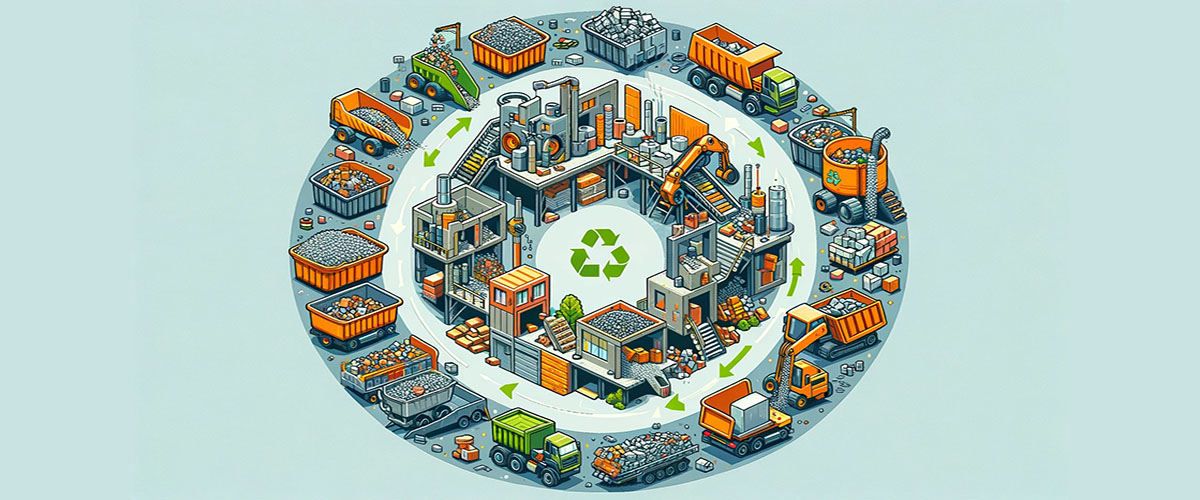
Scale of the problem: construction and demolition waste
The fundamentals of construction material recycling start from a quantifiable reality: the construction sector generates approximately 374 million tonnes of construction and demolition waste (CDW) per year in the EU-27 (Eurostat, 2020), representing 35% of total solid waste generated. In Spain, CDW production is estimated at 40-45 million tonnes annually, of which only 40% is recycled or reused (PEMAR 2016-2022), versus the 70% target set by the Waste Framework Directive 2008/98/EC for 2020.
Typical CDW composition in Spain is: concrete and ceramic materials (75%), wood (4-5%), metals (2-3%), plastics (1-2%), glass (0.5-1%), gypsum (3-5%), and other (10-15%). Each fraction has a specific recycling pathway with differentiated recovery rates and markets. CDW landfill costs in Spain range from EUR 15 to 45/tonne depending on the autonomous community, while treatment and recycling costs are around EUR 8-20/tonne, making recycling economically viable even without considering environmental benefits.
Concrete recycling: recycled aggregate
Concrete is the most consumed construction material on the planet (4.4 billion tonnes/year of cement production, USGS 2023) and the most abundant CDW. Concrete recycling produces recycled aggregate through crushing, screening, and impurity separation. Standard EN 12620 classifies recycled aggregates and permits their use in structural concrete with limitations: Spain's EHE-08 Structural Concrete Code allows up to 20% substitution of natural coarse aggregate with recycled in concrete with strength ≤ 40 MPa.
Environmental savings are significant: one tonne of recycled aggregate avoids extraction of 1 tonne of natural gravel, saves 1.3 kg CO₂ through reduced transport (local source vs. quarry), and diverts 1 tonne from landfill. Projects like the London Olympic Park (2012) used 5 million tonnes of recycled concrete from prior demolitions, achieving 98.5% landfill diversion.
Metal recycling: steel and aluminum
Metals are the construction materials with the highest recycling rate: steel achieves 85-90% global recycling rate (World Steel Association, 2022) and aluminum 75-80%. Steel is recycled indefinitely without loss of mechanical properties through electric arc furnace (EAF), which consumes 74% less energy and emits 58% less CO₂ than primary production via blast furnace (BF-BOF route).
Recycled aluminum saves 95% of the energy needed to produce it from bauxite (from 170 MJ/kg to 8 MJ/kg). In construction, aluminum fenestration, facade cladding, and auxiliary structure are sources of high-purity, easily recyclable aluminum. The Bureau of International Recycling (BIR) estimates that 75% of all aluminum produced since 1888 remains in active use thanks to its recyclability.
Wood and organic material recycling
Recovered construction wood has three main destinations in order of environmental preference: direct reuse (beams, planks, flooring), transformation into derivative products (particleboard, OSB with recycled content), and energy recovery (biomass). Direct reuse is the lowest carbon footprint option, as the wood continues storing CO₂ captured during growth (approximately 0.9 t CO₂/m³ of solid wood).
Standard EN 14081 allows strength grading of reused wood, and several European companies (SalvoWEB, Rotor Deconstruction) operate markets for recovered structural timber with certified mechanical properties. CCA (copper-chromium-arsenic) preservative treatment, common in pre-2004 exterior wood, prevents recycling as board or biomass and requires hazardous waste management per REACH Regulation.
Ceramic materials, glass, and gypsum
Ceramic bricks and tiles are recycled as aggregate for fills, road sub-bases, and drainage, with recycling rates of 70-80% in countries like the Netherlands and Belgium. Quality solid bricks can be cleaned and directly reused: a reused brick saves approximately 0.5 kg CO₂ versus a new one (WRAP, 2010).
Construction flat glass is recycled as cullet (raw material for new flat glass) with 25% energy savings per 10% cullet added to the furnace. The main obstacle is separation of laminated glass (PVB) and coated glass, requiring specific processes. Gypsum is 100% recyclable without property loss: plasterboard is crushed, paper separated (for composting), and calcium sulfate reused as raw material. Knauf and Placo operate gypsum recycling plants with capacities of 30,000-60,000 t/year in Europe.
Regulatory framework and trends
The Waste Framework Directive (2008/98/EC, amended by 2018/851) establishes the waste hierarchy (prevention > reuse > recycling > energy recovery > disposal) and the 70% CDW recovery target. In Spain, Royal Decree 105/2008 regulates CDW production and management, requiring a waste management plan for all works with budgets exceeding EUR 50,000. The new Royal Decree 7/2022 (Waste and Contaminated Soil Law for a Circular Economy) strengthens these requirements with source-separation obligations by fraction.
The trend toward material passports (such as the Madaster platform, operational in the Netherlands, Germany, and Switzerland) allows registering the composition, location, and residual value of each material incorporated into a building, facilitating recovery at end of life. The urban mining concept considers the building stock as a material bank whose recovery value can exceed EUR 300/m² in buildings with steel structure and aluminum fenestration.
References
- [1]Waste statistics: Construction and demolition wasteEuropean Commission.
- [2]Steel Statistical Yearbook and Sustainability IndicatorsWorld Steel Association.
- [3]Real Decreto 105/2008: Regulation of CDW production and managementBOE.
- [4]Directive (EU) 2018/851 amending Directive 2008/98/EC on wasteOfficial Journal of the EU.
- [5]Reclaimed building products guideWRAP UK.

Comments 0
No comments yet. Be the first!
Leave a comment