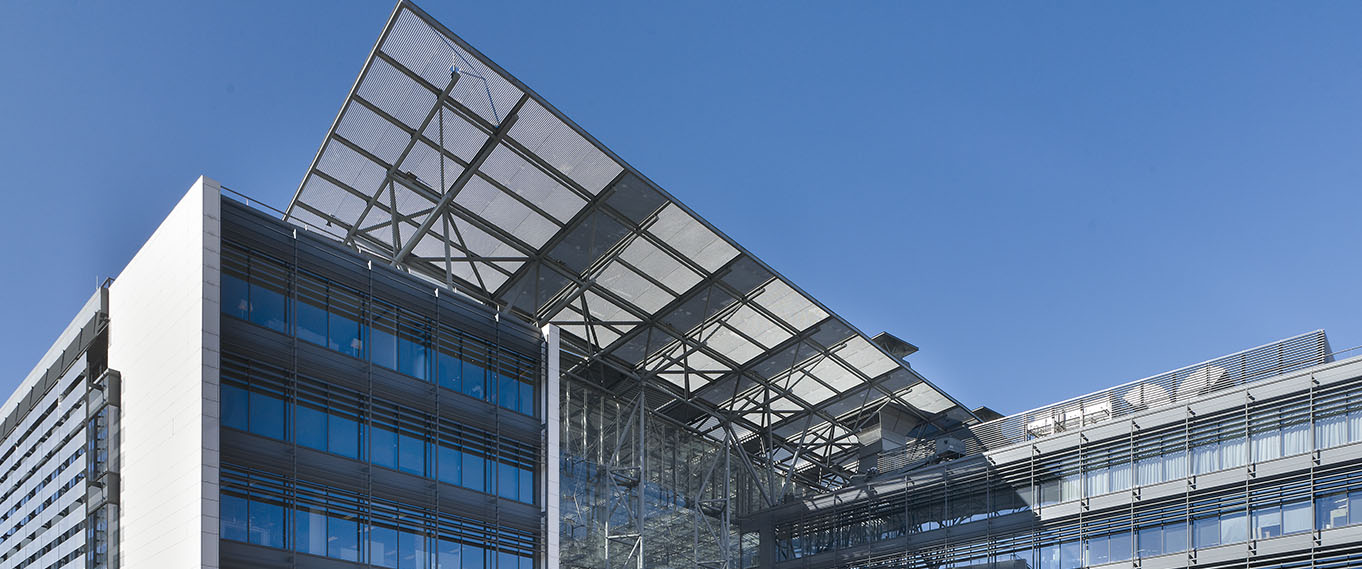
Energy retrofit of the Empire State Building
The energy retrofit of the Empire State Building (New York, 1931, 204,385 m² of floor area across 102 storeys) stands as the global benchmark for energy efficiency applied to large-scale existing buildings. The project, executed between 2009 and 2013 at a cost of 31 million USD (within a total renovation budget of 550 million USD), was led by Johnson Controls, Rocky Mountain Institute (RMI), and Jones Lang LaSalle (JLL). The measures implemented included: on-site renovation of the 6,514 windows (removal, insertion of reflective film, argon gas fill, and reinstallation, at a cost of 700 USD/window versus 3,000 USD/window for full replacement), upgrading of the 6,500 radiators with reflective barriers and air exchangers, and reconfiguration of the 302 air handling units (AHUs) with variable frequency drives and heat recovery units with 75% efficiency.
The verified results surpassed the energy model projections. Annual consumption was reduced by 38% (from 336,000 MWh/year to 208,000 MWh/year), with savings of 4.4 million USD/year in energy costs. The energy use intensity (EUI) dropped from 218 kBTU/ft²·year to 135 kBTU/ft²·year (473 to 293 kWh/m²·year). CO₂ emissions were reduced by 40,000 tCO₂/year. The payback period for the efficiency investment was 3.1 years, compared to the 4.2 years initially estimated, because actual savings exceeded model projections by 15%. This project demonstrated that a 93-year-old building can achieve energy performance comparable to new construction, and that deep retrofitting generates attractive financial returns even without public incentives. The RMI published the complete project data as an open case study, generating more than 2,000 downloads in the first year and serving as a model for similar retrofits in 15 countries.
Heidelberg's Bahnstadt: a complete Passivhaus district
The Bahnstadt district in Heidelberg (Germany, 116 hectares on converted railway land, developed 2009-2022) constitutes the largest urban complex built entirely to the Passivhaus standard worldwide. With more than 5,000 dwellings, 7,000 planned residents, and 185,000 m² of office, laboratory, and commercial space, all buildings meet the heating demand criterion of ≤ 15 kWh/m²·year, certified by the Passivhaus Institut in Darmstadt. The typical residential building envelope features: ETICS insulation of 300 mm graphite EPS (conductivity 0.032 W/m·K), wall transmittance U = 0.10-0.12 W/m²·K, triple-glazed windows with insulated frames (Uw ≤ 0.80 W/m²·K), air permeability n₅₀ ≤ 0.6 ach verified by Blower Door test, and mechanical ventilation with heat recovery at an efficiency of ≥ 85%.
The Bahnstadt district heating network supplies space heating and domestic hot water through a biomass cogeneration system (local woodchip) supplemented with natural gas for peak demand. The energy cost per dwelling stands at 200-350 EUR/year for heating, compared to 800-1,500 EUR/year in equivalent conventional dwellings in Germany. The construction cost premium for the Passivhaus standard was estimated at 5-8% above the material execution budget, amortised within 8-12 years through energy savings. Post-occupancy monitoring of 18 buildings conducted by the University of Heidelberg (2018) confirmed that 85% of the buildings meet the target demand of 15 kWh/m²·year in actual operation, and the remaining 15% show deviations of only 2-5 kWh/m²·year, attributable to occupant behaviour (ventilation through window opening). This project demonstrates that the Passivhaus standard is scalable to urban scale using commercially available technologies.
Net zero energy buildings: Bullitt Center and Pixel Building
Net zero energy buildings (NZEBs) produce as much or more renewable energy as they consume annually. The Bullitt Center (Seattle, 2013, 4,830 m²) operates with an EUI of 86 MJ/m²·year (24 kWh/m²·year), 83% lower than the average for Seattle offices (140 kWh/m²·year). Photovoltaic generation of 230,000 kWh/year from 575 panels rated at 318 W on a 980 m² canopy exceeds annual consumption by 60%. Efficiency measures include: LED lighting with daylight controls (lighting power density: 4.8 W/m², compared to 10.8 W/m² per ASHRAE 90.1), stairs as the primary circulation (lifts account for only 4% of vertical trips), and natural ventilation assisted by automated operable windows covering 82% of annual occupied hours. The construction cost was 355 USD/ft² (3,820 USD/m²), 20% higher than a standard Seattle office building, with a payback period for the sustainability premium of 12 years.
The Pixel Building (Melbourne, 2010, Studio505 Architects, 1,130 m²) was the first carbon-neutral office building in Australia, achieving the maximum score of 105 points under Australia's Green Star system (out of a theoretical maximum of 100+). The facade incorporates photovoltaic panels (28 kW peak capacity) and coloured glass panels at variable angles that optimise solar capture according to orientation. The water management system collects 100% of rainwater and greywater, treating it through a membrane bioreactor (MBR) that produces reusable water with quality below 5 NTU and 0 CFU/100 ml of E. coli. A 5 kW vertical axis wind turbine on the roof contributes 8% of total electricity generation. Operational energy consumption is 48 kWh/m²·year, fully offset by on-site renewable generation. These successful projects demonstrate that net zero energy is achievable with mature technologies, both in temperate-rainy climates (Seattle, 952 mm/year precipitation, 1,510 hours of sunshine annually) and in warm-dry climates (Melbourne, 603 mm/year, 2,363 hours of sunshine).
Common lessons and success factors
Cross-cutting analysis of successful energy efficiency projects reveals five replicable success factors. The first is energy simulation from the concept phase: all four referenced projects used dynamic energy modelling (EnergyPlus, IES-VE, or DesignBuilder) with at least 10 design iterations before fixing the final geometry. The second is prioritising passive strategies over active ones: insulation, orientation, compactness, solar protection, and natural ventilation reduce demand before mechanical systems intervene. In the Bahnstadt, passive measures account for 75% of the demand reduction; mechanical systems (heat recovery, heat pumps) contribute the remaining 25%. The third factor is rigorous commissioning: commissioned start-up of MEP systems, with functional verification of each component and adjustment of control parameters, improves actual performance by 10-20% over uncommissioned performance (Mills, 2011).
The fourth factor is continuous monitoring and verification: all four projects incorporate building energy management systems (BEMS/BMS) with sub-metering by floor, zone, or end use, enabling deviation identification and real-time correction. The IPMVP (International Performance Measurement and Verification Protocol) provides four verification options (A: spot measurement; B: continuous measurement; C: calibrated bills; D: calibrated simulation) that document savings with controlled uncertainty (< ±10% for option B). The fifth factor is transparent communication of results: publishing actual operational data (not just projections) builds credibility and enables replication. The New Buildings Institute (NBI) Getting to Zero programme records more than 700 verified or in-design net zero energy buildings in the USA (2023), with publicly accessible data on EUI, renewable generation, and costs. Successful energy efficiency projects share the discipline of measuring, verifying, and disseminating, transforming each building into a replicable laboratory.
References
- [1]Empire State Building Case Study: Cost-Effective Greenhouse Gas Reductions via Whole-Building RetrofitsRMI.
- [2]Bahnstadt Heidelberg: Monitoring Results of the World's Largest Passive House SettlementPassivhaus Institut, Darmstadt.
- [3]Living Building Challenge 4.0: A Visionary Path to a Regenerative FutureILFI.
- [4]Building Commissioning: A Golden Opportunity for Reducing Energy Costs and Greenhouse Gas Emissions in the United StatesEnergy Efficiency, 4(2), 145-173.
- [5]2023 Getting to Zero Status Update and List of Zero Energy BuildingsNBI.
Comments 0
No comments yet. Be the first!
Leave a comment