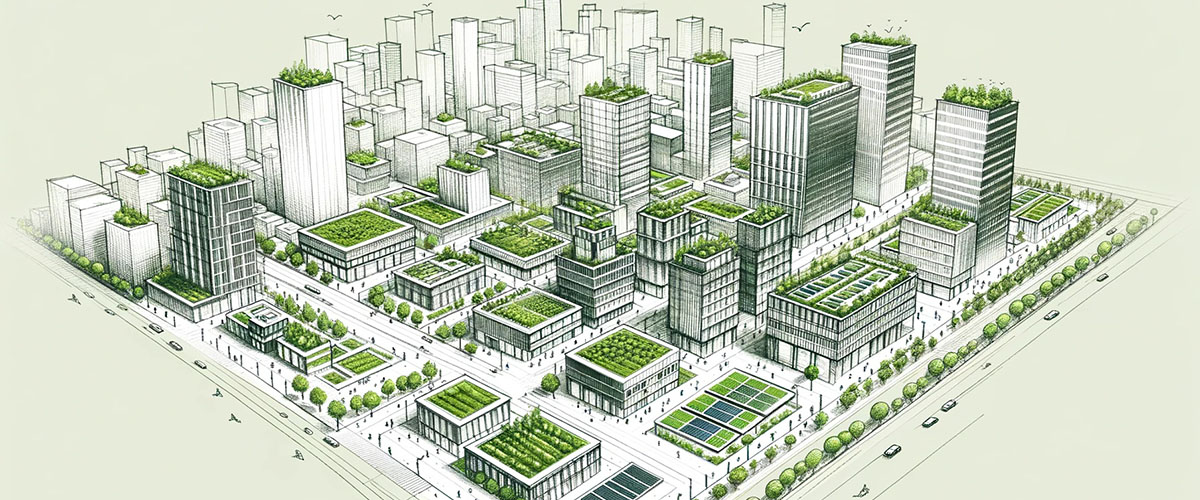
LEED for Cities v4.1: framework and Arc platform metrics
LEED Cities: sustainable urbanism in action extends the LEED framework beyond individual buildings to the scale of entire municipalities and districts. LEED for Cities v4.1, administered by GBCI since 2016, evaluates urban performance across five categories — Energy, Water, Waste, Transportation, and Human Experience — using real operational data rather than design projections. The Arc performance platform serves as the data backbone, ingesting utility records, transit ridership counts, waste-diversion reports, air-quality readings, and resident-satisfaction surveys to generate a composite score on a 0-to-100 scale for each category. As of 2024, 135 cities and communities in 42 countries have enrolled or achieved certification.
The data-driven approach distinguishes LEED for Cities from prescriptive urban-planning tools. Rather than mandating specific interventions — a particular modal split or a renewable-energy percentage — the framework rewards measurable outcomes benchmarked against peer cities of comparable size, climate, and economic profile. This outcome orientation allows cities to pursue locally appropriate strategies while maintaining global comparability. Annual recertification through Arc ensures that performance is sustained over time, addressing the common criticism that one-time certifications do not guarantee ongoing operational excellence. The platform's open API also enables integration with municipal smart-city dashboards, allowing elected officials and citizens to track sustainability metrics alongside conventional indicators such as GDP growth and unemployment rates.
Washington D.C.: the first LEED Platinum city
Washington D.C. became the first city worldwide to achieve LEED Platinum certification in 2017, earning an Arc score of 85 out of 100 across all five categories. The District's sustainability performance rests on decades of policy investment: a 32% reduction in greenhouse-gas emissions below 2006 levels (achieved by 2020), 38% tree-canopy coverage maintained through an urban-forestry programme that plants 8,600 trees annually, and a 37% public-transport modal share anchored by the Metro system's 98 stations and 188 km of rail. The Clean Energy DC Omnibus Act (2018) set a legally binding 100% renewable-electricity target for 2032, backed by a building-performance standard that requires all large commercial buildings to reduce energy use intensity by 20% by 2027.
The Clean Rivers Project, a 2.7-billion-USD combined-sewer-overflow programme, addresses the water category through construction of three deep tunnels (7.0 m diameter, 37 km combined length) that will capture 96% of combined-sewer overflows by 2030, preventing 6.8 billion litres of polluted discharge into the Anacostia and Potomac rivers annually. Waste diversion reached 47% in 2023, supported by a pay-as-you-throw pilot and a commercial-organics collection mandate for food-service establishments above 2 tonnes per week. The Human Experience score incorporates walkability indices, park-access metrics (98% of residents live within a 10-minute walk of a park), and health-outcome data. Washington's experience demonstrates that LEED Platinum at the city scale requires coordinated action across energy, infrastructure, land use, and public health — not merely the aggregation of green buildings.
Songdo International Business District: planned sustainability and its limits
Songdo, a 600-hectare purpose-built district on reclaimed land in Incheon, South Korea, was conceived from inception as a model smart-sustainable city. Designed for 65,000 residents and 300,000 workers, its master plan allocates 40% of total area to green space, including a 40-hectare central park modelled on New York's Central Park. Technical infrastructure includes a pneumatic waste-collection system — underground vacuum pipes transport waste from building chutes to a central processing facility, achieving a 76% recycling rate and eliminating truck-based collection within the district — and a district-cooling network with seawater-source heat pumps operating at a coefficient of performance (COP) of 4.5-5.5.
Songdo's limitations are equally instructive. Despite advanced infrastructure, the district's transportation modal split remains approximately 60% private car, reflecting the suburban-density morphology (floor-area ratio 2.0-3.0) and limited rail connectivity at the time of initial occupancy. Resident satisfaction surveys report high marks for air quality and green space but lower scores for community vitality and retail diversity, symptoms of phased development and a population that has grown more slowly than projected. These outcomes highlight a structural tension in greenfield smart-city projects: technology can optimise systems, but urban vitality depends on density thresholds, mixed use, and organic social infrastructure that cannot be engineered top-down. For LEED Cities, Songdo illustrates the importance of the Human Experience category in capturing livability dimensions that energy and water metrics alone cannot represent.
European cases: Portland, Stockholm, Madrid, and Barcelona
European cities offer diverse models of LEED and LEED-adjacent sustainable urbanism. Portland, Oregon, while not European, is the benchmark American reference: its mandatory LEED Gold requirement for all publicly funded buildings has driven market transformation since 2005, and its urban-growth boundary limits sprawl while sustaining transit-oriented density. Stockholm targets 1.5 tonnes of CO₂ per capita by 2040, down from 2.2 in 2020, through district heating supplied 80% by biomass and waste incineration, a congestion charge that reduced central-area car traffic by 20%, and the Royal Seaport eco-district designed to net-zero operational carbon for 12,000 dwellings.
In Spain, Madrid Nuevo Norte — a 5.6-million-m² urban-regeneration project around Chamartín station — pursues LEED for Neighbourhood Development (LEED-ND) certification, integrating 10,500 housing units, 400,000 m² of office space, and a 200-hectare linear park atop buried railway infrastructure. Barcelona's Superilles (Superblocks) programme, which reconfigures standard city blocks to restrict through-traffic and reclaim road space for pedestrians and greenery, has documented a 25% reduction in motorised traffic within completed superblocks and measurable improvements in NO₂ concentrations. At the continental scale, the EU Mission for 100 Climate-Neutral and Smart Cities by 2030 has selected 112 cities — including 7 Spanish municipalities (Madrid, Barcelona, Valencia, Seville, Valladolid, Vitoria-Gasteiz, and Zaragoza) — to serve as innovation hubs for urban decarbonisation, creating a policy ecosystem that complements voluntary certification with binding climate-investment plans.
Net-zero urban benchmarks and the path to 2030
Defining quantitative benchmarks for sustainable cities requires convergence across multiple performance dimensions. Leading frameworks — LEED for Cities, the Covenant of Mayors, C40's Deadline 2020 programme, and the EU Mission — coalesce around approximate thresholds: per-capita greenhouse-gas emissions below 5 tonnes CO₂eq, building energy-use intensity below 80 kWh/m²/year for the existing stock, domestic water consumption below 120 litres per capita per day, municipal solid-waste recycling above 50%, and renewable-energy penetration above 40% of final consumption. The Covenant of Mayors, signed by over 11,000 European local authorities, commits signatories to a 55% GHG reduction by 2030 relative to their baseline year.
Achieving these benchmarks demands integrated investment across building retrofit, renewable-energy deployment, electrified public transport, circular-economy waste infrastructure, and nature-based solutions for stormwater and heat management. Cost estimates from the European Investment Bank place the required annual urban-climate investment at 150-200 billion EUR across the EU-27, or approximately 350-450 EUR per urban resident per year. Certification frameworks such as LEED for Cities provide the measurement, reporting, and verification layer that translates political commitments into auditable performance trajectories. For municipal leaders, the value lies not in the plaque but in the data infrastructure: Arc's continuous monitoring converts sustainability from an aspiration stated in master plans into an operational discipline embedded in monthly management reviews, budget allocations, and procurement specifications.
References
- [1]LEED for Cities and Communities Rating SystemU.S. Green Building Council.
- [2]Clean Energy DC Omnibus Act and Sustainable DC 2.0 PlanGovernment of the District of Columbia.
- [3]EU Mission: 100 Climate-Neutral and Smart Cities by 2030European Commission.
- [4]Superilles — Programa de SupermanzanasAjuntament de Barcelona.
- [5]LEED in Motion: Cities and CommunitiesU.S. Green Building Council.
Comments 0
No comments yet. Be the first!
Leave a comment