The origin: the Brundtland Report (1987)
The most widely cited definition of sustainable development comes from the report Our Common Future, published in 1987 by the United Nations World Commission on Environment and Development, chaired by Gro Harlem Brundtland. The report defines sustainable development as that which "meets the needs of the present without compromising the ability of future generations to meet their own needs". Although generic, this definition established two key concepts: the concept of needs (particularly those of the world's poorest) and the idea of limitations imposed by the state of technology and social organization on the environment's capacity to meet present and future needs.
The Brundtland Report did not specifically address construction, but it laid the groundwork upon which all subsequent sectoral definitions were built. Its direct influence can be seen in the Rio Summit (1992), Agenda 21, and more recently, in the Sustainable Development Goals (SDGs) of the 2030 Agenda.
The figures underscore the urgency of this definition applied to construction: according to the UNEP/GlobalABC Global Status Report 2022, the building sector accounts for 37% of global energy-related CO₂ emissions and 36% of total final energy consumption worldwide. Cement production alone generates approximately 8% of global CO₂ emissions (around 2.8 billion tonnes annually). These figures make sustainable construction not an option but a structural necessity to meet the Paris Agreement target of limiting global warming to 1.5°C.
The Triple Bottom Line: Elkington (1997)
John Elkington, in Cannibals with Forks: The Triple Bottom Line of 21st Century Business (Capstone, 1997; ISBN 978-1900961271), formulated the concept of the Triple Bottom Line (TBL): the idea that sustainability cannot be measured solely in economic terms but must simultaneously integrate three dimensions —economic, social, and environmental— which he called profit, people, planet.
Applied to construction, the TBL means that a sustainable building is not merely one that consumes little energy (environmental dimension), but also one that is economically viable throughout its life cycle (economic dimension) and one that contributes positively to the well-being of its occupants and the community (social dimension). This tripartite framework has become the conceptual skeleton of most certification systems: LEED, BREEAM, and DGNB evaluate, with different weightings, these three dimensions.
Sustainable construction according to Kibert (1994-2022)
Charles J. Kibert coined the term sustainable construction at the First International Conference on Sustainable Construction held in Tampa, Florida, in November 1994. In his work Sustainable Construction: Green Building Design and Delivery (Wiley; 5th edition, 2022; ISBN 978-1119706458), he defines sustainable construction as "the creation and responsible management of a healthy built environment based on resource efficiency and ecological principles".
Kibert identifies six fundamental principles: (1) minimize resource consumption, (2) maximize resource reuse, (3) use renewable and recyclable resources, (4) protect the natural environment, (5) create a healthy and non-toxic environment, and (6) pursue quality in the built environment. These principles operate across five base resources: land, materials, water, energy, and ecosystems.
Quantifying these principles is key. According to International Energy Agency (IEA) data, improving the energy efficiency of existing buildings could reduce sector emissions by 40% by 2040. In the materials dimension, cross-laminated timber (CLT) stores approximately 0.8 tonnes of CO₂ per cubic meter, compared to the 0.4 tonnes emitted by conventional concrete per cubic meter of equivalent structure. These data illustrate how Kibert's principles translate into project decisions with measurable impact.
The autonomous building: Vale and Vale (1991)
Brenda and Robert Vale, in Green Architecture: Design for a Sustainable Future (Thames & Hudson, 1991; ISBN 978-0500341179), proposed a vision of green architecture centered on building self-sufficiency. Their approach is based on the capacity of buildings to minimize their dependence on external infrastructure through the use of renewable energy, rainwater harvesting, local waste treatment, and low-impact material selection.
The Vales argue that material selection, construction processes, response to landscape and climate, building services management, and user participation are the five key areas where green architecture materializes. Their approach, pioneering in 1991, anticipated concepts that are now central to standards such as Passivhaus and Living Building Challenge.
Standardization: ISO 15392 and the European framework
ISO 15392:2019 (Sustainability in buildings and civil engineering works — General principles) represents the international consensus on what sustainability in building means. It defines sustainability as the contribution of construction works to sustainable development, considering their complete life cycle from inception to end of life.
The standard establishes nine general principles: continual improvement, equity, global thinking and local action, holistic approach, involvement of interested parties, long-term consideration and resilience, responsibility, risk management, and transparency. This framework is complemented by ISO 21931 (framework for methods of assessment of environmental performance), EN 15978 (assessment of environmental performance of buildings), and EN 15643 (general framework for assessment of buildings sustainability).
Operational definitions: certification systems
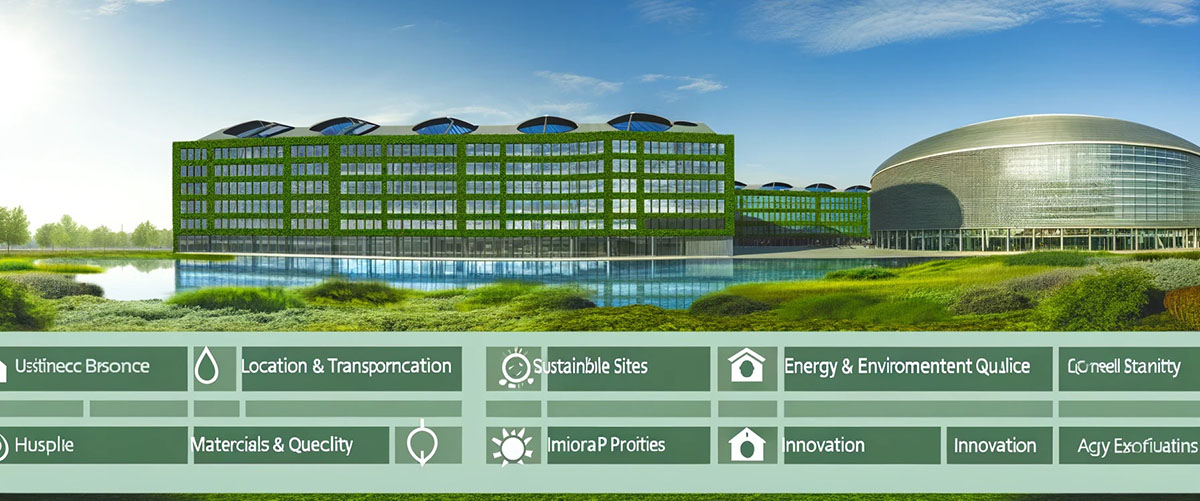
Each certification system implies an operational definition of sustainability. LEED (Leadership in Energy and Environmental Design) defines it through credits in seven categories: integrative process, location and transportation, sustainable sites, water efficiency, energy and atmosphere, materials and resources, and indoor environmental quality. BREEAM (Building Research Establishment Environmental Assessment Method), the oldest system (1990), evaluates ten categories: management, health and wellbeing, energy, transport, water, materials, waste, land use and ecology, pollution, and innovation.
The German DGNB (Deutsche Gesellschaft fur Nachhaltiges Bauen) system probably best reflects Elkington's TBL, assigning balanced weights to environmental, economic, sociocultural and functional, technical, and process dimensions. Unlike LEED and BREEAM, DGNB explicitly evaluates life cycle cost and the building's adaptability to future changes of use.
In numbers, by the end of 2023 there were more than 180,000 LEED-registered projects across 185 countries, totaling over 2.6 billion square meters. BREEAM had certified more than 600,000 buildings in 90 countries. The DGNB system had over 9,000 certified projects. These figures demonstrate that operational definitions of sustainability are not theoretical: they are applied at global scale with verifiable metrics.
Synthesis: an integrative definition
Analyzing the above definitions, sustainable construction can be defined as the practice of designing, building, operating, and decommissioning buildings so that: (1) they do not consume more resources than natural systems can regenerate, (2) they do not generate more waste and emissions than natural systems can absorb, (3) they are economically viable throughout their complete life cycle, and (4) they contribute to the physical, psychological, and social well-being of their occupants and communities.
This integrative definition captures Brundtland's intergenerational dimension, Elkington's three dimensions, Kibert's operational principles, the Vales' autonomy concept, and ISO 15392's life-cycle approach. It is not a static concept: it evolves with science, technology, and regulation, as demonstrated by the recent incorporation of climate resilience criteria, circular economy principles, and whole life-cycle carbon metrics.
Comparative table of definitions
References
- [1]Our Common Future (Brundtland Report)Oxford University Press. ISBN: 978-0192820808
- [2]Cannibals with Forks: The Triple Bottom Line of 21st Century BusinessCapstone, Oxford. ISBN: 978-1900961271
- [3]Sustainable Construction: Green Building Design and Delivery (5th ed.)Wiley. ISBN: 978-1119706458
- [4]Green Architecture: Design for a Sustainable FutureThames & Hudson, London. ISBN: 978-0500341179
- [5]ISO 15392:2019 Sustainability in buildings and civil engineering works — General principlesInternational Organization for Standardization.
- [6]EN 15643 Sustainability of construction works — Framework for assessment of buildingsEuropean Committee for Standardization.

Comments 0
No comments yet. Be the first!
Leave a comment