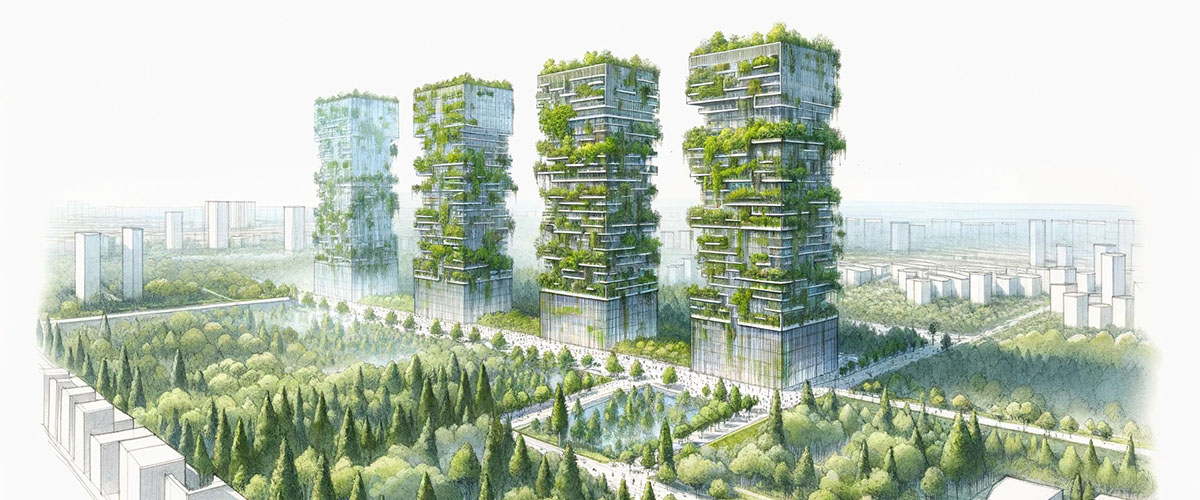
Urban nature deficit and its quantified consequences
75% of the European population lives in urban areas (Eurostat, 2023), a proportion that will reach 84% by 2050. However, European cities have an average green space coverage of 38%, with extreme disparities: Oslo reaches 68%, London 47%, Madrid 35%, and Athens barely 15% (European Environment Agency, 2022). The WHO recommends a minimum of 9 m2 of accessible green space per inhabitant within 300 m of the home, but 40% of European cities with more than 100,000 inhabitants do not meet this criterion. The deficit has measurable health consequences: a systematic review of 143 studies published in The Lancet Planetary Health (Rojas-Rueda et al., 2019) estimated that living within 300 m of a green space reduces premature mortality by an average of 4%, equivalent to 43,000 avoidable deaths per year in the EU if all cities met the WHO threshold. The lack of urban vegetation exacerbates the heat island effect, which raises temperatures in city centers by 2 to 8 degrees C above the surrounding rural areas (Oke et al., 2017), with direct consequences for heat-wave mortality: excess mortality in Europe during the summer of 2022 was 62,000 people, concentrated in urban areas with low vegetation cover (Ballester et al., 2023).
The urban nature deficit also has a quantifiable economic impact. A study by the Trust for Public Land (2023) across 100 American cities estimated that each hectare of urban park generates annual benefits of 85,000-220,000 USD in public health (reduced healthcare costs), air quality, stormwater management, carbon sequestration, and real estate value. In Europe, the European Commission's EnRoute project (2019) calculated that European urban green spaces provide ecosystem services valued at 140,000-310,000 billion EUR/year, but the loss of permeable soil to urbanization at a rate of 1,000 km2/year in the EU is eroding this natural base. Soil sealing reduces rainwater infiltration from 50-80% on natural ground to 5-15% on urbanized ground, multiplying surface runoff volume by 5-10 times and generating urban flood costs of 7.4 billion EUR/year in the EU (EEA, 2023).
Nature-based solutions: typologies and verified performance
Green roofs are the nature-based solution (NBS) with the largest body of quantified evidence. An extensive green roof (8-15 cm of substrate, sedum and herbaceous plants) retains between 40% and 70% of annual precipitation, reduces the roof surface temperature by 20-40 degrees C in summer (from 70-80 degrees C on a conventional dark roof to 30-40 degrees C), decreases cooling demand on the top floor by 25-50%, and extends the waterproofing membrane's service life from 20 to 40-60 years by protecting it from UV radiation and thermal cycling (Oberndorfer et al., 2007). Intensive green roofs (25-100+ cm of substrate, shrubs and trees) multiply these benefits but require load-bearing structures that support 250-800 kg/m2 at saturation, compared to 60-150 kg/m2 for extensive types. Installation costs range from 50-100 EUR/m2 for extensive to 150-500 EUR/m2 for intensive, with payback periods of 8-15 years considering energy savings, stormwater retention, and membrane life extension. Copenhagen, which has required green roofs on all new construction with slopes below 30 degrees since 2010, has reached 325,000 m2 of operational green roofs.
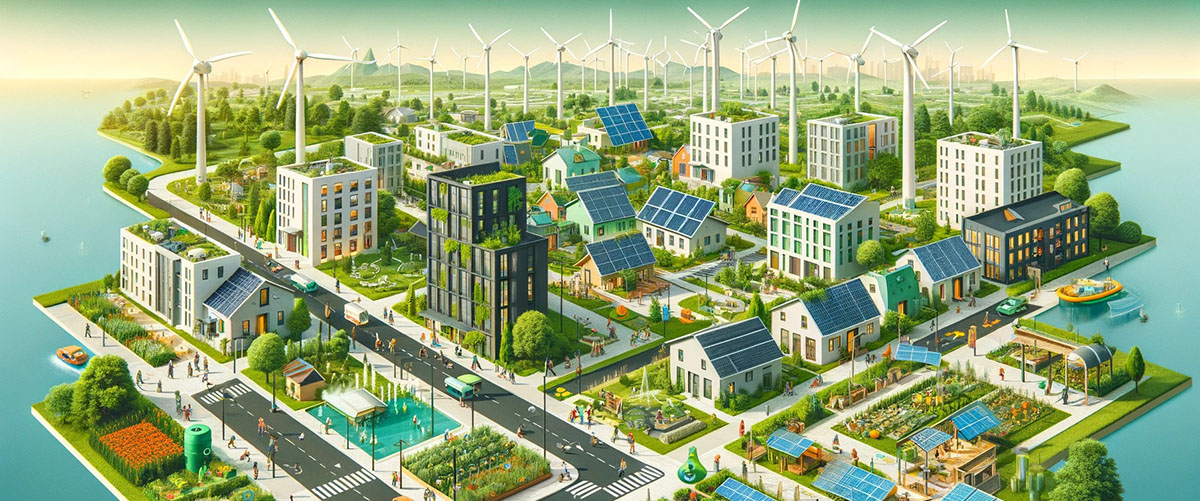
Sustainable urban drainage systems (SuDS) integrate rainwater management into urban design through rain gardens, permeable pavements, filter strips, and constructed wetlands. A rain garden covering 5-8% of the drained catchment area retains 80-90% of runoff from precipitation events below 25 mm (which represent 85-90% of annual rainfall events in a Mediterranean climate) and removes 60-80% of suspended solids, 40-60% of heavy metals, and 30-50% of total nitrogen (Davis et al., 2009). The cost of SuDS is 15-40% lower than conventional drainage with buried collectors for the same return periods, according to an analysis of 24 projects by the Construction Industry Research and Information Association (CIRIA, 2015). The city of Philadelphia has invested 2.4 billion USD in its Green City, Clean Waters program (2011-2036) to manage 34% of the city's impervious surface with SuDS, avoiding investments of 8-10 billion USD in expanding the conventional sewerage network.
Ecological corridors and urban tree canopy: network scale
The effectiveness of NBS multiplies when they move from isolated interventions to green infrastructure networks. Urban ecological corridors -- continuous vegetation strips connecting parks, riverbanks, greenways, and gardens -- enable the dispersal of wildlife (birds, pollinators, small mammals) and the flow of ecosystem services at the metropolitan scale. Barcelona has developed the Superilles (Superblocks) program that transforms 21 street intersections into green plazas with 600-900 m2 of new vegetation per intervention, creating a network of 503,000 m2 of additional green space and reducing NO2 exposure by 25% in treated segments (Mueller et al., 2020). Singapore, which offsets its high density (8,300 inhabitants/km2) with a garden-city policy since 1967, maintains 47% tree canopy cover and has connected 80% of its parks via 340 km of Park Connectors, green corridors 4-10 m wide for pedestrians and cyclists that harbor 395 bird species, 55 reptile species, and 102 butterfly species in a territory of just 733 km2 (NParks Singapore, 2023).
The urban tree canopy is the green infrastructure component with the greatest per capita impact. A mature urban tree (canopy diameter of 10-15 m) intercepts 2,500-5,000 liters of rainwater per year, absorbs 20-50 kg of CO2, removes 100-300 g of atmospheric pollutants (PM10, NO2, SO2, O3), reduces the surrounding air temperature by 1-3 degrees C through evapotranspiration, and provides shade that decreases cooling demand of the adjacent building by 10-30% (i-Tree, USDA Forest Service, 2022). The economic value of these services is estimated at 30-80 EUR/tree per year for medium-growth species and 100-250 EUR/tree per year for large specimens such as plane trees, lindens, and elms (Rogers et al., 2015). Madrid has 1.8 million trees (5.5 trees/inhabitant), Berlin has 430,000 in public streets (0.12/inhabitant), and Paris plans to plant 170,000 additional trees before 2030 to reach 40% street shade coverage, up from the current 23%. Melbourne's Urban Forest Strategy (2014-2032) will increase tree canopy cover from 22% to 40% with the planting of 3,000 trees/year and species adapted to a +2 degrees C temperature increase.
Regulatory framework and financing of green infrastructure
The EU has institutionalized green infrastructure as a planning tool through the Biodiversity Strategy for 2030, which requires cities with more than 20,000 inhabitants to develop urban re-naturing plans and sets the goal of planting 3 billion additional trees across the EU. The Nature Restoration Regulation (EU 2024/1991), adopted in June 2024, obliges member states to ensure no net loss of urban green space from 2031 onward and to increase tree canopy cover by 5% relative to the 2024 baseline. Funding comes from multiple sources: ERDF funds allocate 8.7 billion EUR (2021-2027) to green infrastructure investments; the LIFE program finances pilot projects with 580 million EUR/year; and the European Investment Bank approved 3.2 billion EUR in loans for urban NBS between 2018 and 2023. At the municipal level, land value capture mechanisms allow green infrastructure to be financed through the property value increase it generates: properties located within 100 m of an urban park are worth 8-20% more than equivalent ones without access to green space (Crompton, 2001).
The effective integration of nature into urban planning requires overcoming the traditional separation between urbanism, civil engineering, and ecology. The cities with the most advanced results (Copenhagen, Singapore, Melbourne, Vitoria-Gasteiz) share three characteristics: binding green infrastructure plans with quantitative targets and monitoring indicators; stable dedicated budgets (Copenhagen allocates 3% of its municipal budget to green spaces, equivalent to 120 EUR/inhabitant per year); and citizen participation in design and maintenance (Vitoria-Gasteiz coordinates 380 volunteers in the Green Belt, a periurban belt of 613 hectares that restored quarries, landfills, and wastelands since 1993). The documented return on investment in urban green infrastructure ranges between 3.50 and 10 EUR for every euro invested when all ecosystem services are accounted for (European Commission, 2013), making it one of the most economically efficient urban strategies available.
References
- [1]Green Spaces and Mortality: A Systematic Review and Meta-Analysis of Cohort StudiesThe Lancet Planetary Health, 3(11), e469-e477.
- [2]Green Roofs as Urban Ecosystems: Ecological Structures, Functions, and ServicesBioScience, 57(10), 823-833.
- [3]Bioretention Technology: Overview of Current Practice and Future NeedsJournal of Environmental Engineering, 135(3), 109-117.
- [4]Changing the Urban Design of Cities for Health: The Superblock ModelEnvironment International, 134, 105132.
- [5]Building a Green Infrastructure for EuropePublications Office of the EU. ISBN: 978-92-79-33428-3


Comments 0
No comments yet. Be the first!
Leave a comment