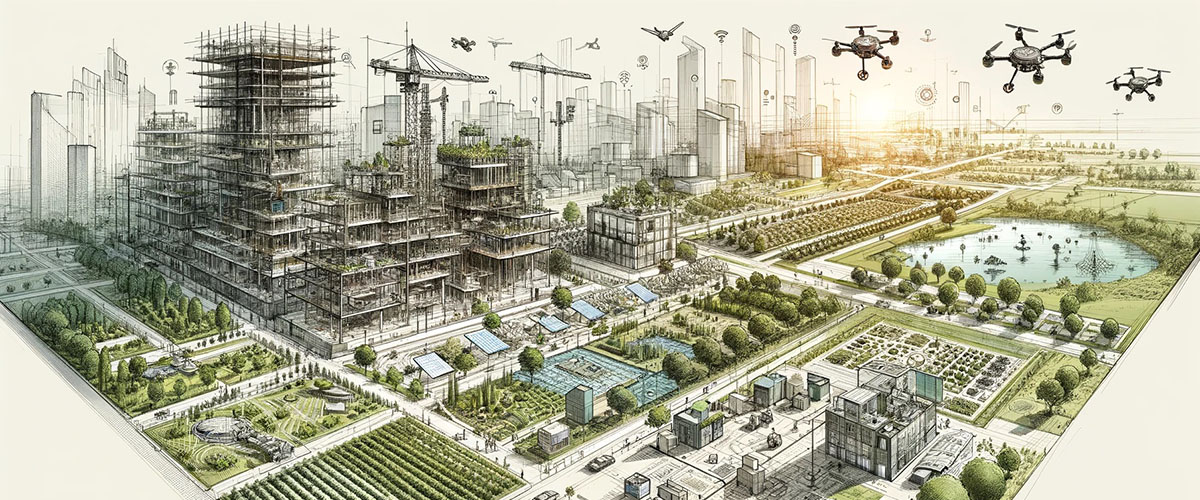
Scale and concentration: the magnitude of the challenge in megacities
The United Nations classifies as a megacity any urban agglomeration with more than 10 million inhabitants. In 2024 there are 33 megacities housing 680 million people, 8.5% of the world's population (UN DESA, 2024). Tokyo leads with 37.4 million, followed by Delhi (33.8 million), Shanghai (29.9 million), Dhaka (23.9 million), and Sao Paulo (22.6 million). Concentration is increasing: in 1990 there were 10 megacities; by 2030 there will be 43, all but 5 located in Asia and Africa. These metropolises generate between 60% and 80% of national GDP in developing countries, but concentrate environmental impacts disproportionately: they produce 14.5% of global CO2 emissions (5.4 billion tCO2/year), consume 75% of global energy destined for buildings, and generate 750 million tonnes of solid waste per year (C40 Cities, 2023). The ecological footprint of a megacity like London (9.5 million inhabitants, 1,572 km2) requires a productive territory 293 times its area to supply food, energy, materials, and absorb waste (GLA, 2018).
The building sector is the largest energy consumer in megacities, representing between 55% and 70% of total energy demand (compared to the 40% global average), due to the high density of tertiary, commercial, and multi-family residential buildings. In Hong Kong, buildings consume 90% of electricity and generate 60% of GHG emissions (EMSD Hong Kong, 2023). In Mexico City, the building sector accounts for 58% of metropolitan electricity consumption, with 2.3 million air conditioning units of low average efficiency (SEER < 4.0) that spike peak demand by 4,200 MW during May afternoons. Dubai, with temperatures exceeding 45 degrees C for 90 days/year, dedicates 70% of its electricity consumption to building cooling, produced 97% from natural gas. The paradox of megacities is that their density offers potential efficiencies (lower per capita transport consumption, viability of district heating/cooling, economies of scale in waste management), but the speed of growth and informal urbanization prevent capitalizing on these advantages.
Informal building and inefficient existing stock
30% of the population in developing-country megacities lives in informal settlements, in dwellings built without building codes, thermal insulation, or mechanical HVAC systems (UN-Habitat, 2022). In Dhaka, 35% of the 22 million inhabitants reside in slums with densities exceeding 80,000 inhabitants/km2, in corrugated metal constructions with thermal transmittances of 6-8 W/m2 K (compared to 0.2-0.3 W/m2 K for an insulated wall), where indoor temperatures exceed outdoor temperatures by 5-10 degrees C during the day and ventilation is limited to uncontrolled openings. In Lagos (16.4 million), 66% of dwellings were built without permits and 80% lack connection to the sanitation network. In Mumbai, the informal neighborhood of Dharavi (1,000,000 inhabitants on 2.4 km2, density of 416,000 inhabitants/km2) consumes only 200 kWh/inhabitant per year of electricity compared to 5,500 kWh on average in Manhattan, but suffers respiratory disease rates 3 times the urban average due to indoor pollution (biomass burning for cooking) and exposure to concentrated outdoor pollution.
The formal building stock of megacities also presents massive inefficiencies. In Sao Paulo, 75% of 4 million buildings are over 30 years old and lack thermal insulation, since the Brazilian building code did not require thermal standards until 2005 (NBR 15575). In Cairo (22 million), residential buildings constructed between 1960 and 2000 with single-layer 12 cm brick walls and single-pane glass have transmittances of 2.5-3.5 W/m2 K for walls and 5.7 W/m2 K for glazing, generating cooling demands of 100-180 kWh/m2 per year (versus 30-50 kWh/m2 per year for a building with an improved envelope). Beijing has retrofitted 360 million m2 of existing buildings between 2010 and 2023 through its energy renovation program, achieving savings of 25-35% in heating consumption, but 1.2 billion m2 still await retrofitting and consume district heating fueled by coal at 35%. The scale of the challenge is overwhelming: energy-retrofitting the building stock of the 33 megacities would require an estimated investment of 3.5-5 trillion USD by 2050 (IEA/UNEP, 2023).
Water, waste, and pollution: intersecting pressures on liveability
Water stress affects 19 of the 33 current megacities. Mexico City extracts 70% of its water from the underground aquifer at a rate that exceeds natural recharge by 40%, causing ground subsidence of 30-50 cm/year in central areas and infrastructure ruptures that result in losses of 40% of potable water through network leaks (CONAGUA, 2022). Chennai (11 million) experienced the complete depletion of its 4 main reservoirs in 2019, affecting 4.6 million people. Sao Paulo faced a 2015 water crisis that reduced reservoirs to 5% capacity, with rationing lasting 8 months. Per capita water consumption in megacities varies from 80 liters/day in Dhaka (limited by infrastructure, not efficiency) to 500 liters/day in Los Angeles, compared to the 50-100 liters that the WHO considers sufficient for all domestic needs. Sustainable buildings with rainwater harvesting, greywater reuse, and low-flow fixtures reduce demand by 40-60%, but their penetration in low-income megacities does not exceed 2-5% of the stock.
Municipal solid waste (MSW) management in megacities is a logistics and environmental challenge of the first order. The 33 megacities collectively generate 750 million tonnes/year of MSW, with per capita rates ranging from 0.5 kg/inhabitant per day in Dhaka to 2.1 kg in New York (World Bank, What a Waste 2.0, 2018). In Lagos, only 40% of MSW is formally collected; the rest is burned in the open (33%), dumped in waterways (15%), or abandoned in illegal dumps (12%). Jakarta generates 7,700 tonnes/day of MSW, of which 70% ends up in the Bantar Gebang landfill (110 hectares, 40 m of accumulated waste height), the largest in Southeast Asia. Air pollution in megacities systematically exceeds WHO limits (5 microg/m3 annual PM2.5): Delhi registers an annual mean of 99 microg/m3, Dhaka 78 microg/m3, Cairo 73 microg/m3, and Beijing 35 microg/m3, levels causing 4.2 million premature deaths per year worldwide (WHO, 2022). Buildings with HEPA filtration and controlled ventilation reduce indoor PM2.5 exposure by 70-90%, but their cost of 15-30 EUR/m2 limits adoption to offices and high-end residential buildings.
Mitigation strategies and successful experiences at the metropolitan scale
The megacities achieving the best sustainability outcomes combine strict regulation, infrastructure investment, and integrated metropolitan governance. Tokyo implemented in 2010 the world's first municipal cap-and-trade system for buildings larger than 2,000 m2, covering 1,300 buildings that represent 21% of the city's commercial energy consumption. The system achieved a 27% reduction in tertiary-sector CO2 emissions between 2010 and 2023, exceeding the initial 17% target (Tokyo Metropolitan Government, 2023). Seoul launched in 2012 the One Less Nuclear Power Plant program, which reduced metropolitan energy consumption by 10% (4 million toe) through retrofitting 120,000 buildings, installing 1,200 MW of urban photovoltaics, and mobilizing 1.4 million citizens in domestic efficiency programs. London has reduced per capita emissions by 44% since 2000 (from 8.2 to 4.6 tCO2/inhabitant in 2022), largely thanks to the UK's electricity decarbonization (from 500 to 180 gCO2/kWh) and Part L building standards that have required a 31% reduction in operational emissions since 2021 compared to the previous regulation.
The C40 Cities network, which brings together 96 major cities representing 25% of global GDP, has facilitated the transfer of best practices in urban sustainability. Its members have committed to reaching carbon neutrality before 2050, with intermediate reduction targets of 50% by 2030. However, analysis of actual progress shows that only 11 of the 96 cities are on a trajectory compatible with the 1.5 degrees C target, and that the group's aggregate emissions declined by only 7% between 2015 and 2022 (C40 Annual Report, 2023). The fundamental challenge of megacities is speed: Delhi adds 400,000 inhabitants/year, Lagos 500,000, Dhaka 600,000, and every new building constructed without efficiency standards locks in 40-60 years of emissions. The solutions exist -- stringent building codes, heating electrification, green infrastructure, mass public transit, circular waste management -- but implementing them at the speed and scale demanded by megacity growth requires governance, financing, and technical capacity that most metropolitan administrations in the Global South do not yet possess.
References
- [1]World Urbanization Prospects: The 2024 RevisionUnited Nations.
- [2]C40 Annual Report 2022-2023C40 Cities Climate Leadership Group.
- [3]What a Waste 2.0: A Global Snapshot of Solid Waste Management to 2050World Bank Group. ISBN: 978-1-4648-1329-0
- [4]World Cities Report 2022: Envisaging the Future of CitiesUnited Nations Human Settlements Programme. ISBN: 978-92-1-133395-4
- [5]Results of Tokyo Cap-and-Trade Program for Large FacilitiesBureau of Environment, TMG.
Comments 0
No comments yet. Be the first!
Leave a comment