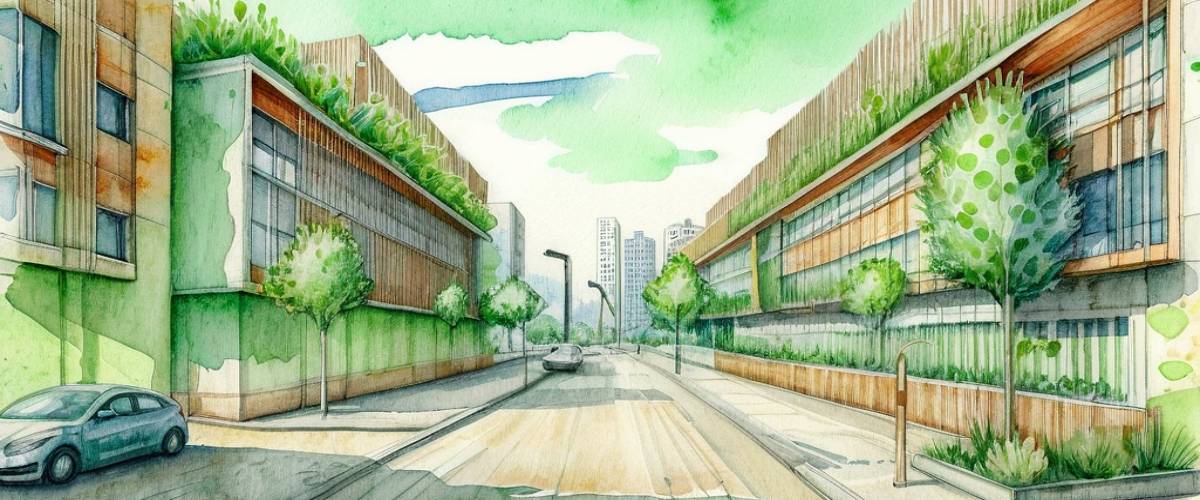
Structural durability: designing for 100 years and beyond
Durability and design flexibility determine how long a building remains functional and how much it contributes to sustainability over its full life cycle. Design service life according to EN 1990:2002 (Eurocode 0) defines 5 categories: temporary structures (10 years), replaceable components (10-25 years), agricultural and similar buildings (15-30 years), standard buildings and structures (50 years), and monumental buildings, bridges and civil works (100+ years). However, the actual average service life of buildings in Europe is only 40-60 years (Huuhka and Lahdensivu, 2016), with many demolished not due to structural failure but functional obsolescence — the building ceased to serve its occupants' needs.
Extending service life from 50 to 100 years reduces annualized environmental impact by 30-50%: the embodied carbon in the structure (modules A1-A3) is amortized over twice the period, and a complete demolition-plus-reconstruction cycle (modules C + new A) is avoided. Reinforced concrete durability depends on minimum cover (35-50 mm per exposure class, EN 1992-1-1), water-cement ratio (≤ 0.45 for XC3-XC4), and cement type (CEM III sulfate-resistant for aggressive environments). Stainless steel reinforcement (AISI 316) eliminates corrosion and extends service life to 150+ years at a premium of 5-8% over carbon steel. Engineered timber (Glulam, CLT) achieves service lives of 100+ years with structural protection by design (service class 1-2, EN 1995) and minimal treatment.
Functional flexibility: buildings that adapt to change
Design flexibility enables a building to change function without demolition or major structural retrofit. The Open Building concept (N.J. Habraken, 1961) distinguishes between the support (load-bearing structure, main services, envelope — 100+ year lifespan) and the infill (partitions, finishes, secondary services — 10-30 year lifespan). This separation allows interior reconfiguration without touching the structure: an office building can convert to residential, or a hospital can reorganize its floors as clinical needs evolve.
Flexibility indicators include: clear floor-to-floor height (≥ 3.00 m to accommodate suspended ceilings and raised floors for any use), clear span between columns (≥ 7.5 m for open-plan offices, ≥ 5.0 m for residential without intermediate columns), floor load capacity (≥ 5 kN/m² to allow conversion to commercial or healthcare use), and service accessibility (accessible risers, raised floors, cable trays). The Entopia Building (Kuala Lumpur, 2022, Ken Yeang) was designed with 12 m structural spans, 4.2 m clear heights, and a modular facade enabling conversion between office, residential, and commercial use at an adaptation cost below 15% of new construction cost. Standard ISO 20887:2020 (Sustainability in buildings — Design for adaptability and disassembly) establishes principles and terminology for adaptive design.
Modular design and Design for Disassembly (DfD)
Design for Disassembly (DfD) complements durability with circularity: when a building reaches end of life, its components are dismantled and reused rather than demolished. DfD principles include: reversible mechanical connections (bolting, interlocking, clips) instead of chemical bonds (welding, gluing, in-situ concrete), independent building layers (structure, envelope, services, finishes that can be separated), comprehensive documentation of materials and connections (digital passport on platforms like Madaster), and dimensional standardization to maximize reuse potential.
Modular construction represents the ultimate expression of DfD: three-dimensional modules manufactured with ±2 mm tolerances, transported and installed on site within hours. Material recovery rates in conventional demolition reach 30-50%, while disassembly of modular systems achieves 80-95% (Rios et al., 2015). The ABN AMRO Circl project (Amsterdam, 2017) was designed with 95% demountable materials documented in Madaster: the laminated timber structure is bolted (no adhesives), the facade is modular, and services are fully accessible. Eurocodes do not penalize bolted connections versus welded ones in structural steel, facilitating DfD design. The DfD premium is 2-5% on initial construction cost, but end-of-life material value more than compensates: dismantled steel retains 90-95% of its value, and dismantled laminated timber retains 50-70%.
Life Cycle Cost analysis (LCC) and the return on durability
Life Cycle Cost analysis (LCC) per ISO 15686-5:2017 and EN 16627:2015 quantifies a building's total cost over its service life: construction cost (20-30% of total), operation and maintenance (50-70%), and end-of-life cost (5-10%). A building designed for 100 years with durable materials has a construction cost 10-20% higher than a conventional 50-year design, but an LCC 25-40% lower because the investment amortizes over a longer period with reduced maintenance and replacement interventions.
Quantified example: a 5,000 m² office building with conventional reinforced concrete structure (50-year service life, cost €1,200/m²) has an LCC of €3,500/m² over 50 years. The same building designed for 100 years (increased cover depths, stainless steel in exposed reinforcement, ventilated stone facade, protective green roof, cost €1,400/m²) has an LCC of €4,200/m² over 100 years — i.e., €2,100/m² per 50-year period, 40% less than the conventional option. The discount rate applied in LCC (typically 2-4% real for public buildings per EU Directive 2014/24) penalizes future benefits, but even at 3%, the durability investment pays back in 15-25 years. LEED v4.1 (credit Building Life-Cycle Impact Reduction) awards up to 5 points for demonstrating 5-20% life cycle impact reduction through durability, adaptive reuse, or flexible design.
Case studies: verified longevity and lessons learned
The longest-lasting buildings demonstrate that durability and design flexibility are proven realities, not theoretical concepts. The Pantheon in Rome (126 AD, 1,900 years in continuous use) combines an unreinforced concrete dome spanning 43.3 m with a central oculus of 8.9 m: its durability derives from the quality of Roman opus caementicium (volcanic pozzolanic ash that generates tobermorite crystals, investigated by Jackson et al., 2017, in American Mineralogist). The Empire State Building (1931, 94 years old) has undergone multiple use changes (military offices in WWII, telecommunications hub, premium office space) thanks to its 7.6 m spans, 3.6 m floor heights, and over-engineered structure. Its 2012 energy retrofit ($31 million USD) reduced energy consumption by 38% and demonstrated that retrofitting is 60-80% less carbon-intensive than demolition and reconstruction.
In Spain, the Matadero Madrid rehabilitation (1911 industrial hall, converted to cultural center in 2007) preserved the original 100+ year steel structure while adapting the interior with demountable partitions and raised floors that enable continuous reconfiguration for exhibitions. Rehabilitation cost was €800/m² versus €1,500-2,000/m² for equivalent new construction. BREEAM Refurbishment and Fit-Out incentivizes reuse of existing structures by awarding additional credits in the Mat (materials) and Wst (waste) categories for avoiding demolition. The European Commission's Level(s) framework (voluntary sustainability indicators for buildings) includes indicator 2.1 (Design for adaptability and renovation) and 6.1 (Life cycle costs), quantifying how durability and flexibility contribute to building sustainability across the entire life cycle.
References
- [1]Supports: An Alternative to Mass Housing (De dragers en de mensen)Scheltema & Holkema (NL); English ed. 1972, Architectural Press. ISBN: 978-0-85139-834-4
- [2]Statistical and geographical study on demolished buildingsBuilding Research & Information, 44(1), 73-96.
- [3]Design for Disassembly and Deconstruction — Challenges and OpportunitiesProcedia Engineering, 118, 1296-1304.
- [4]Phillipsite and Al-tobermorite mineral cements produced through low-temperature water-rock reactions in Roman marine concreteAmerican Mineralogist, 102(7), 1435-1450.
- [5]ISO 20887:2020 Sustainability in buildings and civil engineering works — Design for disassembly and adaptability — Principles, requirements and guidanceInternational Organization for Standardization.
Comments 0
No comments yet. Be the first!
Leave a comment