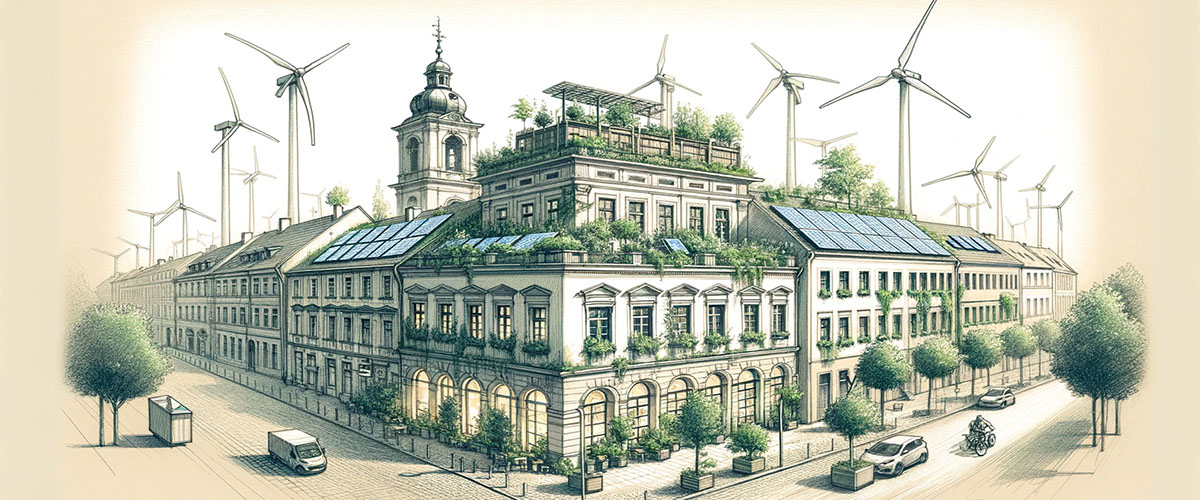
The challenge: reconciling green infrastructure with heritage protection
Green infrastructure development in historic contexts faces a productive tension: European historic districts suffer the greatest impacts from the urban heat island effect (UHI: 3-8°C higher than the peri-urban surroundings), massive impermeabilization (runoff coefficient 0.80-0.95), scarcity of green areas (2-5 m²/inhabitant compared to the 9 m² recommended by the WHO) and air pollution (NO₂ > 40 μg/m³ on traffic corridors) — yet heritage protection regulations restrict interventions that affect the appearance, structure or materiality of listed buildings and spaces.
The Ley 16/1985 de Patrimonio Histórico Español (and its regional equivalents) prohibits altering the exterior appearance of listed buildings (BIC, BRL) and requires that interventions be reversible, differentiated and compatible. The standard EN 16883:2017 (Conservation of cultural heritage — Guidelines for improving the energy performance of historic buildings) establishes an assessment protocol that integrates energy efficiency with heritage values: significance analysis > options evaluation > impact assessment > management plan. The Krakow Charter (2000) adds: every intervention must be "the minimum necessary" and "documented to allow its reversal." The technical challenge is to develop green infrastructure solutions that deliver the same environmental benefits (cooling, water retention, biodiversity) using systems that are reversible, lightweight, self-supporting and anchored without penetration of historic masonry.
Green roofs on historic buildings: reversible extensive systems
Extensive green roofs represent the intervention with the greatest potential in historic districts: most flat roofs (terraces) and pitched roofs of historic buildings are not visible from the street, allowing interventions without visual impact. The system must be self-supporting (gravity-set trays, without perforating the existing waterproofing), lightweight (saturated weight 40-80 kg/m² — compatible with the typical load-bearing capacity of historic floor structures of 150-250 kg/m² superimposed load) and removable (the trays can be withdrawn without leaving a trace if restoration is required).
Modular tray systems (ZinCo Floradrain FD 25-E, Optigrün Click, Nophadrain ND 62) of recycled polypropylene (dimensions 500×500×80 mm or 600×400×100 mm) are filled with lightweight mineral substrate (perlite, expanded clay, volcanic pozzolana: dry density 800-1,100 kg/m³) and pre-planted with Sedum species (S. album, S. acre, S. reflexum), low-growing grasses and native herbaceous plants. Rainwater retention is 50-70% of annual precipitation, surface temperature reduction is 20-30°C (compared to tile/dark zinc roofing) and the extension of the waterproofing membrane service life is 20-30 years (protection against UV and thermal stress). In Copenhagen, the 2010 ordinance requires green roofs on all new construction and rehabilitation with flat roofs in the historic center — more than 200,000 m² of green roofs installed in 10 years, reducing urban runoff by 30% in treated areas.
Urban trees and courtyard gardens within city blocks
Street tree planting in historic districts is constrained by: street width (3-8 m between facades in medieval cores), existing underground networks (18th-19th century sewers, cabling, gas), heritage pavements (granite setts, Roman roads, cobblestones) and protected views. Solutions include structural tree pits (support cells such as Silva Cell, StrataCell: load-bearing capacity 60-80 kN/m² over the root zone, substrate volume 10-20 m³/tree) that allow planting of medium-sized trees (Celtis australis, Melia azedarach, Cercis siliquastrum: canopy diameter 4-6 m) without damaging underground networks.
Courtyard gardens within city blocks recover degraded interior patios (car parks, storage areas, informal dumps) as communal green spaces. The "Pla Buits" program in Barcelona has recovered 40+ plots and block interiors as community-managed temporary gardens. The "Eixos Verds" project (Barcelona, 2020-2024) transforms 21 streets of the Eixample into green corridors with traffic reduction to 25%, planting of 2,100 new trees, widening of sidewalks and creation of 33,000 m² of new green space. In Vitoria-Gasteiz, the Green Ring (6 peri-urban parks, 613 ha) connects with the medieval center through tree corridors, rain gardens and urban allotments, creating a continuous green infrastructure network that has increased urban biodiversity by 30% (censused bird species) over 20 years.
Permeable pavements and SUDS in heritage settings
Permeable pavements in historic districts replace asphalt or concrete slabs with heritage-compatible materials: natural stone setts with drainage joints (joints of 8-15 mm filled with 2-5 mm gravel, infiltration 100-300 l/m²·h), stone slabs on a gravel bed (without mortar, infiltration 50-150 l/m²·h) and stabilized gravel (HDPE geocell filled with limestone or granite gravel: load-bearing capacity 40-60 kN/m², infiltration 400-800 l/m²·h, appearance compatible with historic gardens and plazas). The cost is 40-120 EUR/m² (compared to 25-50 EUR/m² for conventional setts on mortar bed).
SUDS (Sustainable Urban Drainage Systems) adapted to historic contexts include: rain gardens in sidewalk widenings or median strips (depth 150-300 mm, sand-compost substrate, native plants: retention of 20-50 mm of rainfall), soakaways concealed beneath the pavement (gravel wrapped in geotextile, volume 2-10 m³, infiltration to the water table) and recovered historic cisterns — many historic districts have medieval and Arab cisterns (capacity 5-50 m³) that can be rehabilitated as rainwater tanks at a cost of 5,000-20,000 EUR. The city of Girona has recovered 12 medieval cisterns in the Barri Vell for public garden irrigation, with a total capacity of 200 m³. The ordinance of Valencia (Plan Verde 2024-2030) requires the integration of SUDS in all public space rehabilitation within the Ciutat Vella, with a retention target of 80% of rainfall from the first 20 mm within the site.
Reference cases and lessons learned
The reference cases demonstrate that green infrastructure and heritage are compatible: the High Line (New York, 2009-2014, Diller Scofidio + Renfro + James Corner) transformed an abandoned 2.3 km elevated railway into a linear park with 500+ plant species, permeable pavements and a rainwater collection system — it receives 8 million visitors/year and has generated 5 billion USD in real estate investment in the surrounding area. The Promenade Plantée (Paris, 1993, 4.7 km) was the European precursor of the concept.
In Spain, the rehabilitation of the Jardín del Turia (Valencia, 9 km, 110 ha) transformed the former riverbed into the largest urban park in Spain, with 25,000 trees, biodiversity zones, sports facilities and sustainable water management. The recovery of the Manzanares River (Madrid Río, 2011, 10 km, 120 ha) buried the M-30 motorway underground and created a green corridor with 33,000 new trees, 6 renaturalized weirs and a SUDS system that infiltrates 60% of runoff. The lessons learned from these projects include: (1) reversible intervention is no less effective — green roof trays and permeable pavements on gravel beds are removable and achieve performance equivalent to permanent solutions; (2) the additional cost of heritage compatibility is 10-30% over the standard system — recoverable through the benefits of runoff reduction, energy savings and real estate appreciation; (3) community management (urban allotments, courtyard gardens) reduces maintenance costs by 40-60% while increasing social cohesion.
References
- [1]EN 16883:2017 — Conservation of cultural heritage: Guidelines for improving the energy performance of historic buildingsEuropean Committee for Standardization.
- [2]Carta de Cracovia 2000: Principios para la conservación y restauración del patrimonio construidoComité Internacional de Monumentos y Sitios.
- [3]Design Guidelines for Green Roofs in Historic DistrictsNational Trust for Historic Preservation / Green Roofs for Healthy Cities.
- [4]Pla del Verd i de la Biodiversitat de Barcelona 2020: Informe de seguimentAjuntament de Barcelona, Ecologia Urbana.
- [5]High Line: The Inside Story of New York City's Park in the SkyFSG Originals / Farrar, Straus and Giroux. ISBN: 978-0-374-53200-5

Comments 0
No comments yet. Be the first!
Leave a comment