Built heritage as a community asset: scale and state of conservation
The EU has approximately 450,000 buildings and monuments under some form of heritage protection, in addition to 40,000 registered archaeological sites and 90 properties inscribed on the UNESCO World Heritage List (Council of Europe, 2023). In Spain alone, the catalog of Cultural Heritage Assets includes 18,300 properties declared BIC (Bien de Interes Cultural), supplemented by more than 100,000 buildings with municipal planning protection. However, the state of conservation is concerning: a study by Europa Nostra and ICOMOS (2023) identified 12 European monuments in serious danger, and an analysis by Spain's Ministry of Culture (2022) revealed that 35% of BIC-listed buildings are in poor or ruinous condition. The conservation investment deficit for heritage in the EU is estimated at 50 billion EUR (European Heritage Alliance, 2020), a figure that far exceeds available public budgets: Spain allocates 580 million EUR/year to cultural heritage (state + autonomous communities), sufficient to intervene on barely 2-3% of the catalog annually.
This financial gap makes community participation a structural necessity. Exclusively institutional models (conservation managed by public administrations without citizen involvement) prove insufficient for three quantifiable reasons. First, the rate of deterioration outpaces the capacity for public intervention: a historic building without preventive maintenance loses 1-2% of its heritage value annually, and the cost of restoration multiplies by 5-10 when moving from regular maintenance to emergency intervention (English Heritage, 2003). Second, local knowledge about traditional building techniques, oral history, and the social use of heritage resides in communities, not institutions: 70% of European vernacular heritage (mills, wash houses, barns, granaries, olive presses) lacks formal technical documentation and survives only in the memory of artisans and residents over 65 years of age (ICOMOS, 2021). Third, a sense of shared ownership multiplies vigilance and care: heritage buildings with community engagement programs suffer 60% less vandalism and 45% less degradation from abandonment than those managed exclusively by the administration (Heritage Lottery Fund, 2019).
Community participation models: from volunteering to co-management
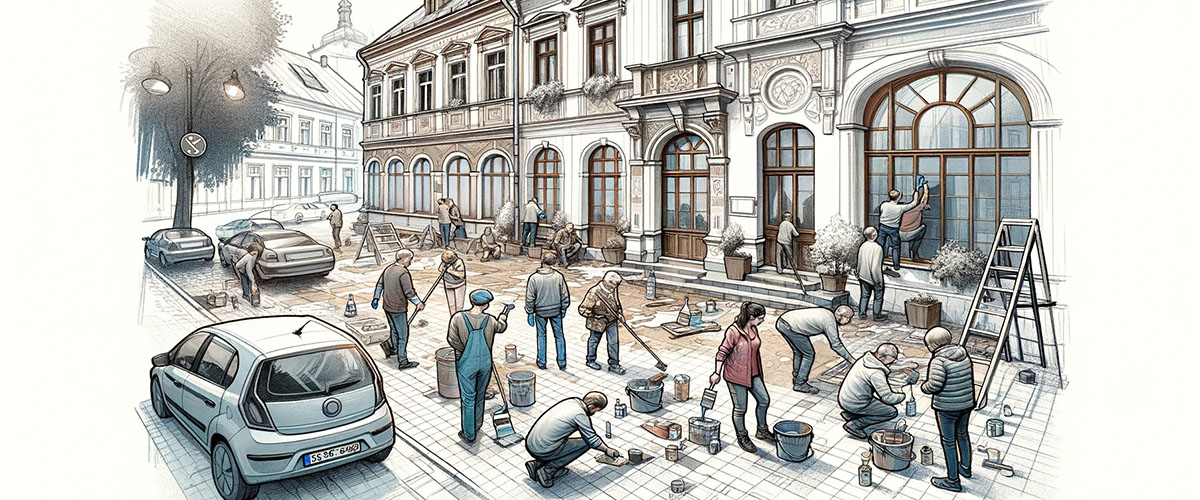
Conservation volunteering is the most direct form of participation. The British National Trust coordinates 70,000 volunteers who dedicate 4.5 million hours/year to maintaining 500 historic properties, equivalent to 2,300 full-time jobs and an economic value of 45 million GBP/year (National Trust Annual Report, 2023). In France, the Chantiers de Benevoles coordinate 15,000 volunteers/year on 300 restoration projects, with an average contribution of 80 hours/volunteer and hands-on training in masonry, traditional carpentry, and lime render restoration. In Spain, the Hispania Nostra Association has mobilized 4,200 volunteers in conservation campaigns since 2013, intervening on 85 heritage buildings with an average investment of 12,000 EUR/intervention in materials, supplemented by 600 hours of volunteer labor equivalent to 18,000-24,000 EUR in wages. The Santa Maria la Real Foundation model (Palencia) has restored 38 Romanesque churches in northern Spain since 2004, combining 2,800 volunteers, workshop schools with 450 students trained in traditional trades, and mixed public-private financing.
Heritage crowdfunding has democratized conservation financing. The Dartagnans platform (France) has raised 12 million EUR for 350 restoration projects since 2015, with an average of 34,000 EUR/project and a 78% success rate. The campaign to restore the Chateau de La Mothe-Chandeniers (Vienne, France) raised 1.6 million EUR from 25,000 donors in 38 countries, becoming the largest heritage crowdfunding campaign in Europe. In Spain, the Verkami platform has funded 85 cultural heritage projects with an average raised amount of 8,500 EUR. Community co-management models go beyond financing: in Italy, the Adotta un Monumento (Adopt a Monument, Naples) program has linked 600 schools with 1,200 monuments since 1992, generating an educational-conservationist model replicated in 42 Italian cities. Heritage stewardship agreements, analogous to land stewardship agreements, formalize commitments by local communities to the conservation of specific buildings through 5-25 year agreements with the owning administrations.
Documented socioeconomic benefits of community participation
The economic benefits of heritage conservation with community participation are extensively documented. A study by the Heritage Lottery Fund (2019) covering 2,000 projects funded in the United Kingdom over 25 years concluded that every 1 GBP invested in participatory heritage conservation generates 1.60 GBP of local economic return (employment, tourism, commercial activity) and 6.30 GBP of total social benefit (including wellbeing, social cohesion, and education). Heritage tourism generates 338 billion EUR/year in the EU (26% of total tourism), contributing 7.8 million direct and indirect jobs (European Commission, Cultural Heritage Counts for Europe, 2015). Visitors to heritage sites managed with community participation spend 25-40% more in the local area than those at exclusively institutionally managed sites, because the offer of participatory experiences (workshops, resident-led tours, local artisan products) extends the average stay from 2.5 to 4.2 hours and diversifies spending.
Social benefits include the strengthening of community cohesion and intergenerational knowledge transfer. A longitudinal study by the University of Sheffield (Beel et al., 2017) covering 8 communities involved in heritage conservation projects over 5 years documented increases of 35% in sense of belonging to place, 28% in interpersonal trust, and 22% in participation in other civic activities. Participatory conservation also generates trade skills transfer: workshop school programs in Spain have trained 380,000 young people in traditional construction trades (masonry, timber framing, ironwork, stucco restoration) since 1985, with employment placement rates of 65-75% (SEPE, 2022). In rural areas experiencing depopulation, heritage conservation acts as a demographic anchor: municipalities with fewer than 5,000 inhabitants that have active heritage conservation projects lose 30% less population than equivalent municipalities without heritage activity (INE/Fundacion Patrimonio, 2021).
Digital tools and the future of participatory conservation
Digital tools amplify the reach and efficiency of community participation. Citizen science platforms such as Heritage Observer (Netherlands) allow any citizen to report pathologies in historic buildings (cracks, dampness, loss of elements) using geolocated photographs from their mobile phone: the platform has recorded 45,000 reports from 12,000 users in 3 years, detecting 850 risk situations that required emergency intervention. The digital twin of heritage buildings, created through laser scanning (point clouds with 100-500 million points per building and accuracy of plus or minus 2 mm), enables the monitoring of deformations, planning of restorations, and creation of virtual reality experiences accessible to the community. Notre-Dame de Paris cathedral, whose pre-fire scan in 2019 by Andrew Tallon contained 1 billion laser points, demonstrated the value of digital recording for guiding reconstruction with millimetric fidelity. The Open Heritage project (Google Arts & Culture) has digitized 37 heritage sites at risk in 18 countries with free and open access for researchers and local communities.
The future of participatory heritage conservation depends on institutionalizing participation mechanisms and providing them with stable funding. The Faro Convention of the Council of Europe (2005, in force since 2011, ratified by 23 countries including Spain since 2022) recognizes the right of communities to participate in the identification, management, and conservation of their cultural heritage, and obliges signatory states to create legal frameworks that facilitate this participation. The Energy Performance of Buildings Directive (EPBD, 2024) introduces the concept of the building renovation passport, which in historic buildings must balance energy improvement with heritage conservation through specific criteria adapted to the type of protection. The integration of low-cost IoT sensors (50-200 EUR/unit) for continuous monitoring of moisture, temperature, vibration, and deformation in heritage buildings enables a shift from reactive to predictive maintenance, reducing long-term conservation costs by 40-60%. With 450,000 protected buildings in the EU and insufficient public resources, organized community participation, equipped with training and digital tools, is the most efficient and democratic response to ensuring that the built heritage endures as an educational, identity, and economic resource for future generations.
References
- [1]Heritage, Health and Wellbeing: 25 Years of National Lottery Funded HeritageNational Lottery Heritage Fund.
- [2]Cultural Heritage Counts for EuropeInternational Cultural Centre Kraków. ISBN: 978-83-63463-27-4
- [3]Cultural Resilience: The Production of Rural Community Heritage, Digital Archives and the Role of VolunteersJournal of Rural Studies, 54, 459-468.
- [4]Framework Convention on the Value of Cultural Heritage for Society (Faro Convention) — CETS No. 199Council of Europe Treaty Series.
- [5]Heritage Counts: The State of England's Historic EnvironmentEnglish Heritage.


Comments 0
No comments yet. Be the first!
Leave a comment