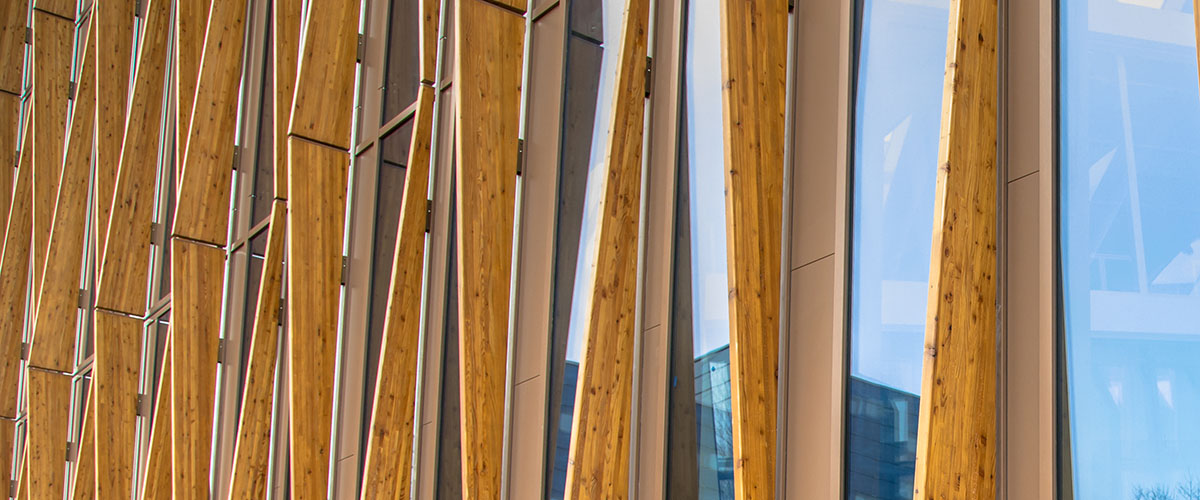
The thermal envelope as the first fundamental element
The fundamental elements of sustainable architecture begin with the thermal envelope, the physical barrier between the conditioned interior and the exterior. Its performance is measured through thermal transmittance (U-value, in W/m²K): the lower the U-value, the less heat loss. Spain's CTE DB-HE (2019) establishes maximum U-values by climate zone: from 0.56 W/m²K for walls in zone A (Cadiz) to 0.27 W/m²K in zone E (Burgos). The Passivhaus standard requires U ≤ 0.15 W/m²K for walls, regardless of climate.
A well-designed envelope reduces heating and cooling demand by 50% to 80%. Key components include: continuous insulation without thermal bridges (ISO 14683 catalogs linear thermal bridges and their impact, which can represent up to 30% of total losses if untreated), high-performance fenestration (Uw ≤ 1.3 W/m²K with low-e triple glazing and thermal break), and airtightness (n50 ≤ 0.6 ACH in Passivhaus, verified by Blower Door test per EN 13829).
Orientation and solar geometry
Orientation determines the quantity and quality of solar radiation each facade receives. In the Northern Hemisphere (latitudes 35-45°N, encompassing the Iberian Peninsula), the south facade receives 2 to 3 times more radiation in winter than east or west facades. The optimal building proportion is 1.5:1 to 2:1 (long axis east-west), and glazing should concentrate on the south facade (WWR 40-60%) with external solar protection, limiting WWR to 20-30% on east and west.
Overhangs on the south facade block direct solar radiation in summer (solar angle of 70-75° at noon in June at 40°N latitude) but allow entry in winter (angle of 25-30° in December). The optimal overhang depth is approximately 1/3 of the opening height. These strategies combined can reduce climate control demand by 20% to 40% with no additional construction cost.
Natural ventilation and air quality
Natural ventilation removes pollutants, controls humidity, and can provide passive cooling. EN 16798-1 establishes minimum ventilation rates of 10 L/s per person for Category II (normal office use). Cross ventilation, requiring openings on at least two opposite facades, generates airflow proportional to exterior wind speed, opening area, and pressure difference between facades.
Stack-effect ventilation exploits the density difference between warm indoor air and cooler outdoor air. The volumetric flow rate Q (m³/s) is proportional to the square root of the product of chimney height, temperature difference, and gravitational acceleration: Q = Cd·A·sqrt(2·g·H·DeltaT/Tm), where Cd is the discharge coefficient (0.60-0.65), A the opening area, H the height, DeltaT the temperature difference, and Tm the mean absolute temperature. A 15 m high atrium with 3°C thermal difference and 2 m² openings can generate flows of 4-6 m³/s, sufficient to ventilate a 2,000 m² office building.
Integrated water management in design
Sustainable architecture treats water as a finite resource to be optimized in three areas: consumption reduction (low-flow fixtures: faucets ≤ 6 L/min, toilets ≤ 4.5 L, showers ≤ 8 L/min), capture and reuse (rainwater for irrigation and cisterns, treated greywater for non-potable uses), and runoff management (Sustainable Urban Drainage Systems, SUDS, that infiltrate, retain, or reuse rainwater at source).
In Spain, CTE DB-HS4 establishes supply requirements that implicitly favor efficiency, and Royal Decree 1620/2007 regulates reuse of treated water. A rooftop rainwater collection system with a 10 m³ tank can cover 30% to 60% of non-potable demand for a single-family home in areas with annual rainfall above 500 mm. Green roofs retain 40% to 80% of annual precipitation, reducing urban runoff and flood risk.
Material selection with environmental criteria
Material selection is based on Life Cycle Assessment (LCA) per EN 15978, evaluating embodied carbon (kgCO2eq/m²), embodied energy (MJ/m²), acidification potential, and eutrophication potential. Type III Environmental Product Declarations (EPDs), verified per ISO 14025, provide comparable data across manufacturers.
FSC/PEFC-certified timber has negative embodied carbon (stores more CO₂ than it emits in production): cross-laminated timber (CLT) stores approximately 0.7-0.9 t CO₂/m³. Conventional reinforced concrete emits 200-400 kgCO₂/m³, but alternatives with GGBS cement (ground granulated blast furnace slag) or fly ash can reduce these emissions by 30% to 70%. Recycled steel reduces emissions by 58% versus primary steel (World Steel Association, 2022). The priority should be: reuse > recycle > low-impact materials > conventional materials.
Integrated vegetation: green roofs and living walls
Vegetation integrated into architecture provides quantifiable thermal, hydrological, acoustic, and ecological benefits. An extensive green roof (8-15 cm substrate, sedum and grasses) reduces top-floor cooling demand by 25% to 50% (Castleton et al., 2010, Renewable and Sustainable Energy Reviews), acts as additional thermal insulation equivalent to 2-5 cm of mineral wool, retains 40-80% of annual precipitation, and reduces urban heat island effect by replacing low-SRI surfaces (asphalt, SRI = 0) with high-evapotranspiration vegetation.
Living wall systems with double-skin configurations reduce facade surface temperature by up to 15°C in summer and provide additional acoustic insulation of 5-10 dB. The CaixaForum Madrid Vertical Garden (Patrick Blanc, 2007), with 460 m² of plant surface and 15,000 plants of 250 species, demonstrates the viability of these systems in continental Mediterranean climate, with irrigation water consumption of 3-5 L/m²/day in summer.
References
- [1]Codigo Tecnico de la Edificacion - Documento Basico HE: Ahorro de EnergiaGobierno de Espana.
- [2]EN 15978: Sustainability of construction works - Assessment of environmental performance of buildingsEuropean Committee for Standardization.
- [3]Green roofs; building energy savings and the potential for retrofitEnergy and Buildings, 42(10), 1582-1591.
- [4]Steel Statistical Yearbook 2022 and Life Cycle Inventory DataWorld Steel Association.
- [5]Arquitectura bioclimatica en un entorno sostenibleEditorial Munilla-Leria, Madrid. ISBN: 978-8489150645
Comments 0
No comments yet. Be the first!
Leave a comment