Integrated water management in off-grid buildings
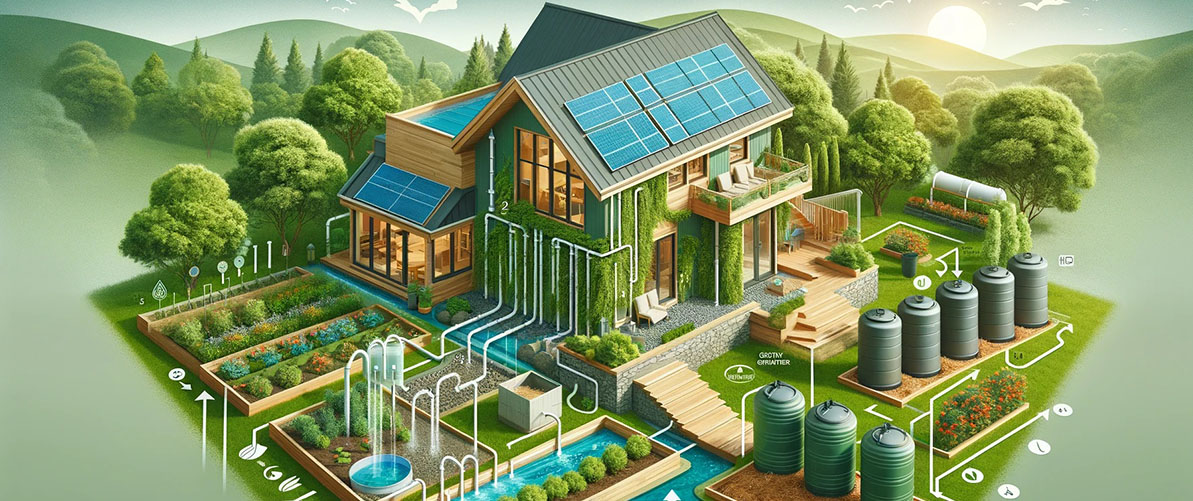
Managing water in an off-grid building requires designing a closed water cycle encompassing harvesting, storage, purification, distribution, efficient use, treatment and reuse. A single-family dwelling of 4 people with standard consumption uses 500-600 litres/day (125-150 l/person/day, INE 2022), but a well-designed off-grid building reduces this figure to 200-320 litres/day (50-80 l/person/day) through low-flow taps (4-6 l/min versus 12-15 l/min conventional), dual-flush toilets (3/6 litres versus 9-12 litres), A+++ class appliances (washing machine: 40-50 litres/cycle versus 70-100 litres) and greywater reuse for cisterns and irrigation. The annual demand thus stands at 73-117 m3/year, a volume that autonomous sources — rainwater harvesting, well or spring — must guarantee even during drought periods.
Rainwater harvesting is the primary source for many off-grid buildings. Annual yield depends on local rainfall and catchment area: with a 150 m2 roof and a runoff coefficient of 0.85 (tiles or metal sheeting), collection is 127.5 litres per mm of rainfall. On the Cantabrian coast (rainfall 1,000-1,800 mm/year), a 150 m2 roof collects 127-230 m3/year, sufficient for a family of 4. In the Spanish Levante (300-500 mm/year), the same roof collects only 38-64 m3/year, covering 30-55% of the reduced demand, which requires supplementary sources. Storage is sized to cover the longest dry period: in a Mediterranean climate, tanks of 15-30 m3 (buried concrete or polyethylene, cost 40-80 EUR/m3 of capacity) guarantee 2-4 months of autonomy. Purification of rainwater requires particle filtration (25-50 microns), activated carbon filtration (removal of VOCs and taste) and UV disinfection (40 mJ/cm2, efficacy > 99.99% against bacteria and viruses according to standard ONORM M 5873).
Greywater and blackwater treatment and reuse
Greywater — from showers, washbasins and washing machines, excluding toilets and kitchen — accounts for 50-70% of domestic wastewater flow (100-220 litres/day in a family of 4) and contains moderate pollutant loads: BOD5 of 50-200 mg/l, suspended solids of 50-150 mg/l and faecal coliforms of 10 squared to 10 to the fourth CFU/100 ml, compared to 200-400 mg/l of BOD5 and 10 to the sixth to 10 to the eighth CFU/100 ml in blackwater. Greywater treatment systems for reuse in toilet cisterns and irrigation are based on: primary sedimentation (removal of 50-60% of solids), biological filtration (gravel bed with biofilm reducing BOD5 to 10-30 mg/l) and final disinfection (UV or chlorination at 0.5-1 mg/l residual chlorine). Compact commercial systems (Pontos AquaCycle, Hydraloop) treat flows of 200-400 litres/day with removal efficiencies of 90-98% for BOD5 and 99.9% for coliforms, occupying 0.5-1 m2 and consuming 1-3 kWh/day.
Blackwater (from toilets and kitchen: 80-160 litres/day for 4 people) requires full biological treatment before infiltration or reuse. The classic system is a two-chamber septic tank (total volume 3-6 m3 for 4-6 people, standard EN 12566-1) followed by a drain field (length 20-40 m in permeable ground) or vertical sand filter (area 5-10 m2/person). The combined removal efficiency is 85-95% for BOD5 and 90-99% for suspended solids. Subsurface flow constructed wetlands represent an alternative with lower operating costs: areas of 2-5 m2/person planted with Phragmites australis or Typha latifolia achieve efficiencies of 90-95% for BOD5, 85-95% for solids and 30-50% for total nitrogen, with construction costs of 100-300 EUR/m2 and virtually zero maintenance. Combining greywater reuse with biological blackwater treatment reduces the potable water consumption of an off-grid building by 40-60%.
Solid waste management in off-grid dwellings
Waste management in an off-grid building follows the hierarchy of reduction, reuse, recycling, recovery and disposal. The average Spanish family generates 1.3 kg/person/day of household waste (476 kg/person/year, Eurostat, 2022), but a sustainability-oriented off-grid household reduces this figure to 0.3-0.6 kg/person/day through bulk purchasing (eliminating 30-40% of packaging), replacing disposable products with reusables, and home composting of the organic fraction. The organic fraction accounts for 37-42% of total domestic waste in Spain (MITECO, 2022): composting it using a vermicomposting bin (Eisenia fetida, processing capacity of 0.5-1 kg/day in a module of 60 x 40 x 40 cm) or a thermophilic garden composter (300-600 litres) reduces volume by 70-85% and produces 80-150 kg/year of compost with nitrogen content of 1.5-2.5%, phosphorus of 0.5-1% and potassium of 0.5-1.5%.
Non-compostable waste requires temporary storage and periodic transport to recycling points. Source separation into 5 fractions (organic, paper/card, lightweight packaging, glass, residual) enables recycling rates of 60-80% in committed households, compared to the 36.4% Spanish average (Eurostat, 2022). Household hazardous waste — batteries (0.5 kg/person/year), used cooking oil (4-6 litres/person/year), expired medications, paints and solvents — must be stored in sealed containers and deposited at civic amenity sites (a network of 2,500+ sites across Spain). Cleaning water is integrated into the greywater circuit. Biomass ash (if the building uses a wood stove or boiler: 5-15 kg/year per tonne of firewood burned) is added to the compost bin as a source of potassium and calcium, closing yet another cycle in autonomous management. Integrated water and waste management in an off-grid building reduces the household's environmental footprint by 50-70% compared to a conventional urban dwelling connected to centralised networks.
Sizing, costs and regulations for off-grid buildings
Sizing the water and waste system of an off-grid building requires a comprehensive balance that cross-references supply (precipitation, well or spring flow) with demand (reduced consumption + irrigation + cleaning) month by month across a dry hydrological year (return period 10-20 years). The Rippl method (cumulative mass diagram) enables calculation of the optimal storage volume: for a 150 m2 roof in a Mediterranean climate (450 mm/year) and demand of 250 litres/day, the required tank is 18-25 m3. Total investment in the autonomous water system — harvesting, storage, purification, distribution, greywater treatment and blackwater treatment — ranges from 8,000 to 25,000 EUR for a single-family dwelling of 4 people, depending on site complexity and treatment levels. The cost of self-produced water works out at 2-5 EUR/m3 (20-year amortisation + operation), comparable to the mains water price in rural Spain (1.5-4 EUR/m3 including sewerage).
The applicable regulations include CTE DB-HS4 (water supply) and DB-HS5 (water drainage), which establish quality and minimum flow requirements also applicable to off-grid installations. Royal Decree 1620/2007 regulates the reuse of treated water, requiring for non-potable domestic use (cisterns, irrigation) a quality with turbidity < 2 NTU, E. coli < 200 CFU/100 ml and suspended solids < 20 mg/l. Individual treatment installations (septic tank + secondary treatment) for fewer than 50 population equivalents are regulated by Royal Decree 509/1996 and require a discharge authorisation from the corresponding river basin authority. Self-supply through a well requires registration in the Water Registry and a potability analysis in compliance with Royal Decree 140/2003 (monitoring of 53 physicochemical and microbiological parameters). Managing water and waste in an off-grid building demands a systemic approach that integrates hydraulic engineering, treatment biology and regulatory compliance into a coherent and economically viable design.
References
- [1]Rainwater Harvesting for Drylands and Beyond — Volume 2: Water-Harvesting EarthworksRainsource Press. ISBN: 978-0-9772464-2-8
- [2]Treatment WetlandsCRC Press, Taylor & Francis, 2nd Edition. ISBN: 978-1-56670-526-4
- [3]Guidelines on Sanitation and HealthWorld Health Organization. ISBN: 978-92-4-151470-5
- [4]Memoria Anual de Generación y Gestión de Residuos — Residuos de Competencia Municipal 2020MITECO.
- [5]Código Técnico de la Edificación — Documento Básico HS: SalubridadBOE.
Comments 0
No comments yet. Be the first!
Leave a comment