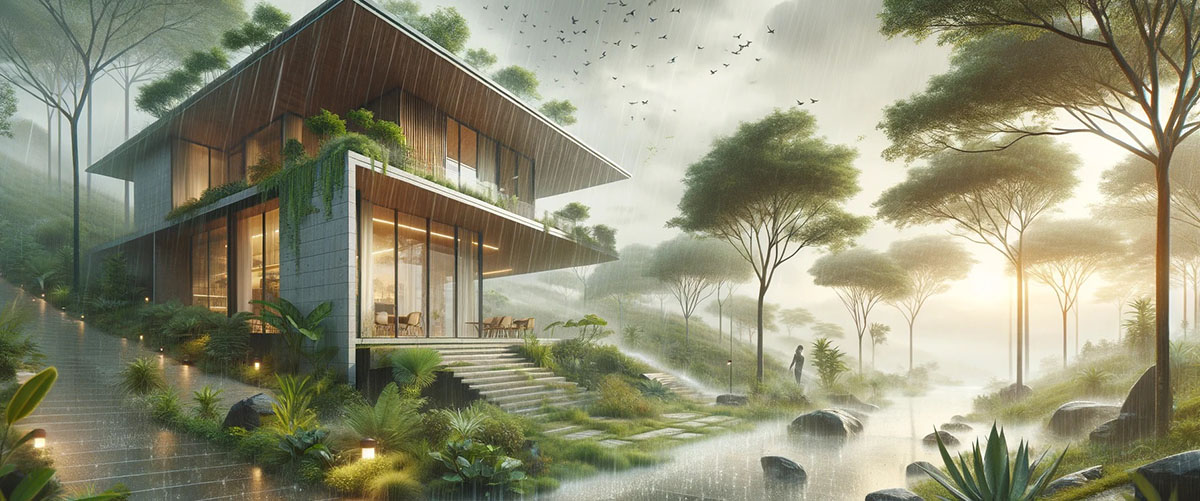
Climate as the primary determinant of architectural design
How climate and environment influence design decisions is the foundational question of bioclimatic architecture. A building's energy demand depends 40-60% on external climatic factors — solar radiation, air temperature, relative humidity, prevailing wind, and precipitation — and only 40-60% on internal factors such as occupancy, equipment, and lighting (Santamouris, 2014). The Köppen-Geiger climate classification divides the planet into 30 subtypes, but for architectural design, the climatic zones of Spain's CTE (A4 to E1, with 12 combinations of winter and summer climate severity) or ASHRAE 90.1's 8 zones are more practical. An identical building located in Seville (zone B4, 938 heating degree-days base 20°C) and Burgos (zone E1, 2,850 degree-days) shows heating demand differences of 200-300% with inverse cooling demands.
Solar radiation is the climatic parameter with the greatest impact on design. At mid-latitudes (35-45°N, the range where Spain is located), the south facade receives in winter between 3.5 and 5.0 kWh/m²·day of radiation on a vertical surface, while in summer it receives only 1.5-2.5 kWh/m²·day (the high sun reduces incidence on the vertical plane). The west facade, by contrast, receives 3.0-4.5 kWh/m²·day in summer at low angles of incidence that make solar protection difficult. The immediate surroundings — topography, vegetation, adjacent buildings — modify effective radiation: a building on a north-south oriented street with a height-to-width ratio of 2:1 receives 40-60% less direct radiation on its facades than a freestanding building (Oke, 2017). Design decisions regarding orientation, window-to-wall ratio, solar shading, and thermal mass must respond to these specific climatic conditions, not to generic prescriptions.
Design strategies for hot and temperate climates
In hot-dry climates (CTE zones B4, C4, cities like Seville, Cordoba, Almeria), the priority is solar protection and heat dissipation. Strategies include: orienting the longitudinal axis east-west to maximize the south facade (controllable with overhangs) and minimize the east and west facades (difficult-to-block irradiation); window-to-wall ratio ≤ 30% on east and west facades and ≤ 40% on the south facade with solar shading (solar heat gain coefficient g ≤ 0.25); high thermal mass (walls of 400-600 kg/m²) to buffer the daily thermal oscillation of 15-20°C; light-colored roofs (solar reflectance ≥ 0.70) that reduce surface temperature by 30-40°C compared to dark roofs; and nighttime cross ventilation at rates of 10-15 air changes/hour to evacuate heat stored during the day. The natural environment provides additional resources: perimeter vegetation reduces surrounding air temperature by 2 to 5°C (oasis effect), and interior courtyards — a traditional element of Mediterranean architecture — generate descending convective currents that cool adjacent spaces.
In temperate-humid climates (CTE zones C1, C2, cities like Bilbao, Santiago de Compostela, with 1,200-1,800 mm/year of precipitation and 150-200 days of rain), design decisions prioritize passive solar gain in winter and moisture management. The south facade should maximize glazed area (window-to-wall ratio 40-60%) with low-emissivity glass (U ≤ 1.1 W/m²·K, g ≥ 0.50) to capture the scarce winter radiation (1.5-2.5 kWh/m²·day in December). The envelope must be highly insulated (U ≤ 0.25 W/m²·K for walls) yet vapor-permeable (μ ≤ 30 for the insulation) to prevent interstitial condensation in a climate with average relative humidity of 75-85%. Oversized eaves and gutters (150% of standard calculations) protect facades from wind-driven rain which, combined with winds of 60-100 km/h, generates water pressures of 500-1,500 Pa on the facade plane. The environment in these zones — deciduous vegetation on the south side, evergreen vegetation to the north as windbreaks — complements architectural design decisions.
Design strategies for cold and mountain climates
In cold continental and mountain climates (CTE zones D and E, cities like Burgos, Soria, Avila, with average January temperatures of -1 to 4°C and 2,500-3,500 heating degree-days), heating demand dominates the energy balance: 80-120 kWh/m²·year in conventional buildings versus 15-25 kWh/m²·year in optimized buildings. Design decisions focus on minimizing heat losses: envelope with U-values ≤ 0.18 W/m²·K for walls, U ≤ 0.15 W/m²·K for roofs, and U ≤ 0.85 W/m²·K for windows (triple glazing with argon). Airtightness is critical: air infiltration can account for 25-40% of total heat losses; the Passivhaus standard requires n₅₀ ≤ 0.6 ACH measured with a Blower Door test. Building compactness (ratio of envelope surface area to habitable volume) must be minimized: a building with a form factor of 0.5 m⁻¹ has 30% fewer losses than one with a factor of 0.8 m⁻¹ at equal transmittance.
The environment in cold mountain zones has a decisive influence. Topography determines solar exposure: a south-facing slope with a gradient of 15-20% receives in winter 20-30% more radiation than horizontal ground at the same latitude, which can reduce heating demand by 10-15 kWh/m²·year. Snow acts as a reflector (albedo 0.60-0.90), increasing reflected radiation onto facades by up to 40% in January-February, a relevant factor for sizing windows and solar collectors. Katabatic winds (descending by gravity on slopes) and thermal inversions (cold air trapped in valleys) create microclimates with temperature differences of 5-10°C over distances of 500 m. Design must incorporate natural windbreaks (dense conifer hedges with 40-60% porosity that reduce wind speed by 50-70% over a distance of 5-10 times the hedge height) and leverage the thermal mass of the ground (stable soil temperature of 12-15°C at 2 m depth) through earth-air heat exchangers or thermally activated foundations.
Urban microclimate and climate analysis tools
The urban microclimate substantially modifies reference climate parameters. The urban heat island effect (UHI) raises nighttime city temperatures by 2 to 8°C compared to rural surroundings (Oke et al., 2017), increasing cooling demand by 15-25% and reducing heating demand by 5-10%. Urban geometry — defined by the height-to-width ratio of the urban canyon (H/W), the sky view factor (SVF), and street orientation — determines solar access, ventilation, and comfort in public spaces. An SVF of 0.15-0.25 (narrow streets with tall buildings) reduces direct solar radiation at street level by 60-80%, beneficial in summer but problematic in winter. Microclimate simulation tools such as ENVI-met, CitySim, and RayMan allow evaluating these interactions with spatial resolutions of 0.5-5 m and temporal resolutions of 1-10 minutes.
Climate analysis tools for architectural design have reached a high degree of maturity. Climate Consultant (UCLA) processes EPW (EnergyPlus Weather) files from 2,100+ weather stations and generates psychrometric charts with quantified bioclimatic design strategies: for each climate, it indicates the percentage of comfort hours achievable with each strategy (natural ventilation, thermal mass, shading, passive solar heating). Ladybug Tools (Grasshopper/Rhino) integrates solar radiation, wind, outdoor comfort, and energy demand analysis in a parametric environment. Meteonorm generates synthetic climate data for any point on the planet with hourly resolution, interpolating between 8,400 stations in its database. Rigorous climate analysis at the beginning of a project — an investment of 20-40 hours of specialized professional time — can reduce a building's energy demand by 20% to 40% at no additional construction cost, simply through form, orientation, and envelope decisions informed by local climate data (Givoni, 1998). Design decisions grounded in how climate and environment influence the building are the foundation of all sustainable architecture.
References
- [1]Cooling the Cities — A Review of Reflective and Green Roof Mitigation Technologies to Fight Heat Island and Improve Comfort in Urban EnvironmentsSolar Energy, 103, 682-703.
- [2]Urban ClimatesCambridge University Press. ISBN: 978-0-521-84950-0
- [3]Climate Considerations in Building and Urban DesignJohn Wiley & Sons. ISBN: 978-0-471-29177-0
- [4]Design with Climate: Bioclimatic Approach to Architectural RegionalismPrinceton University Press (reeditado por Princeton Architectural Press, 2015). ISBN: 978-0-691-16910-0
- [5]Documento Básico HE — Ahorro de Energía (actualización 2019)Ministerio de Transportes, Movilidad y Agenda Urbana.
- [6]ANSI/ASHRAE/IES Standard 90.1-2022: Energy Standard for Sites and Buildings Except Low-Rise Residential BuildingsAmerican Society of Heating, Refrigerating and Air-Conditioning Engineers. ISBN: 978-1-955516-43-8
Comments 0
No comments yet. Be the first!
Leave a comment