
Industrial recycling of construction materials: scale and trends
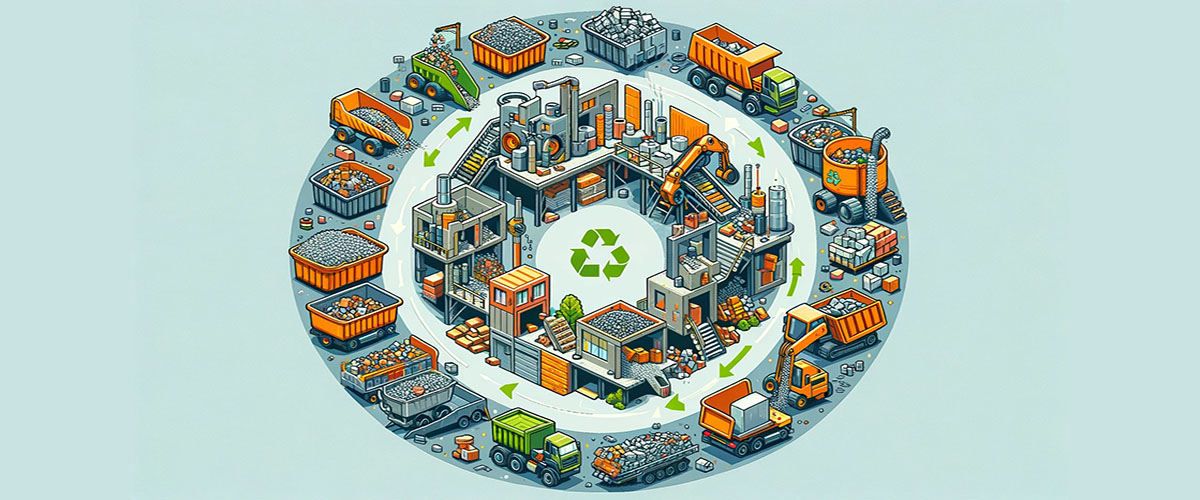
The use of recycled materials in modern construction has evolved from an experimental practice to a consolidated industrial sector. The EU generates 374 million tonnes per year of construction and demolition waste (CDW, Eurostat 2020), of which 69% is recovered, although the majority as low-quality backfill (downcycling). The real challenge is upcycling: reincorporating waste as materials with performance equivalent to or better than the original. Regulatory advances are driving this transition: EN 206:2013+A2:2021 permits up to 50% substitution of natural aggregate with recycled aggregate in structural concrete, the Construction Products Regulation (CPR recast, 2024) will include minimum recycled content requirements, and the EU Green Taxonomy recognises material circularity as a criterion for sustainable investment. These regulatory mechanisms collectively shift the economic baseline, making recycled content a market expectation rather than a niche preference.
Global volumes of recycled materials entering the construction supply chain are already significant: 630 million tonnes per year of recycled steel (World Steel Association, 2023 — representing 32% of global production), 250-300 million tonnes of recycled concrete aggregate (RILEM estimate, 2022), 82 million tonnes of recycled plastic globally (of which 5-8% is directed toward construction products), and 33 million tonnes of recycled glass (Container Recycling Institute, 2023). Modern construction has the capacity to absorb a significant fraction of these material flows, contributing to closing industrial-scale material cycles. As processing technology improves and regulatory pressure increases, the proportion of recycled content in standard construction specifications is projected to double within the next decade.
Recycled aggregate concrete: standards and structural performance
Recycled aggregate concrete (RAC) is the recycled material with the largest potential volume in construction. The process involves crushing demolished concrete to particle sizes of 4-32 mm, separating contaminants (wood, plastic, metals) through screening and flotation, and partially replacing natural aggregate. The European standard EN 206:2013+A2:2021 classifies recycled aggregates into types: Type A (at least 90% concrete, absorption below 7%, density above 2,100 kg/m3) permits up to 50% substitution for classes up to C30/37; Type B (at least 70% concrete and stone) permits up to 30%. National annexes vary: the UK's BS 8500-2 allows up to 20% substitution for designated concrete, while the Netherlands permits higher rates based on project-specific testing.
Performance studies confirm viability: a systematic review of 142 articles by Silva et al. (2014) concludes that replacing 30% of natural aggregate with Type A recycled material reduces compressive strength by 5-10%, tensile strength by 5-15%, and the elastic modulus by 10-20%. These reductions are compensable through mix design adjustments (5-10% additional cement or the addition of plasticiser admixtures). Durability is the primary concern: the higher porosity of recycled aggregate (3-8% absorption versus 0.5-2% for natural aggregate) increases permeability and susceptibility to carbonation, but treatments such as silane impregnation and pre-saturation of the aggregate effectively mitigate these effects. Recent research at ETH Zurich has demonstrated that carbonation curing of recycled aggregate before use can reduce absorption to levels comparable to virgin material, potentially allowing higher substitution rates in future code revisions.
Recycled steel: the EAF route as a modern construction standard
Steel is the most recycled material in the world by absolute volume: 630 million tonnes of steel scrap are processed annually (World Steel Association, 2023). The EAF (electric arc furnace) route melts scrap using electricity, emitting 0.3-0.8 tCO2 per tonne compared with 2.0-2.5 tCO2/t from the BOF (blast furnace with iron ore) route. In the EU, 43% of steel is produced via EAF (Eurofer, 2023), with Italy (82%), Spain (75%), and Turkey (69%) as leaders. Steel is infinitely recyclable without degradation of mechanical properties: an HEB profile produced today from scrap has identical strength to one manufactured from virgin ore. This metallurgical reality makes steel the construction industry's most circular structural material by a substantial margin.
In modern construction, specifying steel with high recycled content is one of the decisions with the greatest impact on embodied carbon. A structural profile from an EAF with 95% scrap and renewable electricity has a GWP of 0.15-0.25 tCO2/t — a 90% reduction compared to conventional BOF steel. EPDs (Environmental Product Declarations) from manufacturers such as ArcelorMittal, Celsa, and Gerdau specify recycled content per product, enabling the specifier to select low-impact steel. Standard EN 10025 does not differentiate mechanical properties between primary and recycled steel: grade S275 is S275, regardless of the raw material. This means that architects and engineers can substitute high-recycled-content steel in any structural application without design modification, making it one of the simplest and most impactful decarbonisation decisions available during the specification stage of a building project.
Recycled plastic: from waste stream to building material
Recycled plastic in construction is growing as a high-value niche. Verified applications include: plastic lumber (boards and profiles of recycled HDPE for urban furniture, pergolas, and fences — lifespan exceeding 50 years, maintenance-free, resistant to moisture and wood-boring insects), PET recycled insulation (thermal conductivity 0.034-0.039 W/m K, manufactured from shredded bottles — approximately 30-50 bottles per m2 of insulation), geotextiles and geogrids from recycled PP/PET (for layer separation, drainage, and soil reinforcement), and tiles and panels from recycled polymer (companies such as EcoCocon and Conceptos Plasticos manufacture structural HDPE panels for social housing — 50% lighter than concrete, 30% lower cost). These applications demonstrate that recycled plastic can meet structural and performance requirements when properly formulated and tested.
The principal challenge for recycled plastic is feedstock heterogeneity: plastic waste from CDW includes PVC pipes, PE sheeting, EPS and PS foams, packaging film, and PVC-coated cables. Separation by polymer type is critical to obtaining recycled material with predictable properties. Technologies such as near-infrared (NIR) sorting achieve purities of 95-99% by polymer type, and chemical recycling (pyrolysis, solvolysis) enables decomposition of mixed plastics into reusable monomers. The EU has set a target of 10 million tonnes of recycled plastic incorporated into products by 2025 (European Plastics Strategy, 2018), with construction designated as a priority absorption sector. Achieving this target will require investment in dedicated CDW plastic sorting infrastructure and the development of product standards specifically addressing recycled polymer performance in building applications.
References
- [1]Properties and composition of recycled aggregates from construction and demolition waste suitable for concrete productionConstruction and Building Materials, 65, 201-217.
- [2]Sustainability Indicators 2023 — Steel RecyclingWorld Steel Association.
- [3]A European Strategy for Plastics in a Circular EconomyEuropean Commission, COM(2018) 28 final.
- [4]Characteristics and pozzolanic reactivity of glass powdersCement and Concrete Research, 35(5), 987-993.
- [5]Generation of waste by waste category — Construction waste statisticsEuropean Commission / Eurostat.
- [6]Informe Anual 2023: Gestión de Neumáticos Fuera de Uso en EspañaSIGNUS Ecovalor.

Comments 0
No comments yet. Be the first!
Leave a comment