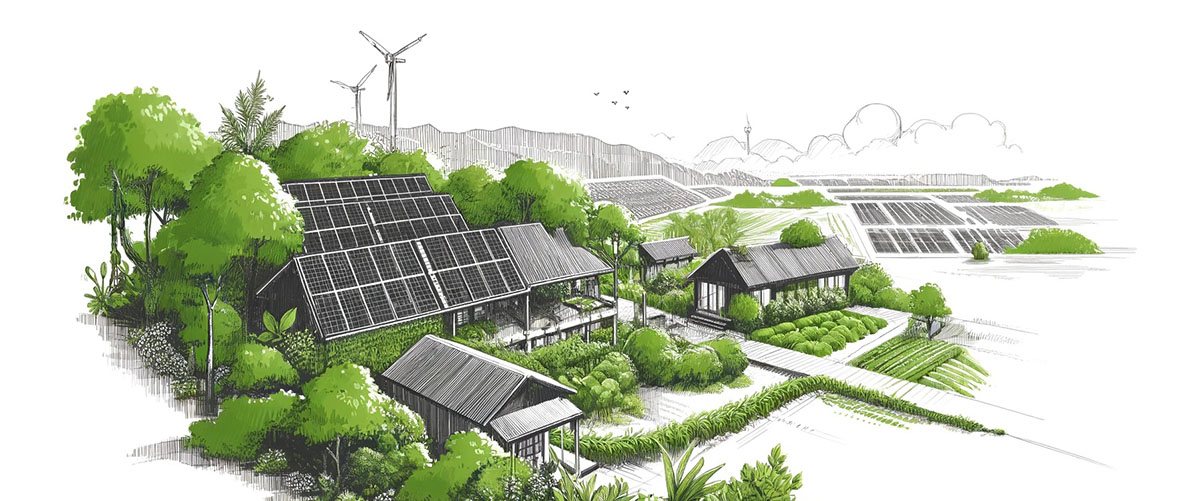
High-Performance Envelope: The First Barrier Against Energy Waste
Techniques and technologies for optimizing energy consumption in buildings begin with the envelope, responsible for 40-60% of thermal losses in existing buildings. A wall with ETICS insulation of 120-200 mm graphite EPS (λ = 0.031 W/mK) achieves U-values of 0.15-0.25 W/m²K, reducing heating demand by 50-70% compared to an uninsulated wall (U = 1.2-2.0 W/m²K). Inverted roofs with 120-160 mm XPS (λ = 0.034 W/mK) achieve U = 0.18-0.25 W/m²K. Thermal bridges — floor-to-facade junctions, window perimeters, columns — represent 15-30% of total losses and are resolved with thermal break elements such as Schöck Isokorb (ψ ≤ 0.10 W/mK) or continuous external insulation.
High-performance windows are the weakest component of the envelope: triple glazing with dual low-e coatings and krypton gas fill achieves Uw = 0.7-0.9 W/m²K (compared to 2.5-3.5 W/m²K for single glazing). Frames of PVC with fiberglass reinforcement or timber-aluminum achieve Uf = 0.8-1.0 W/m²K. Air tightness is critical: the Passivhaus standard requires n₅₀ ≤ 0.6 air changes/hour (Blower Door test at 50 Pa), while the Spanish CTE allows up to 6.0 ACH in dwellings — an order of magnitude difference. Each reduction of 1.0 ACH in infiltrations saves 8-15 kWh/m²·year in heating. Deep energy retrofit of the envelope — ETICS + windows + airtightness — reduces the total energy demand of the building by 60-80% (European project EuroPHit, 2014-2019).
High-Efficiency HVAC Systems: Heat Pumps and Heat Recovery
Heating, ventilation and air conditioning (HVAC) systems represent 40-60% of the total energy consumption of buildings. Current air-source heat pumps (Daikin Altherma 3, Vaillant aroTHERM plus, Saunier Duval GeniaAir) achieve COP values of 4.0-5.5 at 7°C/35°C (EN 14511) and seasonal SCOP values of 3.5-4.8, generating 3.5-4.8 kWh of heat per kWh of electricity consumed. Ground-source heat pumps (with vertical boreholes at 80-150 m depth) achieve COP values of 4.5-6.0 thanks to the stable ground temperature (12-16°C), with a borehole drilling premium of 40-80 EUR/linear meter amortizable in 8-12 years.
Mechanical ventilation with heat recovery (MVHR) is essential in airtight buildings: cross-flow heat exchangers achieve efficiencies of 75-85%, while enthalpy counterflow units achieve 85-95% (Zehnder ComfoAir Q, Systemair SAVE VTR). An MVHR unit with η = 90% in a Passivhaus building recovers 25-35 kWh/m²·year from the 30-40 kWh/m²·year of ventilation losses. The electrical consumption of the MVHR is only 0.3-0.5 Wh/m³ of treated air. VRF (Variable Refrigerant Flow) systems for commercial buildings (offices, hotels) modulate capacity from 10-100% of the load, achieving EER values of 4.0-6.5 in cooling mode and savings of 30-40% compared to conventional fixed-capacity ducted systems.
LED Lighting, DALI Control and Natural Light Harvesting
Lighting represents 15-25% of electricity consumption in office buildings and 5-10% in dwellings. Current LED technology achieves efficacies of 80-200 lm/W (compared to 12-15 lm/W for incandescent and 60-80 lm/W for fluorescent), a service life of 50,000-100,000 hours (L70) and a color rendering index CRI ≥ 90. Replacing T8 fluorescents with LED panels in a 1,000 m² office reduces lighting power density from 12-15 W/m² to 4-7 W/m² — a saving of 50-65%. The investment of 15,000-25,000 EUR is amortized in 2-4 years at an electricity cost of 0.20 EUR/kWh.
The DALI-2 (Digital Addressable Lighting Interface) protocol enables individual luminaire control with 0-100% dimming, occupancy detection and automatic daylight-linked regulation (daylight harvesting). A DALI system with occupancy and luminosity sensors reduces lighting consumption by an additional 40-60% beyond the base LED efficiency. PIR/microwave occupancy sensors eliminate 100% of consumption in unoccupied zones (corridors, toilets, meeting rooms). Integration with motorized blinds maximizes the contribution of natural light: an sDA (spatial Daylight Autonomy) ≥ 55% of the floor area illuminated with ≥ 300 lux during ≥ 50% of occupied hours (LEED EQ Daylight criterion, 2 points). The The Edge building (Amsterdam, 2015, PLP Architecture, BREEAM Outstanding 98.36%) consumes only 70 kWh/m²·year total thanks to 30,000 IoT sensors that regulate lighting, HVAC and blinds by occupancy zone.
Integrated Renewables: Photovoltaics, Solar Thermal and Geothermal
On-site renewable energy generation is the complementary strategy to demand reduction. Rooftop photovoltaic systems with high-efficiency monocrystalline panels (20-22%, power 400-600 Wp/panel) generate 1,200-1,800 kWh/kWp·year in Spain (irradiation 1,600-2,100 kWh/m²·year). A 2,000 m² office building with 500 m² of rooftop PV (100 kWp) generates 140,000-170,000 kWh/year, covering 40-70% of its electricity consumption. The cost of rooftop PV has fallen to 0.8-1.2 EUR/Wp installed (2024), with an LCOE of 0.03-0.06 EUR/kWh and a payback period of 4-7 years.
BIPV (Building Integrated Photovoltaics) systems integrate photovoltaic cells into the facade, roof or sunshades, replacing conventional building materials. Ventilated facade BIPV modules (Onyx Solar, Schüco) generate 60-100 kWh/m²·year in a south-facing orientation at 90° inclination (facade irradiation: 800-1,200 kWh/m²·year). Solar thermal collectors with evacuated tubes achieve efficiencies of 60-75% and cover 50-70% of DHW demand (40-60 l/person·day at 60°C) according to the DB HE-4 of the CTE. Thermal storage in buffer tanks (500-2,000 liters) with phase change materials (PCM, melting point 21-28°C) increases storage capacity by 200-400% per unit volume compared to water. The standard ISO 52000-1:2017 provides the calculation framework for the overall building energy balance, integrating demand, renewable generation and storage.
Intelligent Management: BMS, IoT and Artificial Intelligence Optimization
Building Management Systems (BMS) monitor and control all energy subsystems — HVAC, lighting, blinds, renewables, lifts — from a centralized platform. A BMS with open protocols (BACnet, KNX, Modbus) and 24/7 supervision reduces energy consumption by 15-25% compared to manual operation. The incorporation of artificial intelligence algorithms (machine learning trained on historical data for occupancy, weather and tariffs) optimizes HVAC operating patterns: the Google DeepMind system applied to Google data centers reduced cooling consumption by 40% (2016), and similar systems (BrainBox AI, Siemens Building X) achieve reductions of 20-35% in office buildings.
IoT monitoring with circuit-level energy meters (submetering) according to the standard EN 15232 (class A: high energy efficiency) enables real-time detection of consumption deviations. A building with submetering and class A BMS consumes 30-40% less than one with class D (no automation). Active demand management (demand response) shifts 10-20% of electricity consumption to off-peak tariff periods or PV surplus windows, reducing energy cost by 15-25%. The standard LEED v4.1 EA awards up to 18 points for Optimize Energy Performance, requiring energy simulation (ASHRAE 90.1 Appendix G) demonstrating savings of 24-50% compared to the reference building. The combination of high-performance envelope + efficient HVAC + LED + renewables + BMS enables achievement of the NZEB (Nearly Zero Energy Building) target defined by European Directive 2010/31/EU, with total consumption of 15-40 kWh/m²·year of primary energy.
References
- [1]A review on buildings energy consumption informationEnergy and Buildings, 40(3), 394-398.
- [2]Directive 2010/31/EU on the energy performance of buildings (EPBD recast)Official Journal of the European Union, L 153/13.
- [3]ASHRAE Standard 90.1-2019: Energy Standard for Buildings Except Low-Rise ResidentialAmerican Society of Heating, Refrigerating and Air-Conditioning Engineers. ISBN: 978-1-947192-47-6
- [4]DeepMind AI Reduces Google Data Centre Cooling Bill by 40%DeepMind Blog / Google.
- [5]EN 15232-1:2017 — Energy Performance of Buildings: Impact of Building Automation, Controls and Building ManagementEuropean Committee for Standardization.

Comments 0
No comments yet. Be the first!
Leave a comment