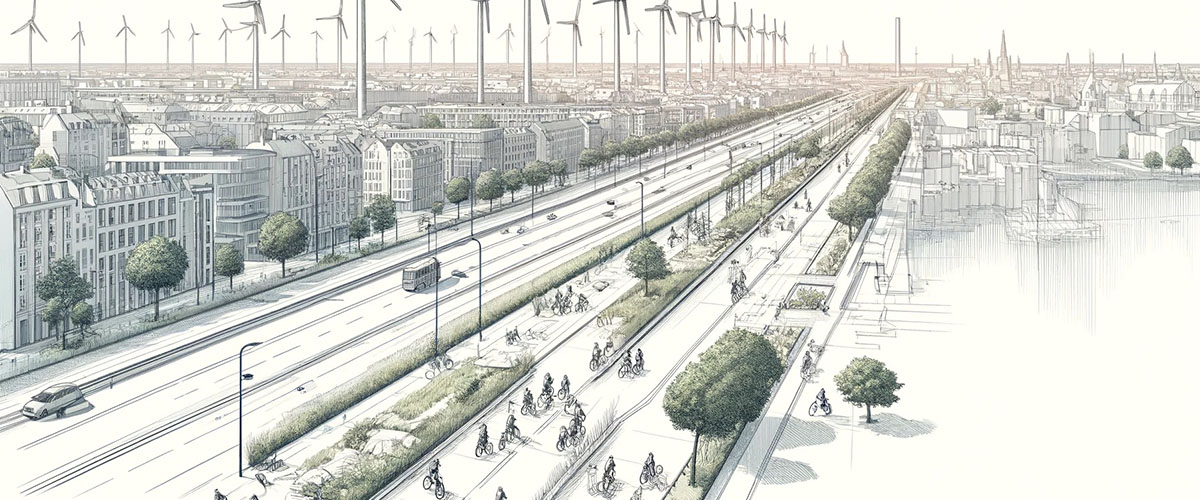
The Copenhagen model: from industrial city to global green capital
Urban sustainability in Copenhagen is the result of 50 years of coherent and cumulative policies. In 1962, the Stroget — the central commercial artery — was pedestrianized, becoming the first permanent pedestrian street in Europe. In the 1970s, the oil crisis drove investment in district heating and cycling infrastructure. In 2009, the Copenhagen Climate Plan established the goal of being the world's first carbon neutral capital by 2025. As of 2024, per capita CO2 emissions have declined from 6.0 tCO2/inhabitant (2005) to 1.4 tCO2/inhabitant — a reduction of 77% in 19 years.
Copenhagen's population has grown from 502,000 inhabitants (2000) to 644,000 (2024) — a 28% increase — while emissions decreased by 77%. This absolute decoupling between economic/demographic growth and emissions is the most significant achievement of the model: Copenhagen's GDP per capita is 62,000 EUR/inhabitant (2023), above the Danish average and that of most European capitals. The pillars of the model are: (1) integrated urban planning (Finger Plan of 1947, updated in 2007: densification along public transport "phalanges," preservation of "green valleys" between them); (2) continuous investment in cycling infrastructure and public transport; (3) energy transition of district heating; (4) progressively stricter building regulations (Building Regulations BR18: maximum heating demand of 20 kWh/m2·year for new buildings).
Cycling mobility: 390 km of lanes and 49% of commuting trips
Copenhagen has built the most heavily used urban cycling network in the world: 390 km of protected bike lanes, 27 km of cycling superhighways (supercykelstier) connecting the suburbs to the center at average speeds of 20-25 km/h, and 670,000 bicycles for 644,000 inhabitants (more bicycles than people). 49% of commuting trips to work and school are made by bicycle (Copenhagen Municipality, 2023) — the highest percentage of any capital city in the world.
The cycling infrastructure includes: bidirectional lanes of 3.0-4.5 m width separated from motorized traffic by raised curbs or parking rows, green waves (gronne bolger) of traffic lights synchronized at 20 km/h on main arteries (allowing cyclists to cross the center without stopping), real-time counting sensors (18 permanent counting stations: 24,000-50,000 cyclists/day at the busiest station, Dronning Louises Bro), and 3,500 covered bicycle parking facilities next to metro and S-tog (commuter rail) stations. The cycling and pedestrian bridge Cykelslangen (Bicycle Snake, 2014, DISSING+WEITLING, 235 m length, helical ramp) connects the Islands Brygge neighborhood with the center, eliminating a 5 m elevation difference. Investment in cycling infrastructure is 30-50 million EUR/year, with a documented social return of 5.50 DKK for every 1 DKK invested (Copenhagen Economics, 2019) through reduced healthcare costs, congestion and pollution.
District heating: Europe's greenest thermal network
Copenhagen's district heating network (HOFOR + CTR + VEKS) is one of the most extensive in the world: >1,650 km of pipes distributing heat to 550,000 households (98% of the city). The energy transition of the network has been radical: in 1990, 80% of the heat came from fossil fuels (natural gas + coal); in 2024, 80-85% comes from renewable and residual sources: incineration of non-recyclable waste (30%: Amager Bakke/CopenHill and Vestforbraending plants), biomass (25%: certified wood chips and pellets), industrial and data center waste heat (15%: including server heat from Facebook/Meta), deep geothermal (5%) and large-scale heat pumps (10%).
District heating emissions have fallen from 200 gCO2/kWh (2005) to 40-60 gCO2/kWh (2024). The Amager Bakke / CopenHill plant (2019, BIG Architects, 440,000 tonnes/year of waste, 63 MW electrical + 247 MW thermal) is the flagship facility: the world's cleanest incinerator (dioxin emissions 99.5% below the EU limit), with a rooftop ski slope of 85 m vertical drop and an 80 m climbing wall. The BioCirc project (under construction, 2025: organic waste biogasification plant, 50 MW thermal) will eliminate the last coal dependency. Copenhagen targets 100% renewable heating by 2030. The cost to users is 0.08-0.12 EUR/kWh of heat — competitive with individual natural gas — with a supply reliability of 99.97% (less than 3 hours of unscheduled interruption per year).
Reference buildings: The Silo, CopenHill and 8 House
Copenhagen concentrates an exceptional density of innovative buildings that materialize urban policies. The The Silo (2017, COBE Architects, 38 m, 40 dwellings) converts an industrial grain silo from 1963 into luxury housing with a facade of perforated galvanized steel balconies that provide panoramic harbor views, solar protection and privacy — rehabilitation budget: 3,500 EUR/m2, with heating energy consumption of 35 kWh/m2·year (connected to the district network). UN City (2013, 3XN, 45,000 m2, headquarters of 11 UN agencies in Copenhagen) achieved LEED Platinum with: triple-glazed facade with solar screen printing, atrium with natural ventilation, 1,400 m2 of rooftop photovoltaics, seawater cooling and consumption of 65 kWh/m2·year.
The Nordhavn (North Harbor, under development 2012-2040, 40,000 residents, 40,000 jobs) is Copenhagen's largest urban development project and a sustainability laboratory: 100% renewable energy (district heating + photovoltaics + geothermal), electric and cycling mobility (no surface car parking), 60% green or blue public space (canals, parks, waterfront promenades), and buildings with energy demand < 20 kWh/m2·year (BR18). The project integrates climate adaptation solutions: streets with sustainable drainage, floodable parks (retention capacity: 10,000 m3 during extreme rainfall events) and flood defense barriers against sea level rise (+1.0 m projected for 2100). Copenhagen demonstrates that urban sustainability is a generational program — current results are the fruit of decisions made 30-50 years ago — and that coherence between mobility, energy, construction and public space policies is more decisive than any individual technology.
Replicable policies and lessons for other cities
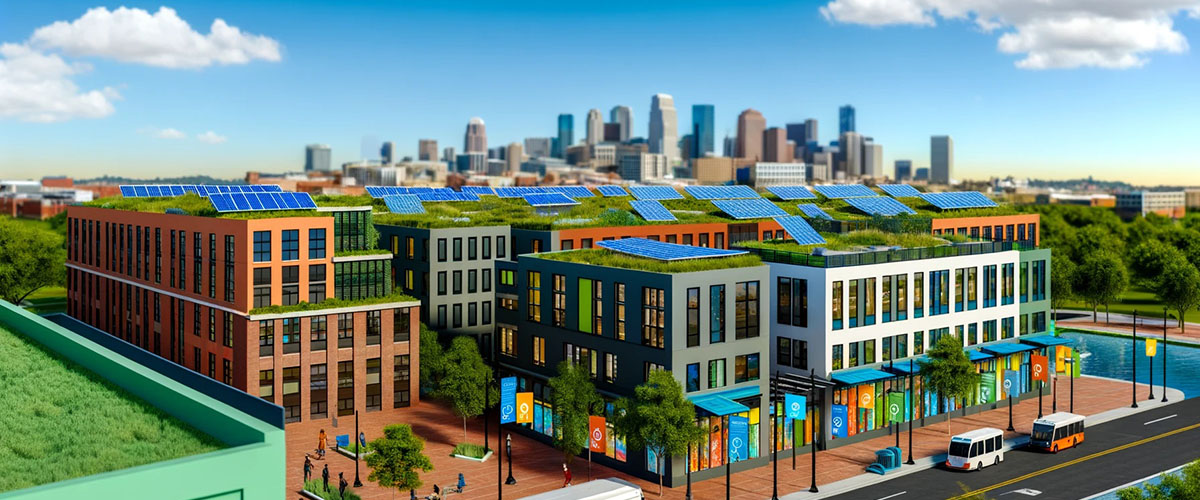
The replicable policies of the Copenhagen model include: (1) legal cycling priority — Danish Traffic Law requires cars to yield to bicycles at intersections, and urban planning allocates 25-30% of road space to cycling; (2) progressive fossil fuel ban — since 2013, new buildings in Copenhagen cannot connect to natural gas; since 2020, existing gas boilers must be replaced at end of life with district network connection or heat pump; (3) green roof ordinance — since 2010, all new construction with flat roofs must incorporate vegetated roofing (over 200,000 m2 installed); (4) data transparency — the municipality publishes emissions, energy consumption, mobility and air quality data in real time (Open Data Copenhagen platform).
The lessons for cities aspiring to replicate the model are: (1) investment in cycling infrastructure has a social return of 4-6x the investment; (2) district heating is the key technology for decarbonizing heating in cities with density > 50 dwellings/ha; (3) progressively stricter regulations (BR10 to BR15 to BR18: reduction of the heating limit from 52 to 30 to 20 kWh/m2·year) allow industry to adapt; (4) sector integration (energy + transport + waste + water + construction) produces synergies that sectoral approaches do not capture — the Hammarby model of circular urban metabolism was adopted and expanded by Copenhagen. The European Green Capital Award, granted to Copenhagen in 2014, recognized the city's systemic approach. Barcelona, Madrid, Valencia and Seville are selectively adopting policies from the Copenhagen model: superblocks (Barcelona), Madrid Central/Madrid 360, Valencia's cycling ring and Seville's district heating network (pilot project Expo 2025).
References
- [1]CPH 2025 Climate Plan: A green, smart and carbon neutral cityThe City of Copenhagen, Technical and Environmental Administration.
- [2]Copenhagen City of Cyclists: Bicycle Account 2022The City of Copenhagen, Traffic Department.
- [3]The Socio-Economic Benefits of Cycling in CopenhagenCopenhagen Economics ApS / Danish Ministry of Transport.
- [4]District Heating in Greater Copenhagen: Fuel Mix and CO₂ Emissions 2023Greater Copenhagen Utility (HOFOR A/S).
- [5]European Green Capital Award 2014: Copenhagen — Technical Assessment ReportDG Environment, European Commission.

Comments 0
No comments yet. Be the first!
Leave a comment