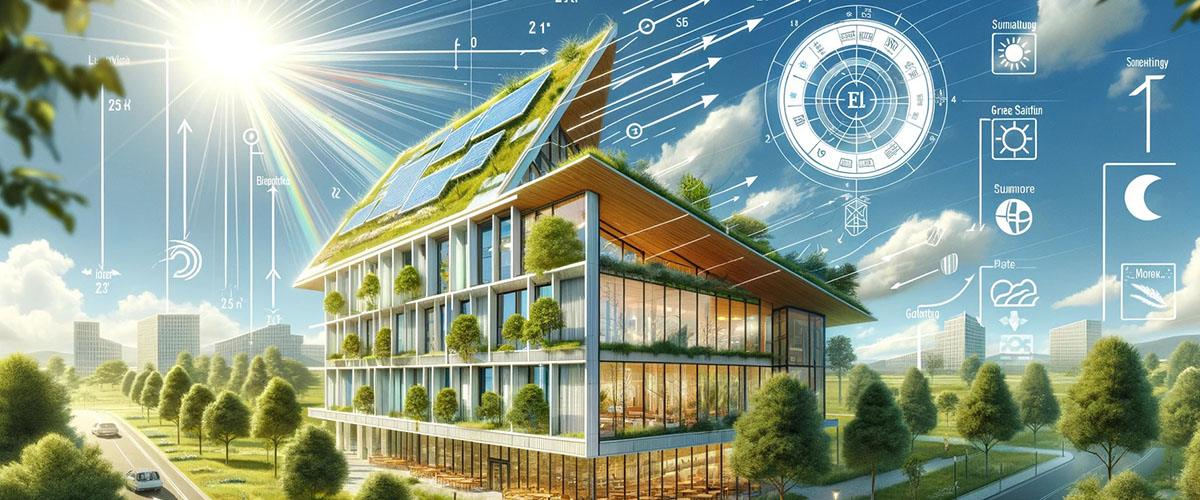
Orientation as a Foundational Design Decision
LEED Certification places great importance on building orientation as a key determinant of energy performance. Building orientation determines the amount of solar radiation each facade receives throughout the year, conditions the effectiveness of natural ventilation, and establishes the foundation for interior luminous comfort. According to a study published in Sustainability (MDPI, 2024) analyzing the energy performance of residential buildings across different climatic zones in Afghanistan, the difference between optimal and worst orientation can yield energy savings between 25.6% and 48.9% in combined heating and cooling.
The Bonneville Power Administration and the California Department of Energy documented that a home correctly oriented toward the sun, without any other solar modifications, saves between 10% and 20% on heating, and in optimal configurations with appropriate thermal mass and glazing, savings can reach 40%. These figures make orientation the passive strategy with the best cost-benefit ratio, as it involves zero additional construction cost.
Solar Geometry and Latitude
In the Northern Hemisphere, the south facade receives maximum solar radiation in winter (low angle of incidence, deep penetration) and minimum in summer (high angle, easily blocked by overhangs). The building's aspect ratio is critical: a building with its longitudinal axis oriented east-west maximizes the south facade. The recommended proportion is 1.5:1 to 2:1 (length along the E-W axis versus width along the N-S axis).
For latitudes between 35°N and 45°N (Mediterranean zone, central-southern Europe, central U.S.), the south facade receives approximately 2.5 times more radiation in winter than east or west facades. In summer, east and west facades receive radiation at a grazing angle, which is difficult to block, generating the highest cooling loads. Therefore, LEED-oriented design prioritizes minimizing glazed surfaces on east and west orientations.
In tropical latitudes (0°-23.5°N/S), the roof receives the highest solar load. Here the strategy shifts: optimal orientation seeks to minimize roof exposure and maximize cross ventilation by harnessing prevailing winds.
Impact on LEED Credits — Energy and Atmosphere (EA)
The EA category in LEED v4.1 awards up to 33 points, representing 30% of the total score. Orientation directly affects the Optimize Energy Performance credit (up to 18 points), as the energy model per ASHRAE 90.1 Appendix G compares the proposed building with a reference building. An orientation that maximizes passive solar gains in winter and minimizes them in summer reduces HVAC demand, improving the savings percentage over the baseline.
In quantitative terms, a properly oriented office building in climate zone 4A (Madrid, New York) can achieve a 15-25% reduction in HVAC demand through orientation and glazing ratio optimization alone, equivalent to 4-8 additional LEED points in the EA credit. Combined with calibrated external solar protections (horizontal overhangs with depth = 1/3 of glazing height on the south facade), savings can exceed 30%.
Impact on Indoor Environmental Quality (IEQ)
Orientation conditions two IEQ credits: Daylight (up to 3 points) and Quality Views (1 point). The daylight credit requires 55% to 90% of regularly occupied area to achieve illuminance levels between 300 and 3,000 lux, measured via CIE sky simulation or direct measurement at the equinoxes.
A south orientation (Northern Hemisphere) with a Window-to-Wall Ratio (WWR) of 40-60% on the south facade and 15-25% on east and west facades maximizes diffuse natural light without generating direct glare. North facades provide consistent diffuse light, ideal for workspaces requiring luminous uniformity, as in the offices of the New York Times Building (Renzo Piano, 2007, LEED Gold), which uses automated ceramic curtains on east and west facades and large glass panels facing north for diffuse illumination.
Impact on Sustainable Sites (SS)
The Heat Island Reduction credit (SS, 2 points) indirectly benefits from orientation: a building with lower cooling loads emits less residual heat to the surroundings. Additionally, orientation determines which facades can effectively incorporate vertical vegetation or green roofs (north facades receive less radiation, requiring shade-tolerant species).
Orientation also influences rainwater management: roof slope and orientation affect collection system performance. A south-sloping roof in areas with predominantly southwest rainfall can capture up to 15% more useful runoff than a north-facing one.
Solar Analysis Tools for LEED Projects
Orientation analysis should be conducted during the initial design phases. Commonly used tools in LEED projects include: Autodesk Insight (integrated with Revit, enabling solar radiation studies per facade), Ladybug/Honeybee for Grasshopper (parametric analysis of radiation, daylighting, and energy based on EnergyPlus and Radiance), Climate Consultant (UCLA, climate data analysis and bioclimatic strategies), and DIVA for Rhino (daylight and radiation simulation).
The recommended process involves: (1) analyzing site climate data using EPW (EnergyPlus Weather) files; (2) modeling annual solar radiation on facades for different building axis orientations (rotations from 0° to 180°); (3) comparing resulting heating and cooling demands; and (4) selecting the orientation that minimizes total annual energy consumption, weighting heating and cooling by local energy prices.
Case Study: Manitoba Hydro Place, Winnipeg (Canada)
Manitoba Hydro Place (2009, LEED Platinum), designed by Kuwabara Payne McKenna Blumberg Architects, is a paradigmatic example of orientation-driven design. Located at latitude 49.9°N with extreme winters (-35°C), the building is oriented with its main facade facing south, maximizing passive solar gain during the coldest months. The south facade features a double-skin curtain wall with a 1.2 m cavity acting as a solar collector, preheating ventilation air and reducing heating demand by 70% compared to the ASHRAE 90.1 reference building.
The building's measured energy consumption is 85 kWh/m²/year, 65% below the average for Canadian office buildings (240 kWh/m²/year). East and west facades use vertical aluminum louvers that block direct solar radiation when the angle of incidence drops below 45°, reducing summer cooling loads without compromising views.
References
- [1]Impact of Building Orientation on Energy Performance of Residential Buildings in Various Cities Across AfghanistanMDPI Sustainability, 16(24), 11076.
- [2]Passive Solar Design Fact SheetU.S. DOE.
- [3]LEED v4.1 BD+C Rating SystemUSGBC.
- [4]Impacts of some building passive design parameters on heating demand for a cold regionBuilding and Environment, 41(12), 1742-1754.
- [5]Manitoba Hydro Place: Post-Occupancy Performance ReportManitoba Hydro.

Comments 0
No comments yet. Be the first!
Leave a comment