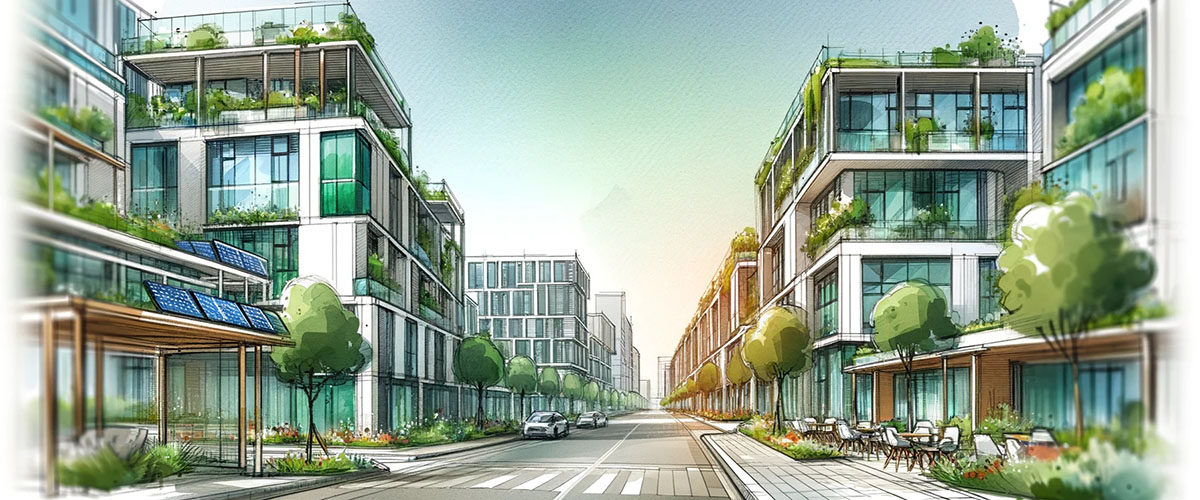
Circular Architecture: From Theory to Completed Buildings
Landmark recycling and reuse projects in modern architecture represent the built translation of circular economy principles. These are not experimental prototypes but real buildings -- occupied, monitored and documented -- that demonstrate the technical, economic and aesthetic viability of recycling and reuse at the architectural scale. Modern circular architecture rests on four design principles: design for disassembly (DfD), which favours reversible mechanical connections over chemical bonds; design by layers (Stewart Brand's concept from How Buildings Learn, 1994: separating structure, skin, services and space plan into components with different service lives); digital documentation (material passports recording composition, condition and residual value); and circular material selection (choosing materials that are recyclable, reusable or biodegradable at end of life).
The number of buildings implementing these principles is growing exponentially: the Madaster platform documents more than 2,500 buildings with material passports across Europe (2024), BAMB (Buildings as Material Banks) developed guidelines applied in over 100 pilot projects between 2015 and 2020, and the Cradle to Cradle certification has evaluated more than 800 construction products. The projects described below are not the only examples, but they are the most thoroughly documented, with cost data, environmental performance metrics and lessons learned published in peer-reviewed literature or verifiable technical reports. They provide a body of evidence that design teams and policymakers can reference when making the case for circular construction at any scale.
Triodos Bank HQ and Brummen Town Hall: 100% Disassemblable Buildings
The Triodos Bank HQ (Driebergen-Zeist, Netherlands, 2019, RAU Architects + Erik Schotte) is the largest timber building in the Netherlands (13,000 m2 above ground) and a global benchmark for design for disassembly. The primary structure is CLT and glulam from FSC-certified spruce, joined exclusively with bolted connections (no structural adhesives). The 1,628 timber columns are anchored with demountable steel plates. The facade is a double-skin glass system with timber frames fixed by bolts and sealed with mechanical gaskets (no silicone). Services run through raised floors and accessible ceilings. 100% of the materials are documented in a Madaster passport recording composition, mass, residual value and disassembly sequence. The estimated additional cost of the disassembly-ready design was 2-4%, but the residual value of the materials at end of life (75 years) is estimated at 15-20% of the original construction cost.
The Brummen Town Hall (Brummen, Netherlands, 2013, RAU Architects) was the first public building designed as a temporary material depot. The municipality signed a 20-year use contract, after which the building will be deconstructed and the materials reused. The bolted steel structure, timber facade with mechanical joints, raised technical floors and accessible services ensure 95% recoverability. Materials are not owned by the municipality but by the manufacturers (a product-as-a-service model): Desso retains ownership of the carpets, Philips of the lighting, and RAU coordinates the deconstruction plan. The operating cost (lease plus services) is competitive with that of conventional public buildings, demonstrating that the circular model does not require a permanent cost premium and can in fact improve long-term financial performance for public sector clients.
Resource Rows and SuperLocal: Building with Reused Materials
The Resource Rows project (Orestad, Copenhagen, 2019, Lendager Group) is a housing development of 32 dwellings whose facades are constructed from 1.4 million reused bricks salvaged from demolished buildings in Copenhagen. The bricks were manually dismantled (original lime mortar bricks separate easily), cleaned, sorted by colour and assembled into prefabricated panels measuring 3 x 1.2 m in a workshop. The visual result is deliberately heterogeneous: each panel displays the patina and tonal variations of its source building. The facade emission reduction was 70% compared to new brick (avoided emissions: 0.20 kgCO2/brick x 1,400,000 bricks = 280 tCO2). The total project cost premium was 5% over a conventional equivalent, offset by marketing value and commercial differentiation in a market increasingly sensitive to environmental credentials.
The SuperLocal project (Kerkrade, Netherlands, 2022) set the record for reused content: 5 dwellings built with 98% of materials (by weight) sourced from demolished buildings within a 15 km radius. The precast concrete structure was cut from existing elements and reconfigured, aluminium window frames were adapted, brick was dismantled and re-laid, and services were recovered and inspected. Embodied carbon was 90% lower than that of equivalent new-build dwellings. The Circle House project (Aarhus, Denmark, 2020, Lendager Group + Lejerbo) applies circular principles to 60 social housing units: precast concrete structure with bolted connections, facade panels of recoverable brick, accessible services throughout. Landfill diversion reached 90% and the cost premium was 3-5%, with an estimated residual value of 20-25% at 50 years. These projects collectively demonstrate that material reuse at scale is not only technically feasible but financially defensible.
Park 20|20 and Other Circular Districts: Scaling Up Circularity
Park 20|20 (Hoofddorp, Netherlands, 2011-ongoing, William McDonough + Partners) is the world's first business district designed according to Cradle to Cradle (C2C) principles. The masterplan covers 100,000 m2 of office space and integrates: buildings with demountable steel structures and double-skin facades with recoverable panels, landscaping with bio-filtration systems that treat grey water and stormwater, construction materials with C2C Silver certification or above, and 100% renewable energy (solar photovoltaics plus geothermal). The buildings completed to date (40,000 m2) have demonstrated energy consumption 35-50% lower than equivalent conventional offices. Delta Development Group (developer) documents the materials of each building in Madaster passports and has implemented product-as-a-service contracts for lighting, HVAC and furniture.
Other landmark projects include: the Arup Circular Pavilion (London, 2016) -- a temporary 48 m2 structure built with 95% reused materials (reclaimed steel, demolition timber, second-hand glass) as a proof of concept --, the People's Pavilion (Eindhoven, 2017, bureau SLA + Overtreders W) -- a 250 m2 pavilion built with 100% borrowed materials that were returned to their owners after the event --, and the Circular Building by Arup and BAM (London, 2016) -- a 200 m2 demountable office prototype where every component is registered in a digital passport with disassembly instructions and a second-life destination. Landmark recycling and reuse projects in modern architecture confirm a single conclusion: circularity is not a utopia but a documentable, quantifiable and increasingly cost-competitive design practice that delivers measurable environmental and financial returns.
References
- [1]Resource Rows and Circle House: Circular Design in Practice — Project DocumentationLendager Group.
- [2]Triodos Bank HQ: Design for Disassembly — Technical ReportRAU Architects.
- [3]Buildings as Material Banks: Final Report — Horizon 2020 Project GA No. 642384European Commission.
- [4]Cradle to Cradle: Remaking the Way We Make ThingsNorth Point Press. ISBN: 978-0-86547-587-8
- [5]How Buildings Learn: What Happens After They're BuiltViking Press. ISBN: 978-0-14-013996-9
- [6]Madaster Platform: Material Passports and Circularity Index — Technical DocumentationMadaster Services BV.


Comments 0
No comments yet. Be the first!
Leave a comment