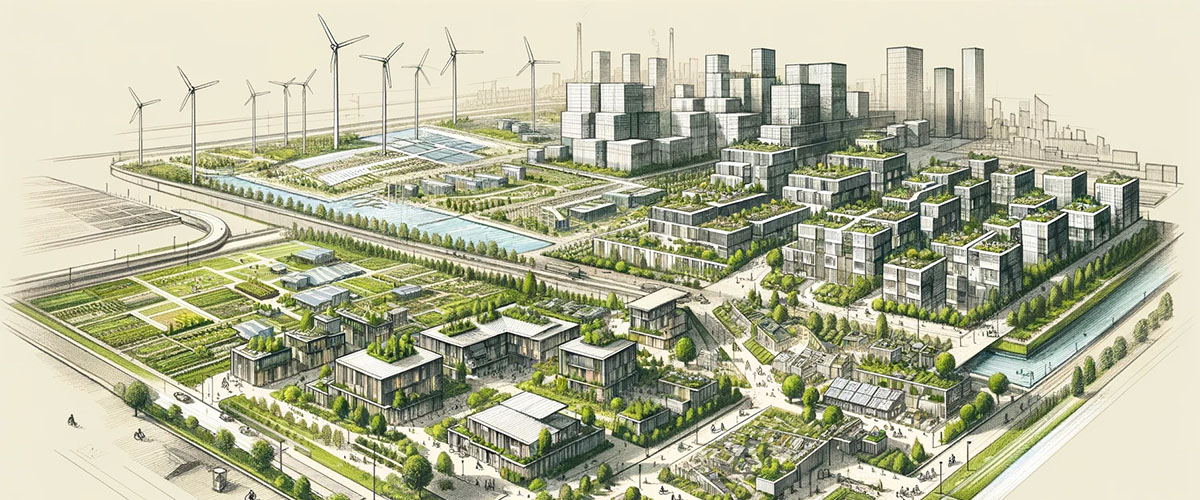
Compact density and mixed land use: the foundation of sustainable urbanism
The fundamental principles of sustainable urban design begin with density: compact cities with 45-120 dwellings/hectare (compared to 5-15 dwellings/ha of suburban sprawl) reduce transport energy consumption by 40-60%, land consumption by 60-80% and infrastructure costs (water, sewerage, electricity, telecommunications networks) by 30-50% per dwelling served. The compact Mediterranean city model (Barcelona, Valencia, Seville: 60-150 dwellings/ha in the ensanche district) is inherently more efficient than the dispersed Anglo-Saxon model (Houston, Phoenix: 5-10 dwellings/ha).
Mixed land use (residential + commercial + community facilities + offices in the same block or street) reduces travel distances to 500-1,000 m for basic services (shops, education, healthcare), enabling walking and cycling mobility. The 15-minute city concept (Carlos Moreno, 2016; adopted by Paris, Barcelona, Melbourne) establishes that 80-90% of daily needs should be accessible within 15 minutes on foot or by bicycle. The LEED ND (Neighborhood Development) certification requires a minimum density of 7 dwellings/acre (~17 dwellings/ha) and mixed use to obtain Smart Location and Linkage credits. Hammarby Sjöstad (Stockholm, 1996-2017, 11,000 dwellings, 26,000 inhabitants) achieves a density of 110 dwellings/ha with 50% green public space, reducing CO₂ emissions by 50% compared to the Stockholm average.
Sustainable mobility: public transport, bicycle and pedestrian
Sustainable mobility is the principle with the greatest impact on urban emissions: transport accounts for 25-35% of a city's CO₂ emissions (EEA, 2022). Urban design determines the modal split: in compact cities with efficient public transport (Vienna, Zurich, Copenhagen), 30-50% of trips are made on foot, 10-25% by bicycle and 20-35% by public transport — relegating the car to 15-30%. In sprawling cities (Atlanta, Dallas), the car accounts for 85-95% of trips.
Protected bike lanes (continuous network, segregated from motorized traffic, width ≥ 2.5 m unidirectional / ≥ 3.0 m bidirectional) are the key infrastructure: Copenhagen (390 km of bike lanes, 49% of commuting trips by bicycle) and Amsterdam (515 km, 36% by bicycle) demonstrate that cycling infrastructure induces demand. The modern tramway (capacity: 200-300 passengers, frequency 3-5 minutes, commercial speed 18-25 km/h) structures urban growth along its corridors with densification at stops (TOD — Transit Oriented Development: 50-200 dwellings/ha within a 400-800 m radius of the station). Superblocks (Barcelona, Salvador Rueda, 2016) group 9 blocks of the Eixample (400×400 m), restricting motorized traffic to the perimeter and transforming 70% of the interior road space into pedestrian plazas, play areas and vegetation — reducing air pollution by 25% (NO₂) and noise by 5 dB within the superblock.
Green infrastructure and urban biodiversity
Urban green infrastructure — parks, green corridors, street trees, green roofs, vertical gardens, urban allotments — provides quantifiable ecosystem services. The WHO recommends a minimum of 9 m² of green area/inhabitant accessible within 300 m of the home. Leading cities far exceed this: Vienna (120 m²/inhabitant), Stockholm (86 m²/inhabitant), Vitoria-Gasteiz (45 m²/inhabitant, European Green Capital 2012). An adult urban tree absorbs 20-50 kgCO₂/year, filters 100 g of PM10 particles/year, transpires 100-400 liters/day (cooling the surrounding air by 2-4°C) and provides shade with a mean radiant temperature reduction of 15-25°C.
Ecological corridors — continuous vegetation strips of ≥ 30 m width connecting parks and peri-urban natural areas — enable wildlife movement (birds, pollinating insects, small mammals) and maintain urban biodiversity. The Vitoria-Gasteiz Green Ring (613 ha, 6 connected peri-urban parks) has documented 208 bird species, 24 mammal species and 580 vascular plant species within the municipal boundary. SUDS (Sustainable Urban Drainage Systems) — bioswales, rain gardens, permeable pavements, retention ponds — reduce runoff by 50-90% and filter 70-90% of pollutants (heavy metals, hydrocarbons) before reaching natural watercourses. The BREEAM Communities certification awards up to 10 credits for ecological land use planning (SE 01-06), and LEED ND awards credits for open space (≥ 0.75 acres/100 inhabitants).
Circular water management and district energy
The urban water cycle in a sustainable district integrates: rainwater collection on roofs and public spaces (50-80% of irrigation demand), neighborhood-scale greywater treatment and reuse (30-40% reduction in potable consumption), natural treatment through constructed wetlands (BOD₅ efficiency 90-95%) and permeable pavements (infiltration 200-800 l/m²·h). The Hammarby Model (Stockholm) closes the cycle: wastewater is treated and the resulting biogas fuels buses and generates electricity; dewatered sludge is used as agricultural fertilizer. Potable water consumption in Hammarby Sjöstad is 100 l/person·day, 40% below the Swedish average.
District energy (district heating/cooling) distributes heat and cooling generated centrally through insulated pipe networks. 4th generation networks (4GDH) operate at 50-60°C supply temperature (compared to 80-120°C for traditional networks), integrating low-temperature sources: solar thermal, geothermal, industrial waste heat, large-scale heat pumps and aquifer thermal energy storage (ATES). The district network of Copenhagen (>1,650 km of pipework) covers 98% of the city's heating with a combination of waste incineration (25%), cogeneration (40%), biomass (20%) and geothermal/solar (15%), with emissions of 40-60 gCO₂/kWh (compared to 200-250 gCO₂/kWh for individual gas boilers). The European Directive 2018/2001 (RED II) establishes that 49% of EU heating and cooling must be renewable by 2030, driving the transformation of district networks.
Citizen participation, SDG-11 indicators and certification
Citizen participation is the cross-cutting principle that legitimizes and improves all urban planning decisions. Co-design processes (participatory workshops, participatory budgeting, digital platforms such as Decidim — Barcelona, Madrid) involve residents in defining priorities: the participatory budget of Porto Alegre (Brazil, since 1989) has demonstrated that participation increases investment in sanitation and healthcare in disadvantaged neighborhoods by 30-50%. In Europe, the SCI Smart Sustainable Cities standard (UNE 178104:2017) establishes digital participation indicators (% of citizens with access to participation platforms: target ≥ 40%).
SDG 11 (Sustainable Cities and Communities) provides the quantifiable targets: universal access to adequate housing and public transport (Target 11.1-11.2), reduction of the environmental impact of cities (Target 11.6: air quality PM2.5 < 10 μg/m³, Target 11.7: ≥ 15 m² of public space/inhabitant), and disaster management (Target 11.5). The LEED ND v4.1 (Neighborhood Development) certification evaluates sustainability at the neighborhood scale across 3 categories: Smart Location and Linkage (connectivity, transport), Neighborhood Pattern and Design (density, mixed use, walkability) and Green Infrastructure and Buildings (energy efficiency, water, waste), with Certified/Silver/Gold/Platinum levels. BREEAM Communities evaluates 40+ indicators across 6 categories (Governance, Social and Economic Wellbeing, Resources and Energy, Land Use and Ecology, Transport and Movement, Innovation) and has certified more than 50 urban developments in Europe, with areas of 10-500 hectares.
References
- [1]Introducing the '15-Minute City': Sustainability, Resilience and Place Identity in Future Post-Pandemic CitiesSmart Cities, 4(1), 93-111.
- [2]Transport and environment report 2022: Digitalisation in the mobility system — challenges and opportunitiesEuropean Environment Agency. ISBN: 978-92-9480-526-8
- [3]Superblocks for the Design of New Cities and Renovation of Existing Ones: Barcelona's CaseIntegrating Human Health into Urban and Transport Planning (Springer), 135-153.
- [4]LEED v4.1 for Neighborhood DevelopmentU.S. Green Building Council.
- [5]International review of district heating and coolingEnergy, 137, 617-631.

Comments 0
No comments yet. Be the first!
Leave a comment