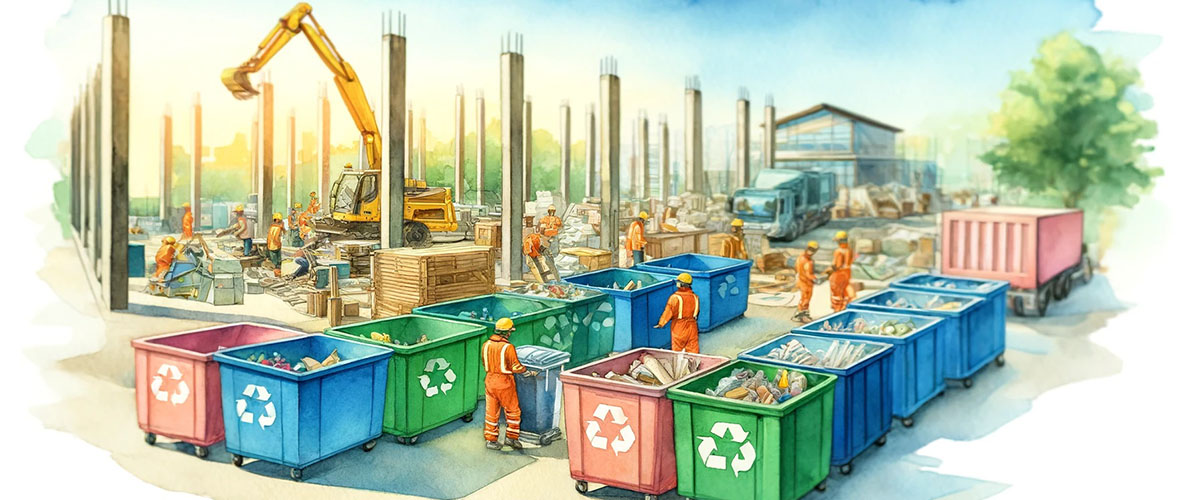
The integrated approach: practices and materials as a system
The practices and materials that enable zero-waste construction function as an integrated system: selecting low-waste materials is insufficient if construction practices generate waste, and applying lean techniques is ineffective if the materials chosen are inherently waste-intensive. The objective is to align design, material selection, construction process, and logistics management to minimise waste at every phase. According to data from WRAP (UK), the combination of these practices enables waste rates of 5-15 kg/m2 of constructed floor area, compared to 30-80 kg/m2 in conventional construction — a reduction of 60-80%. This is not a theoretical projection but a documented outcome from hundreds of projects across the United Kingdom, the Netherlands, and Scandinavia where integrated waste reduction strategies have been systematically implemented and monitored.
The hierarchy of action follows a clear logic: first prevent (design to avoid generating waste), then minimise (reduce what is inevitably generated), then reuse (give a second life without reprocessing), then recycle (transform for a new application), and finally recover energy (extract energy from non-recyclable residual waste). The practices detailed in the following sections operate at the first two levels — prevention and minimisation — which deliver the greatest economic and environmental returns. Prevention eliminates both the cost of the wasted material and the cost of managing it as waste; minimisation reduces the volume requiring management. Together, they address the root causes of construction waste rather than merely improving the efficiency of its treatment after generation.
Modular design and dimensional coordination
Dimensional coordination consists of designing all building dimensions as multiples of a base module — typically 300 mm or 600 mm — that coincides with the standard dimensions of construction materials: plasterboard sheets (1200x2400, 1200x2600, 1200x3000 mm), concrete blocks (400x200 mm), and insulation panels (600x1200 mm). The benefit is direct and immediate: when design dimensions match material dimensions, cuts and offcuts are eliminated. A BRE (2013) study demonstrated that coordination to a 600 mm module reduces plasterboard waste by 22%, block waste by 15%, and insulation waste by 18%. These reductions apply consistently regardless of building type, from single-family housing to multi-storey commercial developments, because they address a universal geometric inefficiency in conventional design practice.
The practice extends to opening dimensions for windows and doors: when opening sizes are coordinated with the module of the block or brick coursing, the adaptation cuts around jambs, lintels, and sills are eliminated entirely. Modular joinery catalogues offering standardised dimensions in increments of 100 or 200 mm facilitate this coordination between the architectural design and the window manufacturer. The additional cost of modular design is zero at the design stage — it is a dimensioning criterion, not an additional material — while the saving typically amounts to 5-15% of interior finishing material costs. For a residential building with an interior finishing budget of 200 EUR/m2, this represents a saving of 10-30 EUR/m2, which across a development of several hundred dwellings compounds to a substantial figure that exceeds the design coordination effort many times over.
Dry construction: partitions, facades and roofing through mechanical assembly
Dry construction eliminates wet processes (mortars, plasters, in-situ cast concrete) and their associated waste streams — packaging, surplus material, cleaning residues, and damaged components. The systems include: light steel frame partitions with plasterboard lining (waste below 2% of material — limited to board offcuts and profile trimmings, both 100% recyclable), ventilated facades with metallic substructure and screwed ceramic or composite panels (waste below 3%, with no bonding mortar or rendering required), and screwed metal sheet or sandwich panel roofing (waste below 1%, with no broken roof tiles or bedding mortar). The manufacturer Knauf documents that its partition system generates 12-15 kg of waste per 100 m2 of installed partition, compared to 60-100 kg for a conventional brick partition with wet plaster finish.
Dry construction offers the additional advantage of disassemblability: a plasterboard partition on screwed steel framing can be dismounted in 15-20 minutes per m2 using hand tools, enabling the reuse of steel profiles (which have an unlimited service life when galvanised) and the recycling of plasterboard sheets. Knauf operates 4 plasterboard recycling plants in Europe that process 250,000 tonnes per year of post-consumer and post-construction plasterboard waste, producing gypsum that re-enters the manufacturing cycle at equivalent quality to virgin gypsum. The materials that favour zero-waste construction are those designed for mechanical assembly, standard dimensions, and separability at end of life — characteristics that align dry construction systems with circular economy principles far more effectively than their wet-trade equivalents.
Lean construction, reusable formwork and process optimisation
The lean construction philosophy, derived from the Toyota Production System, identifies and systematically eliminates 8 types of waste: overproduction, waiting, unnecessary transport, over-processing, excess inventory, unnecessary movement, defects and rework, and underutilised talent. In construction, the most common wastes are: material ordered in excess (10-15% average surplus), rework due to errors (5-10% of execution cost), and logistical waiting (30-40% of on-site time is waiting rather than productive work, as documented by Koskela, 2000). Lean practices include Last Planner System (collaborative planning that reduces rework by 25-40%), Just-In-Time delivery (materials delivered at the rate of consumption, eliminating on-site stockpiling and the damage and wastage it causes), and visual management (Kanban boards on site for material flow control). A meta-analysis by Ballard and Howell (2003) across more than 100 lean construction projects reported schedule reductions of 15-25%, cost reductions of 10-20%, and waste reductions of 30-50%. Lean practices are particularly effective when combined with BIM for precise quantity take-off (enabling procurement with margins below 3%) and prefabrication (which transfers quality control to an industrial environment where tolerances of plus or minus 2 mm are standard, compared to plus or minus 10-15 mm for in-situ work). The construction firm Skanska (Sweden) reports that its projects implementing integral lean construction generate 40% less waste than its conventional projects, a differential consistent across more than a decade of comparative data.
Reusable formwork complements lean methodology by eliminating the waste from disposable timber formwork, which accounts for 10-15% of timber waste on construction sites. Modular metal formwork systems (manufactured by Doka, PERI, and Ulma, among others) permit 200-500 reuse cycles, with a cost per use of 3-8 EUR/m2 under rental arrangements compared to 15-25 EUR/m2 for single-use timber formwork. Recycled plastic formwork (produced by manufacturers such as Geoplast and Rapid-Set) offers a lightweight alternative at 50% less weight than metal systems, permitting 100-200 cycles, and at end of life the plastic is recycled as raw material. Permanent formwork systems (ICF: Insulating Concrete Forms) made of expanded polystyrene or fibre-cement remain integrated into the structure as insulation after the concrete cures, completely eliminating stripping waste while providing thermal performance of R-22 to R-30 depending on configuration. The practices and materials that enable zero-waste construction converge on a coherent strategy: design with dimensions that minimise offcuts, construct with dry mechanical assembly systems, manage the process using lean methodologies, and select materials with high reusability and recyclability. The additional cost of implementing these practices is minimal — 0-5% at the design stage, 0-3% for material specification — and is more than compensated by savings on wasted materials, waste management fees, and shorter construction schedules. For a 5,000 m2 residential building, the combined net saving from these integrated practices typically ranges from 50,000 to 150,000 EUR, a figure that transforms waste prevention from an environmental aspiration into a business imperative supported by project-level financial data.
References
- [1]Halving Waste to Landfill: Achieving the Target — Summary Report of Construction WasteWaste and Resources Action Programme.
- [2]Waste Reduction Through Modular Design: Case Studies from UK HousingBuilding Research Establishment.
- [3]An Exploration Towards a Production Theory and its Application to ConstructionVTT Technical Research Centre of Finland, Publication 408. ISBN: 951-38-5565-1
- [4]Lean project managementBuilding Research & Information, 31(2), 119-133.
- [5]Sustainability Report 2023: Circular Economy and Plasterboard RecyclingKnauf Group.
- [6]Quantifying the waste reduction potential of using prefabrication in building construction in Hong KongWaste Management, 29(1), 309-320.


Comments 0
No comments yet. Be the first!
Leave a comment