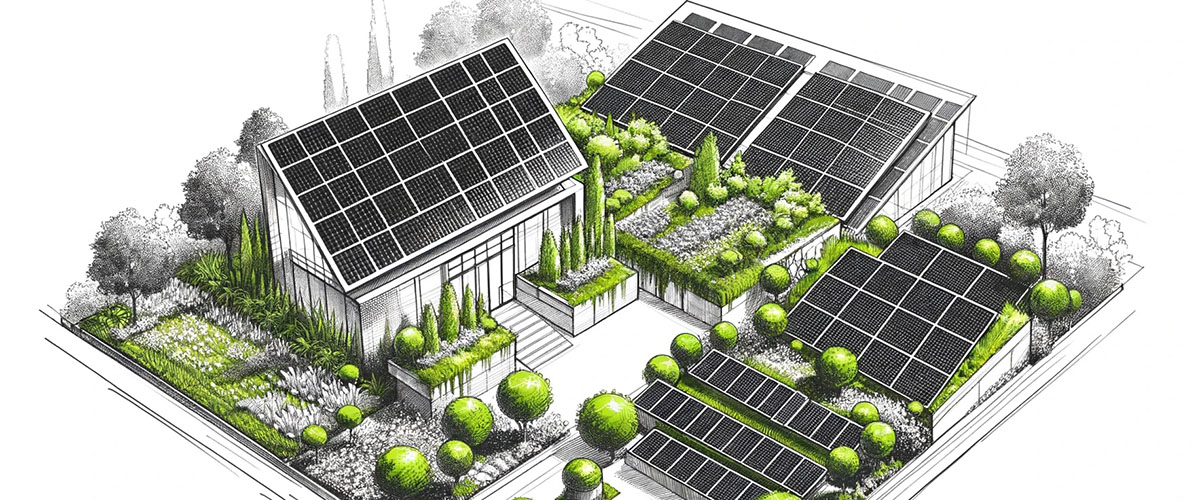
The scale of the problem: consumption and emissions from the building sector
Buildings consume 36% of global final energy (128 EJ out of a total 356 EJ in 2022) and generate 37% of energy-related CO₂ emissions (10 GtCO₂ out of 27 GtCO₂ total from combustion), according to UNEP's 2023 Global Status Report. These figures include direct operational emissions (combustion of gas, oil, and biomass in buildings: 3 GtCO₂), indirect emissions (electricity generation and district heat production consumed by buildings: 7 GtCO₂), and exclude carbon embodied in construction materials (an additional 3.5-4 GtCO₂). The trend is upward: between 2010 and 2022, building energy consumption grew by 15% globally, driven by increasing floor area (+2.5% annually in Asia and Africa), the expansion of air conditioning (+3% annual sales growth, 2 billion units installed globally), and the proliferation of electronic equipment. Maintaining the current trajectory would push sector emissions to 12.5 GtCO₂ by 2050, incompatible with the Paris Agreement goal of limiting warming to 1.5°C.
Energy efficiency is the mitigation tool with the greatest reduction potential at the lowest cost in the building sector. The IEA calculates that commercially available energy efficiency measures can reduce building energy consumption by 40-50% by 2050 relative to the baseline scenario, avoiding 4-5 GtCO₂ annually. The Agency refers to energy efficiency as the first fuel: in 2022, cumulative efficiency improvements since 2000 avoided the consumption of 21 EJ of energy globally, equivalent to the combined oil production of Saudi Arabia and Russia for one year (IEA, Energy Efficiency 2023). The cost of energy avoided through efficiency is 0.02-0.05 USD/kWh, compared to 0.05-0.15 USD/kWh for renewable generation and 0.07-0.20 USD/kWh for fossil generation (including externalities). Every dollar invested in building energy efficiency avoids between 2.0 and 2.5 USD of investment needed in new generation, transmission, and distribution capacity (IEA, 2023).
Energy security and reduced external dependency
Energy efficiency directly reduces dependence on fossil fuel imports. The EU imports 58% of its primary energy, with an external energy bill of 330 billion EUR in 2022 (620 billion at the 2022 peak due to the Russian gas crisis, versus 260 billion in 2019). Spain imports 73% of its primary energy (40 billion EUR/year in net energy imports, Ministry for the Ecological Transition, 2023). Each 1% reduction in building energy consumption in Spain is equivalent to savings of approximately 400 million EUR/year in energy imports. Retrofitting the Spanish building stock to NZEB level would reduce natural gas imports by 25-35% (natural gas covers 40% of residential heating in Spain, 24 TWh/year), decreasing vulnerability to geopolitical supply disruptions. The 2022 energy crisis — with natural gas prices reaching 340 EUR/MWh in August 2022 on the European TTF, versus 15-25 EUR/MWh in 2019 — demonstrated that households in efficient buildings (class A-B) experienced bill increases of 15-30%, while households in inefficient buildings (class E-G) faced increases of 60-120%.
The energy security dimension of efficiency also has a systemic component. Peak electricity demand in summer (cooling) and winter (electric heating) pushes the system to its limits: in Spain, peak winter demand reaches 42-44 GW against an installed capacity of 120 GW, but actual availability at peak hours drops to 50-60 GW due to renewable intermittency and maintenance outages. Energy efficiency flattens the demand curve: a building with a high-performance envelope and thermal storage (thermal mass, PCM, buffer tank) can shift 30-50% of its HVAC demand from peak to off-peak hours, reducing the need for backup power plants and contributing to grid stability. The demand response potential in European buildings is estimated at 50-80 GW of peak reduction, equivalent to 50-80 combined-cycle gas power plants that would not need to be built (European Commission, JRC, 2022). Energy efficiency is the cheapest energy infrastructure to build because it consists, precisely, of not needing to build other infrastructure.
Socioeconomic benefits: employment, health, and equity
Energy retrofit generates local, non-offshorable employment. Every 1 million EUR invested in building energy retrofit generates between 15 and 19 direct jobs (installers, masons, technicians) and 8-12 indirect jobs (materials manufacturing, engineering, management), compared to 5-8 jobs per million invested in conventional power generation (Copenhagen Economics, 2012). The European retrofit program envisioned by the Green Deal (Renovation Wave, 2020) aims to renovate 35 million buildings by 2030, generating 160,000 additional direct jobs across the EU. In Spain, the Recovery Plan estimates the creation of 188,000 direct and indirect jobs linked to energy retrofit between 2021 and 2026, in a sector with an unemployment rate of 8.5% (INE, 2023). The fiscal multiplier of public investment in retrofit is 1.4-1.8 (each public euro mobilizes 1.4-1.8 EUR of total economic activity), higher than that of most infrastructure projects (European Commission, 2022).
The relationship between energy efficiency and health is well documented. The WHO estimates that 3.2 million people die prematurely each year from indoor air pollution caused by the combustion of solid fuels (coal, firewood) in poorly ventilated homes, predominantly in developing countries. In Europe, energy poverty affects 50 million households (Eurostat, 2023) that cannot maintain adequate temperatures in their homes (21°C in winter, 25°C in summer). In Spain, 10.9% of households (2.1 million) reported being unable to keep their homes at an adequate temperature in 2022 (INE, Living Conditions Survey). Homes with indoor temperatures below 18°C in winter increase the risk of cardiovascular disease by 20%, respiratory disease by 30%, and excess winter mortality by 15-25% (Marmot Review Team, 2011). Energy efficiency addresses energy poverty at its root: reducing energy demand by 50-70% through retrofit enables vulnerable households to achieve comfort conditions with the same energy bill, or maintain comfort with a bill reduced by 40-60%.
The climate imperative and the window for action
The IPCC (Sixth Assessment Report, 2023) establishes that limiting warming to 1.5°C requires reducing global emissions by 43% by 2030 and reaching net zero emissions by 2050. The building sector must reduce its operational emissions from the current 10 GtCO₂ to below 2 GtCO₂ by 2050 (80% decarbonization), an achievable goal through the combination of: deep retrofit of 80% of the existing stock (demand reduction of 50-70%), electrification of heating with heat pumps (elimination of 3 GtCO₂ of direct emissions), decarbonization of the electricity grid (elimination of 5-6 GtCO₂ of indirect emissions), and a 50% reduction in embodied carbon through circular economy and low-impact materials (IEA, Net Zero by 2050, 2021). Energy efficiency contributes to the first three vectors simultaneously: a building that consumes half the energy halves both its direct emissions and the indirect emissions associated with electricity generation.
The window for action is narrow. Buildings constructed today will operate until 2070-2080: if they are not built to zero-emission standards, they become stranded assets requiring costly mid-term retrofits or contributing to climate target failure. Existing buildings that are not retrofitted within the next 10-15 years will continue emitting at current rates for decades. The cost of inaction exceeds the cost of action: the European Commission estimates that the cumulative cost of not retrofitting the European building stock amounts to 2.4 billion EUR/year in avoidable energy bills, 800 million EUR/year in health costs associated with inadequate housing, and 1.2 billion tonnes of additional CO₂ through 2050 (Renovation Wave Impact Assessment, 2020). We need to make energy efficient because it is the cheapest, fastest mitigation measure available, with the most co-benefits and the lowest technological risk. Not doing so is the expensive option.
References
- [1]2023 Global Status Report for Buildings and ConstructionUNEP.
- [2]Energy Efficiency 2023IEA.
- [3]Net Zero by 2050: A Roadmap for the Global Energy SectorIEA. ISBN: 978-92-64-46811-2
- [4]The Health Impacts of Cold Homes and Fuel PovertyFriends of the Earth & Marmot Review Team. ISBN: 978-1-85775-835-5
- [5]Multiple Benefits of Investing in Energy Efficient Renovation of BuildingsRenovate Europe.


Comments 0
No comments yet. Be the first!
Leave a comment