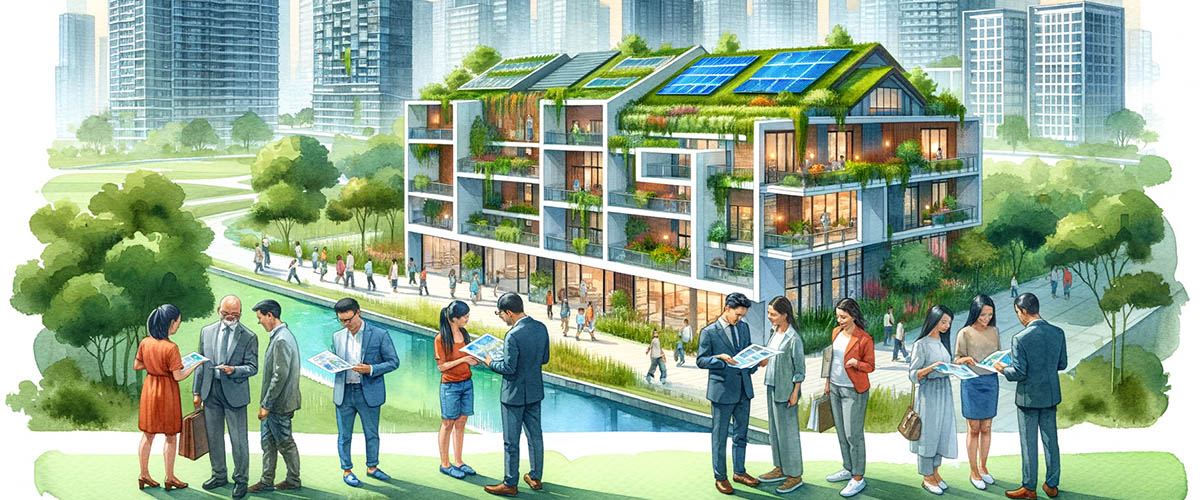
Green public procurement: regulatory framework and market volume
Green Public Procurement (GPP) is the primary driver of institutional demand for sustainable construction in the European Union. The European Commission defines GPP as "a process whereby public authorities seek to procure works, goods, and services with a reduced environmental impact throughout their life cycle" (COM/2008/400). The volume of public procurement in Spain reached 230,000 million EUR in 2023 (OIRESCON), of which the works and building sector accounted for 38,500 million EUR. Law 9/2017 on Public Sector Contracts (LCSP) incorporates sustainability as a cross-cutting principle: Article 145 allows the inclusion of award criteria based on life cycle and environmental cost, while Article 202 establishes special execution conditions with mandatory environmental clauses. The Green Public Procurement Plan 2018-2025 (Order PCI/86/2019) sets quantitative targets: 50% of public works tenders must incorporate GPP criteria by 2025.
The European GPP construction market is estimated at 85,000 million EUR per year (European Commission, 2023). EU GPP criteria for office buildings (2022 version) set specific technical requirements: primary energy consumption 20% below the national NZEB reference building, use of materials with EPD conforming to EN 15804, global warming potential below 800 kg CO₂eq/m² for new construction, and traceability of at least 70% by weight of construction waste. In Spain, bodies such as the Barcelona City Council (Sustainable Public Procurement Instruction, 2022) and the Gipuzkoa Provincial Council have implemented scoring systems where environmental criteria account for up to 35% of the total evaluation in building tenders, compared to the typical 10% minimum in administrations without a structured GPP policy.
B2G marketing strategies for sustainable construction companies
Business-to-government (B2G) marketing in sustainable construction differs radically from B2C: the target audience consists of municipal technical staff, regional asset directors, and European fund managers, with decision cycles of 6-24 months and processes governed by the LCSP. An effective B2G marketing strategy is structured in three phases: prior positioning (participation in preliminary market consultations under Art. 115 LCSP, registration on platforms such as PLACE and Contratación del Estado), technical differentiation (demonstrable environmental credentials through ISO 14001, EMAS certifications, a carbon footprint registered with MITERD, and experience with green-clause contracts), and value proposition (life cycle cost lower than that of the conventional offer, demonstrated through LCC analysis conforming to ISO 15686-5). Companies registered in MITERD's Carbon Footprint Registry -- 3,847 organisations as of December 2023 -- gain a competitive advantage in tenders that score emission offsetting or reduction.
Participation in Public Procurement of Innovation (PPI) offers specific opportunities for sustainable construction companies with differentiating technological solutions. The CDTI's FID (Fomento de la Innovación desde la Demanda) programme has funded 127 PPI projects between 2018 and 2023 totalling 312 million EUR, of which 18% relate to the construction and renovation sector. PPI enables the administration to procure solutions not yet available on the market, through contracts of up to 100,000 EUR without advertising (Art. 118 LCSP for minor contracts) or via competitive dialogue (Art. 172 LCSP) for larger projects. Successful examples include AIMPLAS's contract with Valencia City Council to develop urban pavements using recycled plastic (460,000 EUR) and the REMOURBAN project (Horizon 2020), which demonstrated district-scale renovation models in Valladolid with public investment of 8.2 million EUR and a 51% reduction in energy consumption across the buildings treated.
European funds and public financing programmes for green building
European funds are the main catalyst for public investment in sustainable construction during the 2021-2027 period. Spain's Recovery, Transformation and Resilience Plan (PRTR) allocates 6,820 million EUR to Component 2 (housing renovation and urban regeneration), with the objective of retrofitting 510,000 dwellings and renovating 1,230,000 m² of public buildings by 2026 (RD 853/2021). The programmes are structured across six aid lines managed by autonomous communities: PREE 5000 (municipalities with fewer than 5,000 inhabitants, 50 million EUR), Residential Building Renovation Aid Programme (3,420 million EUR), Neighbourhood Programme (1,000 million EUR), and Public Buildings Programme (1,080 million EUR). As of December 2023, applications totalling 4,200 million EUR had been processed, with an effective execution rate of 38% (European Court of Auditors, 2024).
At European level, the LIFE Clean Energy Transition programme finances capacity-building and technical assistance projects for energy renovation with a budget of 1,000 million EUR (2021-2027). The European Regional Development Fund (ERDF) allocates 30% of its 226,000 million EUR budget to climate objectives, including the renovation of public buildings. The European Investment Bank (EIB) offers specific green building credit lines through national financial intermediaries (ICO in Spain), with interest rates between Euribor + 0.3% and Euribor + 1.2% and maturities of up to 25 years. For sustainable construction companies, detailed knowledge of these financial instruments and their technical requirements constitutes a direct competitive advantage: 62% of PRTR renovation calls require the involvement of companies with demonstrable energy efficiency experience, and 45% require ISO 14001 certification or equivalent (IDAE, 2024).
Success stories and impact metrics in sustainable public construction
Flagship sustainable public construction projects demonstrate the technical and economic viability of advanced GPP criteria. The Cerdanyola del Vallès Health Centre (Barcelona, 2022, architects Pinearq) was the first public healthcare facility in Spain with Passivhaus Premium certification: heating demand of 12.8 kWh/m²·year, renewable primary energy consumption at 120% of demand (energy positive), and a construction cost of 1,650 EUR/m², an 8% premium over a conventional health centre of equivalent specifications. Sant Cugat del Vallès City Council developed a pilot public building tender in 2021 with embodied carbon criteria, requiring a maximum of 500 kg CO₂eq/m² and positively scoring the use of CLT and low-carbon concrete, resulting in a building with 387 kg CO₂eq/m², 42% below the average for Spanish public building stock.
Aggregate GPP impact metrics in construction are quantifiable at the national scale. The report by the National Commission on Markets and Competition (CNMC, 2023) estimates that systematic application of GPP criteria across the 18,400 annual public works tenders in Spain would reduce sector emissions by 4.2 million tonnes of CO₂eq/year, equivalent to 3.8% of total national emissions. ICLEI's (Local Governments for Sustainability) Procura+ programme supports 46 Spanish municipalities in GPP implementation, with documented results: Madrid City Council has incorporated environmental clauses in 78% of its construction tenders (value: 1,200 million EUR/year), while Vitoria-Gasteiz has required an A energy rating for all new municipal construction since 2019. Effective marketing to the public administration requires the presentation of these verifiable success stories, with cost-benefit metrics, to overcome the persistent perception that sustainable construction entails prohibitive cost premiums; the evidence shows premiums of 5-12% for new construction and payback periods of 8-15 years through operational savings.
References
- [1]EU GPP Criteria for Office Building Design, Construction and ManagementPublications Office of the EU.
- [2]Informe sobre la contratación pública de obras en España 2023OIRESCON-CNC.
- [3]Informe Especial 09/2024: Fondos de la UE para la eficiencia energética de los edificiosECA.
- [4]Procura+ Manual: A Guide to Implementing Sustainable Procurement (4th ed.)ICLEI European Secretariat. ISBN: 978-3-943891-10-6
- [5]Real Decreto 853/2021 por el que se regulan los programas de ayuda en materia de rehabilitación residencial y vivienda social del PRTRBOE núm. 239.

Comments 0
No comments yet. Be the first!
Leave a comment