
Advanced crushing and separation technologies
Crushing and separation technologies for construction waste have evolved toward highly selective processes that recover clean fractions suitable for reintroduction into production cycles. Vertical shaft impact (VSI) crushers produce recycled aggregates with shape coefficients (SI ≤ 20) comparable to natural quarried aggregate, eliminating the flaky particles that degrade concrete workability. The CDE Group plant in Duisburg (Germany), operational since 2021, processes 400 tonnes per hour of CDW through a combined line of crushing, wet screening, and densimetric separation that recovers 98% of incoming material into fractions of coarse aggregate (4-32 mm), recycled sand (0-4 mm), and ferrous and non-ferrous metals, with purity exceeding 99% in each fraction.
The Smart Crushing technology, developed by the Dutch company Smart Demolition, uses high-voltage electrical pulses (200-400 kV) to separate aggregates from the hardite cement paste in concrete, recovering the original aggregate free of cement paste contamination. The process consumes 3-5 kWh per tonne, compared with 8-12 kWh per tonne for conventional mechanical crushing, and produces aggregates with water absorption below 2% (compared with the typical 5-7% for conventionally recycled aggregates), suitable for the manufacture of high-strength concrete (≥ C40/50). The pilot plant, funded by the Horizon 2020 program with 2.8 million euros, processed 50,000 tonnes in its first two years of operation. In parallel, NIR (Near Infrared) optical sorting enables the automatic identification and separation of wood, plastic, plasterboard, and mineral fractions at conveyor belt speeds of 3-5 m/s, with hit rates of 95-98%.
Low-carbon cements and binders
The cement industry, responsible for 8% of global CO₂ emissions (approximately 2.8 billion tonnes per year according to the Global Cement and Concrete Association, GCCA, 2023), is developing alternative binders that incorporate recycled materials and reduce the carbon footprint. Cements with pozzolanic additions substitute up to 35% of the clinker with coal fly ash (EN 197-1 type CEM II/B-V) or blast furnace slag (CEM III/A with 36-65% slag), reducing specific emissions from 866 kgCO₂ per tonne of clinker to 550-650 kgCO₂ per tonne of cement. The standard EN 197-5:2021 introduced two new cement types — CEM II/C-M and CEM VI — allowing clinker substitution rates of up to 50% and 65% respectively, broadening the range of reduction options.
The LC3 (Limestone Calcined Clay Cement) technology, developed by the École Polytechnique Fédérale de Lausanne (EPFL) and the Cuban Cement Research Institute, uses calcined clay and limestone to substitute up to 50% of clinker, with emissions reductions of 30-40% and mechanical performance equivalent to conventional CEM I at 28 days. The project has been validated in industrial plants in India, Cuba, and Colombia, with more than 500,000 tonnes produced through 2023. Solidia cement, developed in New Jersey (USA), uses a CO₂ curing process that captures 300 kg of CO₂ per tonne of cement produced, reducing the net carbon footprint by 70% compared with conventional Portland cement. The company has completed industrial trials with LafargeHolcim and projects a production capacity of 200,000 tonnes per year by 2025.
Thermal insulation from industrial and post-consumer waste
The manufacture of thermal insulation from waste represents one of the innovations with the greatest potential environmental impact in the construction sector. Recycled textile fiber panels, produced from garment industry offcuts and post-consumer clothing, achieve thermal conductivities of 0.035-0.040 W/m·K, comparable to rock wool (0.035 W/m·K) and expanded polystyrene (0.032-0.038 W/m·K). The French company Métisse, a subsidiary of the textile cooperative Le Relais, processes 3,500 tonnes per year of used clothing to manufacture insulation panels with 85% recycled cotton, at a price of 8-12 euros/m² for 100 mm thicknesses and an embodied energy of 4.8 MJ/kg, 80% lower than rock wool (26 MJ/kg).
Recycled aerogel represents the technological frontier in high-performance insulation from waste. The company Aspen Aerogels manufactures insulation blankets with conductivities of 0.015-0.020 W/m·K — the lowest on the market — using silica partly derived from rice husk ash, an abundant agro-industrial waste in Asia with annual production of 30 million tonnes. The cost of 25-50 euros/m² for 10 mm thicknesses limits its use to applications where available thickness is critical, such as the renovation of historic facades with profile alteration restrictions. In Spain, the company Aislanat manufactures blown cellulose insulation from recycled newsprint, with conductivities of 0.038-0.040 W/m·K and prices of 4-6 euros/m² for 100 mm thicknesses, processing 8,000 tonnes per year of recovered paper and avoiding the emission of 1.2 tonnes of CO₂ per tonne of insulation produced compared with synthetic alternatives.
Additive manufacturing and new circular value chains
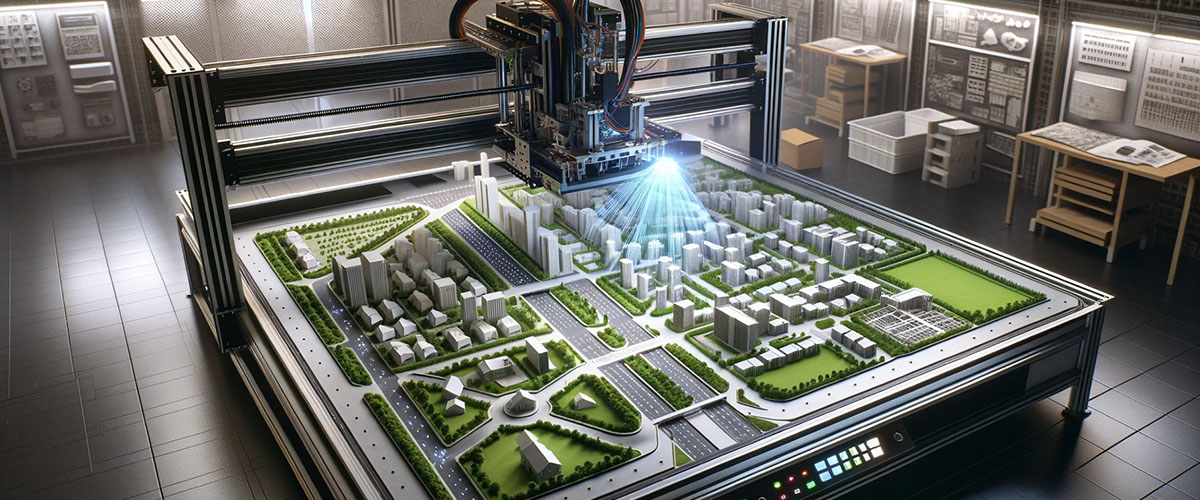
Additive manufacturing (3D printing) with recycled materials opens new possibilities for the reuse of construction waste. The 3DCP (3D Concrete Printing) project at the Eindhoven University of Technology has developed printable mortars with up to 50% fine recycled aggregate, maintaining rheological properties suitable for extrusion: viscosities of 20-40 Pa·s at shear rates of 10 s⁻¹ and initial setting times of 40-90 minutes. The first 3D-printed residential building in Europe, Project Milestone in Eindhoven (2021), used 65 m³ of concrete for a floor area of 94 m², with 30% less material than equivalent conventional construction thanks to topological optimization of the forms.
New circular value chains digitally integrate information on available materials with the demand from new projects. The Excess Materials Exchange (EME) platform, based in Amsterdam, uses artificial intelligence to match industrial waste streams with construction material needs, automatically assessing technical compatibility, logistical feasibility, and environmental impact. In 2023, the platform handled 85,000 tonnes of material transactions and connected 1,200 companies across 14 countries. The HISER (Holistic and Innovative Solutions for a European Renovation) project, funded by Horizon 2020 with 7.9 million euros, developed industrial processes that increase CDW recycling rates from 70% to 90%, with robotic sorting technologies capable of classifying 2,000 objects per hour and a return on investment of under 3 years for treatment plants processing more than 100,000 tonnes per year.
References
- [1]GCCA Concrete Future: 2050 Cement and Concrete Industry Roadmap for Net Zero ConcreteGCCA.
- [2]Eco-Efficient Cements: Potential Economically Viable Solutions for a Low-CO₂ Cement-Based Materials IndustryUNEP / EPFL.
- [3]Additive Manufacturing of Concrete in Construction: Potentials and Challenges of 3D Concrete PrintingVirtual and Physical Prototyping, Vol. 11, No. 3.
- [4]Holistic and Innovative Solutions for a European Renovation — Final ReportEuropean Commission Horizon 2020.
- [5]Isolation Thermique et Acoustique en Coton Recyclé — Fiche TechniqueLe Relais.


Comments 0
No comments yet. Be the first!
Leave a comment