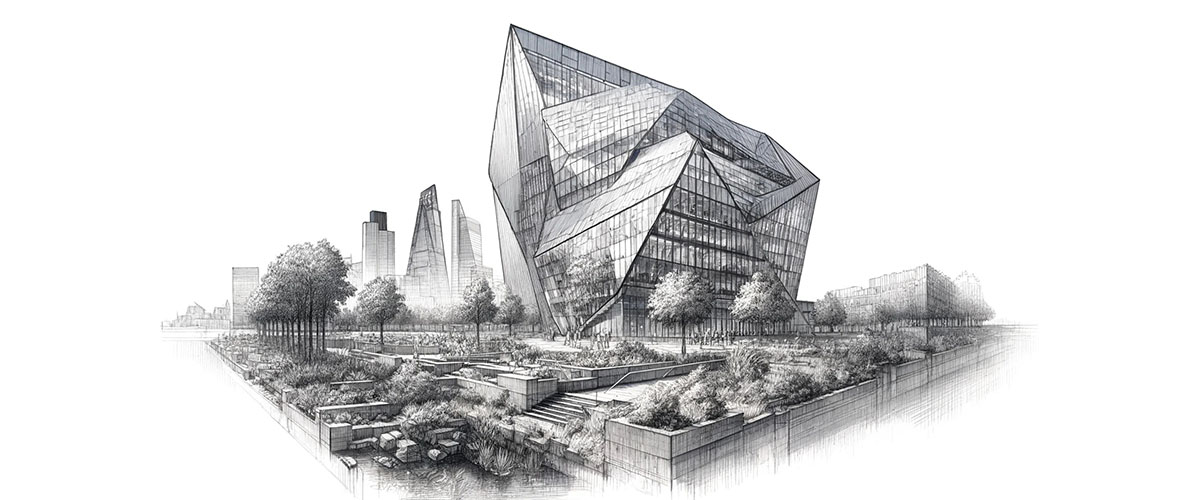
Bank of America Tower: cogeneration and indoor air quality
Innovations in sustainable design, LEED success stories, materialize in buildings that have redefined industry standards. The Bank of America Tower (One Bryant Park, New York, 2009, Cook + Fox Architects, LEED Platinum) was the first skyscraper of this scale to obtain the highest LEED certification. With 55 floors and 204,000 m2 of floor area, the building integrates a 4.6 MW natural gas cogeneration plant that generates 70% of the building's electricity and 100% of its heating, with a combined efficiency of 82% (compared to 35-40% from centralized grid generation).
The air conditioning system uses ice thermal storage (4.5 MWh capacity) that produces ice during the night (off-peak tariff) and uses it for cooling during the day, displacing 25% of peak electrical demand. Indoor air quality is maintained through MERV-14 + activated carbon filters that remove 95% of PM2.5 particles and VOCs, with an outdoor air supply rate of 14 l/s·person (30% above the ASHRAE 62.1 minimum). The facade glazing is triple-pane with selective coating (U = 1.1 W/m2K, Tv = 0.62, g = 0.32) that maximizes natural light (sDA of 75%) while minimizing solar gain. Total energy consumption is 120 kWh/m2·year — 50% below the average for Manhattan office towers (240 kWh/m2·year). The structure uses 45% blast furnace slag in concrete and 95% recycled steel.
The Crystal: zero operational emissions in London
The The Crystal (London, 2012, Wilkinson Eyre Architects, LEED Platinum + BREEAM Outstanding) is one of the few buildings in the world with dual highest certification. With 6,300 m2 of floor area (Siemens conference and exhibition center), the building achieves zero operational CO2 emissions through: 300 kWp of rooftop photovoltaics (production: 270 MWh/year), ground-source heat pump (COP 4.8, 175 kW thermal), evacuated tube solar thermal (24 m2, 50% of domestic hot water) and assisted natural ventilation via solar chimneys (eliminating air conditioning during 60% of occupied hours).
Total energy consumption is 76 kWh/m2·year — 46% below the ASHRAE 90.1 reference building. Water management integrates: rainwater harvesting (roof of 1,500 m2, collection of 900 m3/year), greywater recycling with MBR system (30% consumption reduction), low-flow faucets (4 l/min) and dual-flush toilets (3/6 l). Potable water consumption is 55% below the reference building. The integrated BMS with 3,500 sensors (temperature, CO2, occupancy, luminosity) optimizes HVAC and lighting zone by zone, with additional savings of 15-20%. Construction cost was 4,800 EUR/m2, 20-25% above a conventional office building in London, with a return on additional investment of 12-15 years from operational savings.
Bullitt Center: the greenest commercial building in the world
The Bullitt Center (Seattle, 2013, Miller Hull Partnership, LEED Platinum + Living Building Challenge) is a 4,830 m2 office building on 6 floors that generates more energy than it consumes and treats 100% of its water on site. The oversized rooftop photovoltaic array of 242 m2 (production: 60 MWh/year) covers a consumption of only 78 MWh/year (Energy Use Intensity: 16 kWh/m2·year — 80% below the typical Seattle office building at 80 kWh/m2·year). The energy strategy combines: Passivhaus envelope (wall U = 0.14 W/m2K, triple-glazed windows Uw = 0.85 W/m2K, airtightness n50 = 0.5 ACH), LED lighting with DALI control and sDA of 82%, and motorized natural ventilation (automatic window opening based on outdoor temperature and air quality).
The water system is completely autonomous: rainwater harvesting of 570 m3/year (1,400 m2 roof + facade), treatment by filtration + UV disinfection + chlorination to potable quality (special permit from the Washington Department of Health), and composting of sanitary waste (Phoenix composting toilets that eliminate 100% of blackwater). Construction materials comply with the Living Building Challenge Red List: zero PVC, zero added formaldehyde, zero halogenated flame retardants. The structure is heavy timber from FSC-certified sources. The Bullitt Center demonstrates that an office building can be energy-positive, water-autonomous and materially healthy with a cost premium of 15-20% over conventional construction — recoverable in 8-10 years from operational energy and water savings.
Pixel Building and One Angel Square: carbon neutral in Australia and the United Kingdom
The Pixel Building (Melbourne, 2010, Studio505, LEED Platinum + first 6-star Green Star certification) was Australia's first carbon neutral building. With 1,100 m2 on 4 floors, it achieves a net balance of 0 tCO2/year through: 35 kWp of rooftop and facade photovoltaics (production: 45 MWh/year), 1 kW rooftop wind turbine, anaerobic digester for organic waste, and greywater and rainwater treatment for 100% self-supply of non-potable water. Energy consumption is 48 kWh/m2·year and renewable production is 56 kWh/m2·year. The facade uses colored panels at different angles of inclination that function as fixed brise-soleil, reducing solar gain by 50% in summer.
The One Angel Square (Manchester, 2013, 3DReid, BREEAM Outstanding 95.16% — the highest score in the world for an office at the time) is the Co-operative Group headquarters with 30,000 m2. The building combines: rapeseed oil cogeneration (1.5 MW electrical + 2.0 MW thermal, combined efficiency 85%), double-skin facade with integrated natural ventilation (eliminating air conditioning during 40% of hours), 16 m central atrium with stack effect, rainwater harvesting (600 m3/year) and low-flow faucets (50% reduction). Total energy consumption is 55 kWh/m2·year — 50% below the reference building. Total investment was 3,200 EUR/m2. These projects demonstrate that LEED Platinum certification and its equivalents are not a theoretical exercise in credit accumulation, but the verifiable documentation of strategies that reduce energy consumption by 50-80%, water consumption by 40-55% and CO2 emissions by 60-100% compared to conventional buildings.
Common lessons and replicability of innovations
The common patterns of the analyzed LEED Platinum buildings are: (1) high-performance envelope — all achieve U < 0.25 W/m2K in walls and Uw < 1.2 W/m2K in windows, with airtightness verified by Blower Door; (2) on-site renewable generation — photovoltaics as a minimum, with geothermal, biomass or cogeneration as complement; (3) intelligent management (BMS) — systems with >1,000 sensors and predictive control; (4) natural or mixed ventilation — no building depends exclusively on mechanical HVAC; (5) circular water management — rainwater harvesting + greywater recycling in all cases.
Replicability depends on three factors: climate (natural ventilation works in temperate climates: London, Seattle, Melbourne; extreme climates require MVHR), regulation (the most innovative buildings operate in jurisdictions with stringent standards: California Title 24, UK Building Regulations Part L, Eurocode) and client commitment (all projects had a developer with explicit environmental objectives). The average cost premium of a LEED Platinum building over conventional is 5-20% (World Green Building Council, 2013), with a payback of 5-12 years from operational savings and a market value increase of 10-30% (studies by Miller et al., 2008: rental premium of 3-6% and asset value premium of 16%). LEED v4.1 certification requires demonstrating actual operational performance (not just design) through the Arc platform, closing the gap between projected and measured performance that has historically been 15-30% (performance gap).
References
- [1]Bank of America Tower at One Bryant Park: LEED Platinum Certification ReportDurst Organization / Bank of America.
- [2]Bullitt Center: Performance Documentation and Living Building Challenge CertificationBullitt Foundation.
- [3]The Business Case for Green Building: A Review of the Costs and Benefits for Developers, Investors and OccupantsWorldGBC.
- [4]Does Green Pay Off?Journal of Real Estate Portfolio Management, 14(4), 385-400.
- [5]The Crystal: A Sustainable Cities Initiative — Design and Performance ReportSiemens AG.
Comments 0
No comments yet. Be the first!
Leave a comment