Indoor air quality and occupant health
The impact of architectural design on health begins with indoor air quality (IAQ). The US Environmental Protection Agency (EPA) documents that indoor pollutant concentrations are 2 to 5 times higher than outdoor levels, reaching up to 100 times higher in buildings with poor ventilation and materials that emit volatile organic compounds (VOCs). Primary sources include: formaldehyde from particleboard (50-200 μg/m³ over 3-5 years), total VOCs from paints and varnishes (1,000-10,000 μg/m³ in the first 2-4 weeks), PM2.5 particles from gas hob combustion (25-100 μg/m³ during cooking), and CO₂ from human respiration (concentrations exceeding 1,000 ppm in poorly ventilated classrooms and offices). The WHO sets maximum exposure guidelines for formaldehyde (100 μg/m³ over 30 minutes) and for PM2.5 (15 μg/m³ annual average), while the WELL v2 certification requires stricter thresholds: formaldehyde < 27 ppb and PM2.5 < 15 μg/m³.
The seminal study by Allen et al. (2016), published in Environmental Health Perspectives by researchers at the T.H. Chan School of Public Health at Harvard, assessed the cognitive functions of 109 workers in 10 office buildings over 6 working days. Participants exposed to CO₂ levels below 600 ppm and total VOC concentrations below 50 μg/m³ scored 101% higher on cognitive tests across all 9 functional areas assessed (crisis response, strategy, information usage) compared to those exposed to conventional conditions (CO₂ > 1,000 ppm). A subsequent study by the same group (Allen et al., 2017, CogFx 2.0) confirmed these results in a sample of 302 workers in 40 buildings across 6 countries. Design decisions that determine IAQ include: ventilation rate (the Spanish RITE requires 12.5 l/s·person in offices; the WELL standard requires 30% more than the local code), selection of low-emission materials (certified GREENGUARD Gold, Blue Angel, or Finnish M1), and outdoor air filtration (MERV 13 or ISO ePM1 ≥ 50% filters).
Natural lighting, circadian rhythms, and performance
Natural lighting is the design factor with the greatest documented impact on occupant satisfaction and productivity. A World Green Building Council study (2014) of 30,000 workers found that lighting was the most valued environmental factor, ahead of temperature, acoustics, and air quality. The research by Boubekri et al. (2014), published in the Journal of Clinical Sleep Medicine, demonstrated that workers with windows at their workstations (exposure to > 173 lux of natural light during the working day) slept an average of 46 minutes longer per night and engaged in 25% more physical activity than workers without windows. The underlying mechanism is circadian regulation: blue-enriched light (wavelength 460-490 nm) at intensities above 250 lux at eye level suppresses melatonin production, synchronising the internal biological clock with the day-night cycle.
Design decisions that maximise natural lighting include: limited floor plate depth (maximum 6-8 m from the facade to achieve a daylight factor ≥ 2% across 75% of the floor area), light shelves that redirect direct sunlight toward the ceiling increasing penetration by 40-60%, atria and lightwells with reflectances above 70%, and high light-transmittance glazing (τv ≥ 0.60) with selective solar control (solar factor g ≤ 0.35). LEED v4.1 awards up to 3 points for daylighting (EQ: Daylight), requiring illumination levels between 300 and 3,000 lux at 75% of workstations for at least 50% of occupied hours. WELL v2 goes further with the concept of circadian lighting: it requires 200 melanopic equivalent lux at eye level for at least 4 hours of the working day, a requirement that directly links lighting design with the occupant's endocrine health.
Thermal and acoustic comfort as determinants of well-being
Thermal comfort, defined by standard ISO 7730:2005 as the mental condition expressing satisfaction with the thermal environment, depends on 6 variables: air temperature, mean radiant temperature, relative humidity, air velocity, metabolic activity level (met), and clothing thermal resistance (clo). The Fanger (PMV-PPD) model predicts that the comfort zone for sedentary activity (1.2 met) with office clothing (0.5-1.0 clo) lies between 20°C and 26°C with relative humidity of 30-60%, with a predicted percentage dissatisfied (PPD) below 10%. The adaptive model (EN 15251, ASHRAE 55) for naturally ventilated buildings broadens this range: the comfort temperature varies linearly with the mean outdoor temperature, allowing indoor temperatures up to 28-30°C when the mean outdoor temperature is 25-30°C, which reduces cooling demand by 30-50%. A study by Wargocki et al. (2019) on 3,500 participants quantified that productivity decreases by 2% for every degree of deviation from the optimal temperature.
Acoustic design has a quantifiable impact on concentration and stress. In open-plan offices, the typical background noise level ranges from 55 to 65 dBA, compared to the 35-45 dBA recommended by standard UNE-EN ISO 3382-3:2022 for work requiring concentration. Research by Banbury and Berry (2005) demonstrated that intelligible background speech reduces performance in memory tasks by 33% and in calculation tasks by 14%. Acoustic design strategies include: distribution of acoustic absorption on ceilings (weighted absorption coefficient αw ≥ 0.90), wall panels (αw ≥ 0.80), acoustic barriers 1.4-1.7 m high between workstations (attenuation of 5-8 dBA), and sound masking systems (pink noise or specific spectrum at 40-45 dBA) that reduce the intelligibility of surrounding speech. WELL v2 requires a reverberation time T60 ≤ 0.60 s in open offices and a speech transmission index (STI) ≤ 0.50 in focused work zones.
Biophilic design and return on investment in health
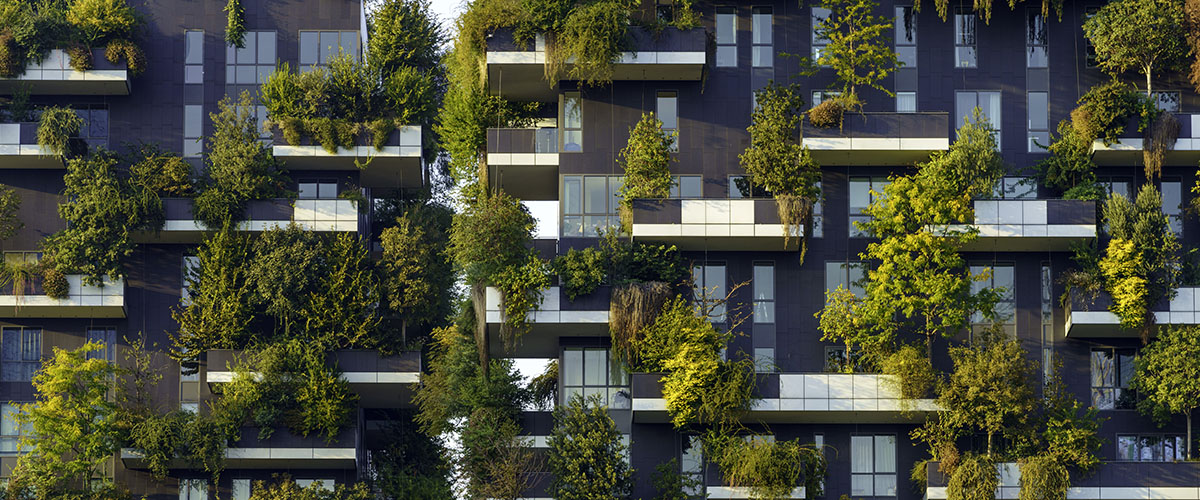
Biophilic design integrates natural elements — vegetation, water, natural light, organic materials, views of nature — into the built environment, grounded in the biophilia hypothesis formulated by E.O. Wilson (1984). A meta-analysis by Browning et al. (2014), commissioned by the consultancy Terrapin Bright Green, synthesised 500 studies and concluded that the presence of indoor vegetation reduces perceived stress by 37%, systolic blood pressure by 3 to 5 mmHg, and sick building syndrome (SBS) symptoms by 23%. Views of nature from the workstation reduce visual fatigue by 50% and absenteeism by 10% (Kaplan, 1995). The Amazon Spheres project (Seattle, 2018, NBBJ Architects) materialises these principles: 3 glass domes of 4 storeys house 40,000 plants from 400 species, creating a working environment with a temperature of 22°C, relative humidity of 60%, and CO₂ levels below 600 ppm.
The return on investment (ROI) in health-oriented design is quantifiable because salary costs represent 85-90% of total operating costs of an office building, while rent accounts for 8-10% and energy for 1-2% (WorldGBC, 2014). A 5% productivity improvement attributable to design equates to salary cost savings 5-10 times greater than the total annual energy cost of the building. The IWBI (International WELL Building Institute) documents that companies in WELL-certified buildings report absenteeism reductions of 15-25% and talent retention improvements of 12-18%. The additional cost of designing and constructing a building to WELL Silver certification standard ranges between 2% and 5% of the execution budget, with a payback period of 2-4 years considering absenteeism reduction alone. These data demonstrate that the impact of design on health and well-being is not an aesthetic luxury but an investment with verifiable returns in productivity, staff retention, and reduced healthcare costs.
References
- [1]Associations of Cognitive Function Scores with Carbon Dioxide, Ventilation, and Volatile Organic Compound Exposures in Office Workers: A Controlled Exposure Study of Green and Conventional Office EnvironmentsEnvironmental Health Perspectives, 124(6), 805-812.
- [2]Impact of Windows and Daylight Exposure on Overall Health and Sleep Quality of Office Workers: A Case-Control Pilot StudyJournal of Clinical Sleep Medicine, 10(6), 603-611.
- [3]The relationships between classroom air quality and children's performance in schoolBuilding and Environment, 150, 13-22.
- [4]14 Patterns of Biophilic Design: Improving Health & Well-Being in the Built EnvironmentTerrapin Bright Green LLC.
- [5]Health, Wellbeing & Productivity in Offices: The Next Chapter for Green BuildingWorldGBC.



Comments 0
No comments yet. Be the first!
Leave a comment