Specific requirements: conservation, perception and efficiency
Efficient and respectful lighting in historic spaces must simultaneously satisfy three demands that conventional lighting does not address: (1) conservation — luminous radiation degrades sensitive materials (pigments, textiles, paper, polychrome wood); the CIE 157:2004 standard and EN 16163:2014 limit annual exposure to 150,000 lux·hour/year for materials of medium sensitivity and 50,000 lux·hour/year for highly sensitive materials (watercolors, inks, silks); (2) perception — light quality must reveal the materiality, texture and color of historic architecture with chromatic fidelity; (3) efficiency — monuments and museums consume 100-300 kWh/m2·year, of which 30-50% is lighting, offering a savings potential of 50-70% with LED technology.
The key metric is the color rendering index (CRI/Ra): a CRI >= 95 (with R9 >= 80 for saturated reds) is essential for correctly perceiving frescoes, oil paintings, gilding and polychromies. The optimal correlated color temperature (CCT) for historic spaces is 2,700-3,000 K (warm), compatible with the historic perception of candlelight (1,800 K) and incandescent light (2,700 K) that illuminated these spaces for centuries. High-fidelity LEDs (TM-30-20) achieve values of Rf >= 95 and Rg = 97-103 (fidelity + saturation), surpassing incandescent lamps (CRI = 100 but low efficacy: 12-15 lm/W) and fluorescents (CRI = 80-85, cool color temperature). UV emission must be < 75 microwatts/lumen (IESNA RP-30 standard) and infrared (IR) radiation must be minimized to avoid heating of illuminated surfaces.
LED technology for heritage: spectrum, miniaturization and control
High-CRI LEDs for heritage use remote phosphor chips with broadband spectrum that reproduces visible wavelengths (380-780 nm) without aggressive peaks in the blue range (450 nm) that characterized first-generation LEDs. Specialized manufacturers (Erco, iGuzzini, Zumtobel, Bartenbach) offer luminaires with CRI >= 95, efficacy of 80-140 lm/W (compared to 12-15 lm/W for the halogen lamps they replace), beam angles of 6-60 degrees (interchangeable lenses for precise focusing) and 0-100% dimming without flicker (flicker-free: <1% at 100 Hz, IEEE 1789 standard).
Miniaturization enables the integration of luminaires into moldings, cornices, handrails and display cases without altering the perception of the space: flexible LED strips of 8-12 mm width with 3M adhesive are concealed in 10x10 mm grooves milled into anodized aluminum profiles. Track-mounted projectors (Erco Parscan, iGuzzini Palco InOut) with bodies of 48-85 mm diameter and power ratings of 10-50 W replace AR111 halogen lamps of 75-150 W with energy savings of 70-85% and a lifespan of 50,000-70,000 hours (compared to 2,000-4,000 h for halogen). The DALI-2 protocol enables the programming of lighting scenes (daytime, nighttime, event, conservation) with gradual transitions of 1-30 minutes that avoid thermal stress on sensitive materials. Tunable white dynamic lighting (adjustable CCT from 2,700 to 6,500 K) allows recreation of natural light variation throughout the day in interior spaces without windows.
Museum and artwork lighting: levels, uniformity and dramatization
Museum lighting follows the EN 12464-2:2014 standard and IESNA RP-30 recommendations: illumination levels vary according to the sensitivity of the exhibited material — 50 lux for textiles, watercolors and photographs (highly sensitive), 150-200 lux for oil paintings, frescoes and polychromies (moderately sensitive), 300 lux for stone, metal, ceramics and glass (low sensitivity). The minimum uniformity over the artwork surface is >= 0.7 (Emin/Eavg ratio) to avoid hot spots and distorting shadows.
The accent lighting dramatization technique uses contrast ratios of 3:1 to 5:1 (artwork illuminance / ambient illuminance) to direct the visitor's attention. Framing projectors (Erco Optec, Zumtobel Arcos) trim the light beam to the exact perimeter of the painting, eliminating light spill onto the wall — reducing wall light exposure by 80-90%. The Museo del Prado (Madrid, lighting rehabilitation 2014-2019) replaced 2,000+ halogen luminaires with LEDs of CRI >= 97, reducing lighting consumption by 75% (from 600 MWh/year to 150 MWh/year) and UV emission by 95%, while simultaneously improving the chromatic perception of the artworks. The Rijksmuseum (Amsterdam, renovation 2013, Cruz y Ortiz) combined filtered zenithal natural light (skylights with motorized control) with fill LEDs (CCT 3,300 K, CRI 97), achieving levels of 200 lux on the Rembrandts with uniformity of 0.8 and an artificial lighting consumption of only 3 W/m2.
Monumental facade lighting and historic outdoor spaces
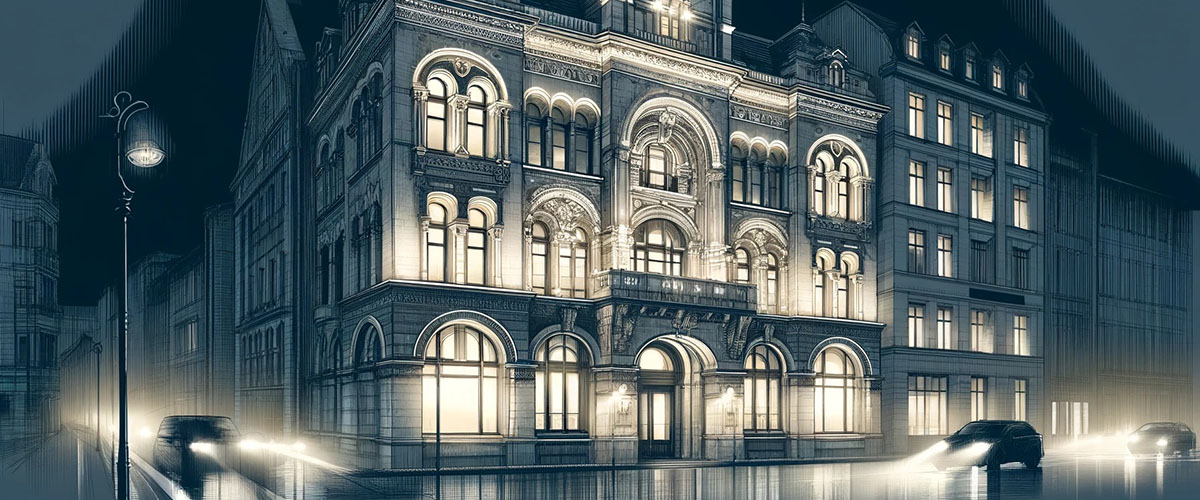
Monumental facade lighting reveals the volumetry, texture and ornamental detail of historic architecture during the night. The principal technique is wallwashing + grazing: ground-mounted (inground) or wall-mounted projectors with angles of 10-30 degrees (grazing: raking illumination that reveals stone texture) and 40-60 degrees (washing: uniform illumination of large surfaces). The installed power for a cathedral facade (500-2,000 m2) is 5-15 kW with LED (compared to 30-100 kW with metal halide), achieving illuminances of 30-100 lux on the stone surface.
Light pollution is a critical factor: the EN 12464-2 standard and night sky protection ordinances (Canary Islands Law 31/1988, Catalonia Decree 190/2015) limit upper hemispheric luminous flux (ULOR) to <1% and color temperature to <= 3,000 K (without the blue component that scatters in the atmosphere). Facade luminaires must have full cut-off and aiming angles < 70 degrees from horizontal. The Notre-Dame Cathedral (Paris, post-restoration lighting project 2024) will use 900 LED luminaires of 2,700-3,000 K with total power of 25 kW (compared to 80 kW previously), with a DALI control system enabling 12 programmed scenes including a minimum scene (5 lux on the facade) for early morning hours. The annual energy savings will be 70% with improved color rendering that will reveal the nuances of the restored limestone.
Reference cases and return on investment
The return on investment (ROI) of LED conversion in historic spaces combines energy savings, maintenance reduction and heritage protection. Replacing halogens with LEDs in a 5,000 m2 museum with 1,000 luminaires involves: investment of 80,000-150,000 EUR, energy savings of 30,000-50,000 EUR/year (70-80% reduction), maintenance savings of 10,000-20,000 EUR/year (lifespan 50,000 h vs 3,000 h: elimination of 4-5 relampings/year), and reduced risk of damage to artworks (incalculable value). The payback period is 2-3 years. The British Museum (London, conversion 2015-2020) replaced 5,000 halogen and fluorescent luminaires with LEDs, reducing lighting consumption by 40% and CO2 emissions by 28%.
The Alhambra of Granada (lighting project 2007-2015, Aureolighting) renovated the lighting of the Nasrid Palaces with 2,500 concealed LED light points in moldings and spandrels, revealing the plasterwork and muqarnas with CCT of 2,700 K and CRI >= 95 without any visual impact on the Islamic architecture. Consumption was reduced from 120 kW (halogen) to 35 kW (LED) — a savings of 71%. The Sistine Chapel (Vatican, conversion 2014, Osram/LED Engin) installed 7,000 LEDs of CRI >= 97 that illuminate Michelangelo's frescoes with 10 times less UV radiation than the previous lamps and a color rendering that revealed tonalities previously invisible under the former lighting. Efficient and respectful lighting in historic spaces is not a compromise between conservation and modernity — it is the only strategy that simultaneously improves heritage perception, its long-term protection and the energy efficiency of the building.
References
- [1]CIE 157:2004 — Control of damage to museum objects by optical radiationCommission Internationale de l'Éclairage. ISBN: 978-3-901906-27-7
- [2]EN 16163:2014 — Conservation of cultural heritage: Guidelines and procedures for choosing appropriate lighting for indoor exhibitionsEuropean Committee for Standardization.
- [3]Light for Art's Sake: Lighting for Artworks and Museum DisplaysButterworth-Heinemann / Elsevier. ISBN: 978-0-7506-6430-7
- [4]IESNA RP-30-21 — Museum and Art Gallery Lighting: A Recommended PracticeIlluminating Engineering Society of North America.
- [5]Sistine Chapel LED Lighting Project: Technical Report — 7,000 LED luminaires for Michelangelo's frescoesOsram GmbH.

Comments 0
No comments yet. Be the first!
Leave a comment