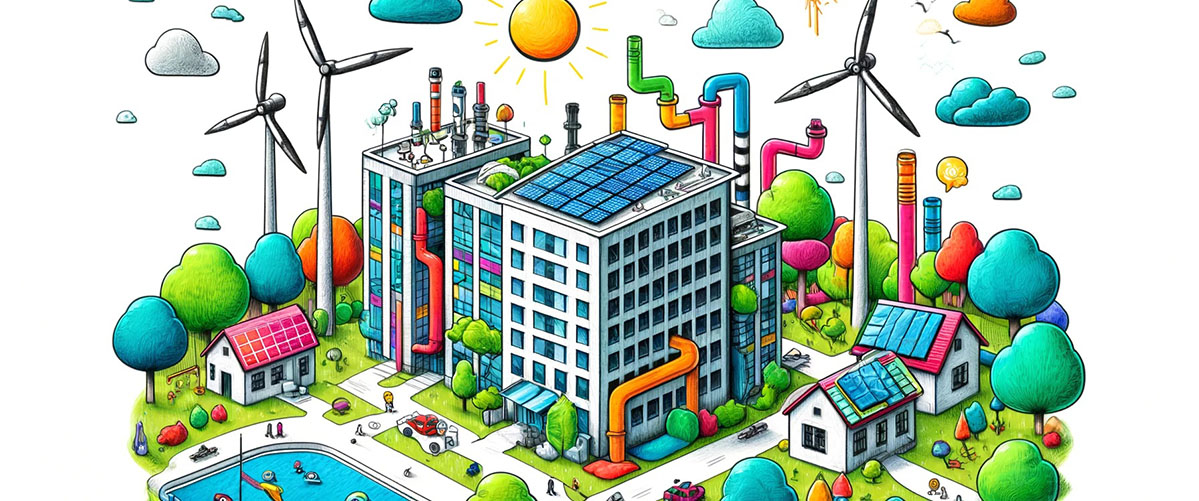
Solar thermal: hot water and heating from the roof
Exploring renewable energy for buildings, solar thermal is the most mature technology for DHW (domestic hot water) production. Flat-plate collectors achieve optical efficiencies of 75-80% and loss factors of 3.5-4.5 W/m²K (EN 12975), translating to annual production of 400-700 kWh/m² of collector in Spain. Spain's CTE DB-HE4 requires a minimum solar contribution of 30-70% of DHW demand depending on climate zone, with a minimum of 50% in zones III-V (central and southern Spain).
Evacuated tube collectors improve performance at high working temperatures (70-120 °C) for underfloor heating or solar absorption cooling (single-effect machines with COP of 0.65-0.75). A solar thermal DHW system for a 40-dwelling apartment block in zone IV (Madrid) typically requires 80-120 m² of collectors, a 4,000-6,000 litre storage tank, and an investment of €35,000-55,000, with savings of €6,000-10,000/year in natural gas and payback periods of 5-8 years (IDAE).
Small wind in urban settings: real potential and limitations
Small wind energy (turbines < 100 kW) applied to buildings has limited but real potential in favourable locations. Vertical-axis wind turbines (VAWT: Darrieus, Savonius, helical) are preferable in urban settings due to lower noise (< 35 dB at 5 m), ability to capture wind from any direction, and operation from speeds as low as 2-3 m/s. However, their efficiency is lower than horizontal-axis types: Cp (power coefficient) of 0.20-0.35 versus the theoretical Betz limit (Cp_max = 16/27 = 0.593).
Urban wind is turbulent, with mean speeds of 3-5 m/s at rooftop height (versus 6-8 m/s in rural areas), dramatically reducing output: a 5 kW rooftop turbine typically produces 3,000-6,000 kWh/year in urban settings versus 8,000-15,000 kWh/year in exposed rural locations. The resulting LCOE of €0.15-0.30/kWh makes urban small wind economically inferior to PV (€0.05-0.10/kWh). Viability is limited to buildings over 30 m tall, coastal locations, or sites with Venturi acceleration between buildings.
Biomass in buildings: boilers and heat networks
Biomass (pellets, wood chips, olive pits) is the main renewable heating source for buildings in rural and peri-urban Spain. Pellet boilers certified to EN 303-5 Class 5 achieve efficiencies of 90-95% with particulate emissions below 20 mg/Nm³. ENplus A1 certified pellets have an NCV of 4.7-5.0 kWh/kg at a price of €0.05-0.08/kWh (2024), competitive with natural gas (€0.07-0.10/kWh) and well below heating oil (€0.09-0.12/kWh).
The CO₂ balance of biomass is considered neutral (combustion CO₂ was previously captured by the plant during growth), although full-cycle emissions (harvesting, transport, processing) add 15-30 gCO₂/kWh versus 200 gCO₂/kWh for natural gas. Spain has 8.5 million hectares of forested area (MITECO, 2020) with a biomass harvesting potential of 17 million tonnes/year, of which only 5 million are currently utilised. Biomass district heating is the most efficient option for communities: the Soria network (REBI) supplies heat equivalent to 10,000 dwellings using local forest chips, avoiding 30,000 tCO₂/year.
Air-source heat pumps: the most deployed building renewable
Air-source heat pumps (air-to-water and air-to-air) are the fastest-growing renewable technology in European buildings. Directive (EU) 2018/2001 (RED II) recognises energy captured from ambient air as renewable provided the SPF (Seasonal Performance Factor) exceeds 2.5 (meaning over 60% of delivered energy comes from air, not electricity). The best equipment on the market (2024) achieves SCOP of 4.5-5.5 in medium climate and SEER of 6.0-8.5.
In Spain, heat pump installations have grown 30% annually since 2019 (AFEC, 2023). An 8 kW air-to-water heat pump for a 120 m² dwelling with underfloor heating costs €6,000-10,000 installed and consumes 2,000-3,500 kWh electricity/year covering heating, cooling, and DHW, at an operating cost of €400-700/year (tariff 2.0TD, 2024). CTE DB-HE4 (2019) allows counting the heat pump's renewable contribution towards the renewables requirement, provided the SPF exceeds the threshold in Commission Decision 2013/114/EU.
Microgrids and intelligent multi-source management
Integrating multiple renewable sources in a building requires intelligent energy management systems. A microgrid combines distributed generation (PV, small wind), storage (batteries, DHW as thermal storage), manageable loads (electric vehicles, heat pumps), and grid connection in a coordinated system. IEEE 2030 defines microgrid interoperability and EN 50549 regulates generator connection to the low-voltage grid.
The POCITYF project (H2020, 2019-2025) implemented microgrids in districts of Évora (Portugal) and Alkmaar (Netherlands) with BIPV, second-life EV battery storage, and heat pumps, achieving 65-80% district energy self-sufficiency and 60% emission reduction. In Spain, Royal Decree 244/2019 and its development through RD-ley 29/2021 enable local energy communities, allowing renewable energy sharing within a 2 km radius — a regulatory framework driving neighbourhood-scale microgrids.
References
- [1]Guía técnica de instalaciones de biomasa térmica en edificiosIDAE / Ministerio para la Transición Ecológica.
- [2]Directive (EU) 2018/2001 on the promotion of the use of energy from renewable sources (RED II)Official Journal of the European Union.
- [3]Informe anual del mercado de bomba de calor en España 2022AFEC.
- [4]POCITYF: Positive Energy Districts in Évora and Alkmaar — Final ResultsEuropean Commission H2020.
- [5]CTE DB-HE4: Contribución mínima de energía renovable para cubrir la demanda de ACSGobierno de España.


Comments 0
No comments yet. Be the first!
Leave a comment