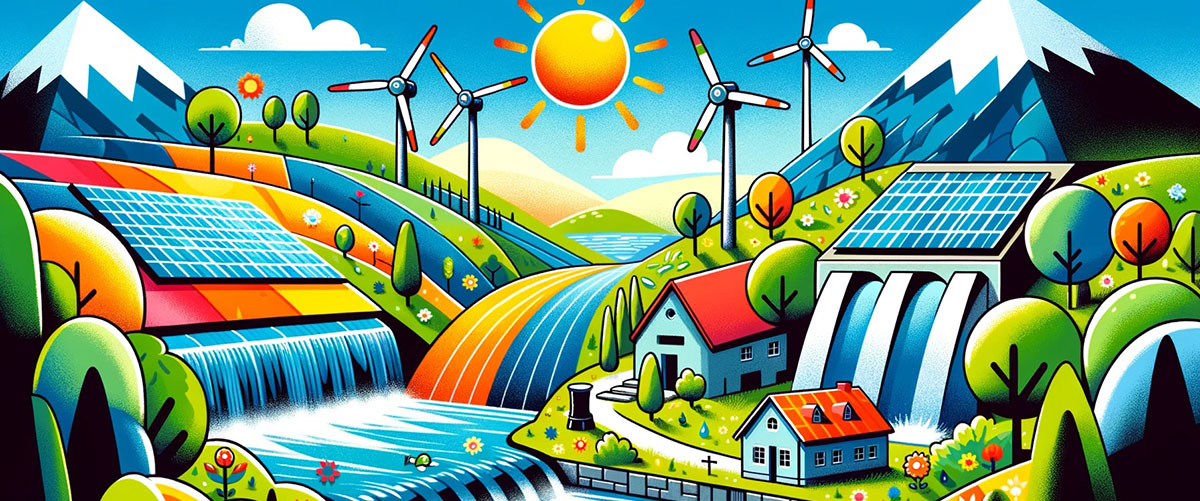
Global panorama of alternative energies in 2024
Alternative energies — sources of electricity and heat generation other than conventional fossil fuels (coal, oil, natural gas) — are undergoing unprecedented expansion. According to the International Renewable Energy Agency (IRENA), global installed renewable capacity reached 3,870 GW by the end of 2023, with a record increase of 507 GW in a single year, 50% more than the 2022 addition (338 GW). Solar photovoltaics led with 346 GW of new capacity (68% of the total), followed by wind with 117 GW (23%). China installed 297 GW, more than the rest of the world combined. In the European Union, renewables generated 44.7% of electricity in 2023, surpassing fossil fuels (33.3%, Ember, 2024) for the first time. Global investment in alternative energies reached 623 billion USD in 2023 (Bloomberg NEF), exceeding investment in fossil fuels for the third consecutive year.
The economic competitiveness of alternative energies is the driving force behind this transformation. The levelised cost of energy (LCOE) for utility-scale solar photovoltaics fell from 0.417 USD/kWh in 2010 to 0.049 USD/kWh in 2023, a reduction of 89% (IRENA, Renewable Power Generation Costs 2023). Onshore wind went from 0.107 to 0.033 USD/kWh (-69%), and offshore wind from 0.197 to 0.075 USD/kWh (-62%). These figures place solar and wind below the cost range of combined cycle gas plants (0.045-0.075 USD/kWh) and well below coal (0.065-0.150 USD/kWh) in 90% of global markets. Grid parity — the point where alternatives match or beat the cost of conventional sources — was reached in 2016 for solar in high-irradiation regions and is now a consolidated reality across all continents.
Solar and wind: the dominant alternatives
Solar photovoltaics has accumulated 1,419 GW of installed capacity globally (IRENA, 2024), with an estimated annual output of 1,600 TWh, equivalent to 5.5% of global electricity generation. The efficiency of commercial monocrystalline silicon modules reaches 22-24% (laboratory cell record: 26.8%, Kaneka, 2024), with annual degradation of 0.3-0.5% and performance guarantees of 25-30 years. Bifacial modules, which capture radiation reflected onto the rear surface, increase output by 5% to 20% compared to monofacial modules and already account for 30% of global sales. Emerging technologies — perovskite cells (laboratory efficiency of 33.9% in perovskite-silicon tandem, EPFL/CSEM, 2023), organic cells and quantum dot cells — promise additional 30-50% reductions in manufacturing cost by the 2030s. In buildings, building-integrated photovoltaics (BIPV) transforms facades, roofs and windows into generating surfaces with efficiencies of 10-19%.
Wind energy reached 1,021 GW installed globally by the end of 2023 (899 GW onshore, 122 GW offshore), generating approximately 2,100 TWh/year (7.3% of global electricity). The most advanced onshore turbines reach rated capacities of 6-7 MW with rotor diameters of 160-170 m and hub heights of 120-160 m, while offshore machines reach 14-16 MW with rotors of 220-260 m (Vestas V236-15.0, Siemens Gamesa SG 14-236). The global average capacity factor for onshore wind is 26-35% and 40-55% for offshore. In Spain, wind generated 61,138 GWh in 2023, 23.5% of peninsular electricity demand (REE, 2024), with 30,610 MW installed. The intermittency of solar and wind — the main challenge — is addressed through battery storage (45 GW/100 GWh installed globally in 2023, 130% growth over 2022), pumped hydro storage (160 GW), electrical interconnections and demand-side management.
Geothermal, biomass and green hydrogen as complementary alternatives
Geothermal energy harnesses heat from the Earth's interior (average gradient of 25-30°C/km depth) for electricity generation and climate control. Global geothermal electric capacity stands at 16.1 GW (2023), concentrated in Indonesia (2.4 GW), the United States (3.7 GW), the Philippines (1.9 GW) and other volcanically active countries. For residential buildings, ground-source heat pumps (GSHP) with closed-loop systems exchange heat with the ground at 2-3 m depth (stable temperature of 12-16°C in Spain) with coefficients of performance (COP) of 4.0-5.5: for every kWh of electricity consumed, they deliver 4 to 5.5 kWh of thermal energy. Residential GSHP investment (15,000-25,000 EUR for a 150 m2 single-family home) pays for itself in 6-12 years through 50-70% savings on heating and cooling compared to conventional gas or electric systems (European Geothermal Energy Council, 2023).
Biomass contributes 150 GW of global electrical capacity and covers 5% of worldwide primary energy demand, with thermal applications (pellet boilers with efficiencies of 90-95%, particulate emissions < 20 mg/m3 in EN 303-5 class 5 certified equipment), electrical (plants of 5-50 MW) and cogeneration. Green hydrogen, produced by water electrolysis using renewable electricity, is emerging as the key alternative for decarbonising hard-to-abate sectors: heavy industry, shipping and aviation. The cost of green hydrogen stands at 3.0-6.0 EUR/kg in 2024, with projections of 1.5-2.5 EUR/kg by 2030 (Hydrogen Council, 2023) that would bring it close to competitiveness with grey hydrogen from natural gas reforming (1.0-2.0 EUR/kg). The EU has established a target of 10 million tonnes of domestic production and 10 million tonnes of renewable hydrogen imports by 2030 through the REPowerEU strategy. Global electrolysis capacity rose from 0.7 GW in 2022 to a projected 134-240 GW by 2030 according to the IEA.
Tidal, wave energy and the future of alternative energies
Ocean energies — tidal (harnessing tides), wave (energy from waves) and ocean thermal energy conversion (OTEC) — represent a theoretical resource of 80,000 TWh/year, equivalent to 3 times global electricity consumption, but their commercial exploitation remains at an early stage. The La Rance tidal plant (France, 240 MW, operational since 1966) and Sihwa Lake (South Korea, 254 MW, 2011) demonstrate large-scale technical feasibility, with capacity factors of 25-28%. Tidal stream turbines (similar to underwater wind turbines) reach capacities of 1-2 MW per unit (Orbital Marine Power, MeyGen in Scotland with 6 MW operational). Wave energy has an estimated exploitable potential of 500 GW along European coasts, with devices such as the Pelamis (750 kW, discontinued) and the Corpower Ocean C4 (300 kW, under testing in Portugal) achieving outputs of 700-1,200 MWh/year. The LCOE of these technologies stands at 0.20-0.50 EUR/kWh, requiring reductions of 60-80% to achieve competitiveness.
The future of alternative energies converges toward a 100% renewable energy system that is technically feasible before 2050, according to modelling by Jacobson et al. (2017) published in Joule covering 139 countries. The pillars of this transition are: massive electrification of transport and heating (EU target: 30 million electric vehicles by 2030), storage at multiple time scales (batteries for hours, hydrogen for weeks, pumped hydro for months), smart grids with the capacity to manage millions of points of distributed generation, and energy efficiency that reduces final demand by 40-50%. The International Energy Agency projects that renewables will account for 80% of new generation capacity installed globally through 2030, adding 4,800 GW in the decade. Alternative energies have ceased to be an aspiration and have become the backbone of the global energy system now under construction.
References
- [1]Renewable Capacity Statistics 2024IRENA, Abu Dhabi. ISBN: 978-92-9260-587-2
- [2]Renewable Power Generation Costs in 2022IRENA, Abu Dhabi. ISBN: 978-92-9260-544-5
- [3]European Electricity Review 2024Ember Climate.
- [4]100% Clean and Renewable Wind, Water, and Sunlight All-Sector Energy Roadmaps for 139 Countries of the WorldJoule, 1(1), 108-121.
- [5]Hydrogen Insights 2023 — An Updated Perspective on Hydrogen Investment, Deployment, and Cost CompetitivenessHydrogen Council.


Comments 0
No comments yet. Be the first!
Leave a comment