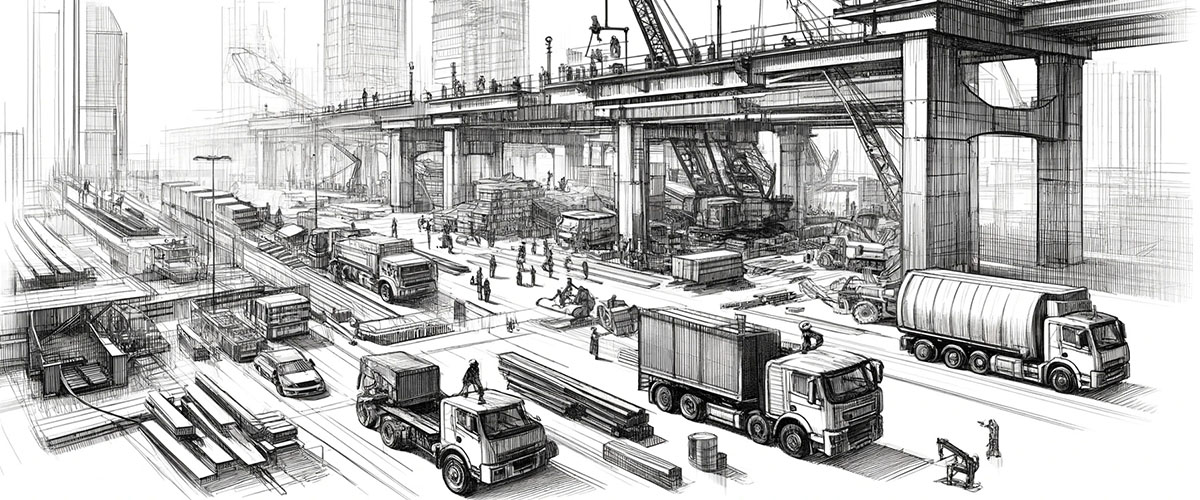
Decarbonising materials transport: a quantified imperative
The Future of Materials Transport in Sustainable Construction demands a radical transformation of a sector that has operated in essentially the same way for the past 50 years. The transport of construction materials accounts for between 5% and 15% of a building's life-cycle emissions (module A4, EN 15978), and in Spain 94% of this transport is carried out by road (MITMA, 2021), with a fleet whose average age exceeds 13 years and that depends almost exclusively on diesel. Average road transport emissions in Spain are 0.08-0.12 kgCO2/t-km for 40-tonne articulated trucks (IDAE, 2020), which means that moving the 2,000-3,000 tonnes of materials for an average residential building generates 15-45 tCO2 from transport alone. Similar patterns prevail across Europe and North America: an ageing diesel fleet, road-dominated modal split, and limited adoption of digital optimisation tools combine to make construction materials transport one of the most carbon-intensive and least-reformed segments of the freight industry.
The European Green Deal requires a 90% reduction in transport emissions by 2050, and the Fit for 55 package (2021) sets intermediate targets of 55% by 2030. For the construction sector, this implies transformation along three axes: electrification of the short- and medium-distance fleet (< 300 km), intermodality (road-rail-waterway combinations) for long distance, and logistics optimisation through digitalisation to eliminate unnecessary trips. Global investment in zero-emission vehicles for heavy transport reached 11 billion USD in 2023 (BloombergNEF), with construction as one of the sectors with the greatest potential for early adoption due to the predictability of its routes and the availability of depot-based charging. The convergence of tightening emissions regulation, falling battery costs, and expanding charging infrastructure creates a window of opportunity for construction firms to decarbonise their transport operations while simultaneously reducing total cost of ownership.
Electrification and alternative fuels: from diesel to zero emissions
Battery electric trucks (BEVs) are the most mature solution for short- and medium-distance construction materials transport. The Volvo FH Electric (range of 300 km, payload of 22 tonnes) and the Mercedes-Benz eActros 600 (range 500 km, payload 22 t) have been in commercial production since 2023-2024. The operating cost of an electric truck is 30-50% lower than diesel (electricity versus diesel fuel, lower maintenance), although the acquisition cost is still 2-3 times higher. The TCO (total cost of ownership) reaches parity with diesel after 5-7 years of use on urban and peri-urban routes (McKinsey, 2022). On urban construction sites, electric trucks eliminate local NOx and particulate emissions, meeting the restrictions of Low Emission Zones (LEZs) that already affect more than 320 European cities. For construction logistics operators serving multiple urban sites, the ability to enter LEZ-restricted areas without penalty or time limitation represents a competitive advantage that accelerates the business case for electrification beyond the pure fuel-cost calculus.
For long-distance transport (> 500 km), green hydrogen is the most promising alternative. Fuel-cell electric trucks (FCEVs) such as the Hyundai XCIENT (range 400 km, already operational in Switzerland with 47 units since 2020) and the Nikola Tre FCEV offer rapid refuelling (< 20 minutes) and payload equivalent to diesel. The cost of green hydrogen currently stands at 5-8 EUR/kg (2024), but is expected to fall to 2-3 EUR/kg by 2030 with production scale-up. Biomethane is another alternative already available: LNG/CNG trucks such as the Iveco S-Way NP reduce CO2 emissions by 15-20% with natural gas and by up to 95% with certified biomethane. In Spain, 20 biomethane plants already inject into the grid (2024), with an estimated potential of 35 TWh/year according to SEDIGAS. The coexistence of battery electric, hydrogen fuel-cell, and biomethane powertrains reflects the reality that no single technology will serve all construction transport use cases, and fleet operators will need a diversified approach matched to their specific route profiles and payload requirements.
Intermodality and rail: the lowest-footprint alternative
Rail transport of construction materials emits 3-4 times less CO2 per tonne-kilometre than road: 0.02-0.04 kgCO2/t-km versus 0.06-0.15 (data from the European Environment Agency, 2022). For heavy materials transported over long distances (cement, steel, imported aggregates), rail reduces transport emissions by 65-75%. In Spain, the rail modal share for freight is just 4.8% (compared with the European average of 18%), which represents an enormous potential for improvement. The Plan to Boost Rail Freight Transport (MITMA, 2022) aims to double the share to 10% by 2030, with investments of 7.5 billion euros in intermodal terminals and connections. Construction materials are particularly well suited to rail because they are heavy, non-perishable, and can tolerate batch scheduling, making them ideal candidates for the scheduled, high-volume movements at which rail excels. The barrier is not technical compatibility but infrastructure: last-mile rail sidings at quarries, cement works, and steel mills have been progressively closed over decades and need reinvestment.
The intermodal model — rail for the trunk haul and electric road vehicles for the last mile — is the optimal combination for construction materials. The container terminal at Barcelona Can Tunis already handles 400,000 TEUs/year with rail connections to Zaragoza, Madrid, and southern France. Inland waterway transport, used extensively in the Netherlands (where 35% of aggregates travel by canal), emits only 0.01-0.03 kgCO2/t-km and has capacity for massive loads (barges of 1,000-3,000 t). Cargo drones represent the future of specialised last-mile delivery: the Dronamics Black Swan carries 350 kg over 2,500 km, and companies such as Zipline and Wingcopter operate autonomous delivery networks that could be adapted to the logistics of lightweight construction components. The intermodal vision for construction materials is not futuristic speculation but an operational reality in markets where the infrastructure exists, and a funded investment priority in markets where it does not yet.
Autonomous and intelligent logistics: construction without drivers
Autonomous vehicles will transform construction materials logistics in two domains: inter-urban transport (Level 4 autonomous trucks on motorways, with a driver only for the urban last mile) and intra-site transport (AGVs that move materials within the site perimeter without an operator). TuSimple, Aurora, and Waymo Via are testing Level 4 autonomous trucks in the United States, with commercial driverless operations projected for 2025-2027. On site, AGVs (Automated Guided Vehicles) such as those from Volvo Construction Equipment (HX series) move earth and aggregates without an operator, with a cost reduction of 25-30% and a safety improvement that eliminates 70% of accidents associated with site vehicles. The combination of autonomous motorway haulage and autonomous on-site movement creates the possibility of a fully driverless materials supply chain from quarry to placement, with human oversight concentrated on exception handling and quality verification rather than routine driving tasks.
Artificial intelligence optimises the entire logistics chain: dynamic routing algorithms (such as those from Google DeepMind applied to logistics) reduce total distance travelled by 10-15% and emissions in the same proportion, through the simultaneous consideration of real-time traffic, delivery windows, load capacity, and site priorities. Predictive planning based on historical data, weather forecasts, and construction progress enables material needs to be anticipated 72-120 hours in advance with an accuracy of 85-93%, eliminating urgent orders (which generate inefficient trips with partially loaded trucks). The Future of Materials Transport in Sustainable Construction does not depend on a single technology but on the convergence of electrification, intermodality, automation, and artificial intelligence into an integrated and digitalised logistics system that minimises emissions, costs, and safety risks. Each technology addresses a different segment of the problem, and their combined effect is multiplicative rather than additive, creating a logistics paradigm where the total carbon footprint of materials transport approaches the physical minimum dictated by mass, distance, and the laws of thermodynamics.
References
- [1]Estrategia de Movilidad Segura, Sostenible y Conectada 2030Ministerio de Transportes, Movilidad y Agenda Urbana, Gobierno de España.
- [2]Preparing the World for Zero-Emission Trucks: Total Cost of Ownership AnalysisMcKinsey Center for Future Mobility.
- [3]Zero-Emission Trucks: State of the Market 2023Bloomberg New Energy Finance.
- [4]Transport and environment report 2022: Digitalisation in the mobility system — Opportunities and challengesEEA. ISBN: 978-92-9480-519-5
- [5]Plan de Impulso al Transporte de Mercancías por Ferrocarril 2022-2030Ministerio de Transportes, Movilidad y Agenda Urbana.
- [6]Factores de emisión de CO₂ y coeficientes de paso a energía primaria de diferentes fuentes de energía final en el sector de edificios en EspañaInstituto para la Diversificación y Ahorro de la Energía.


Comments 0
No comments yet. Be the first!
Leave a comment