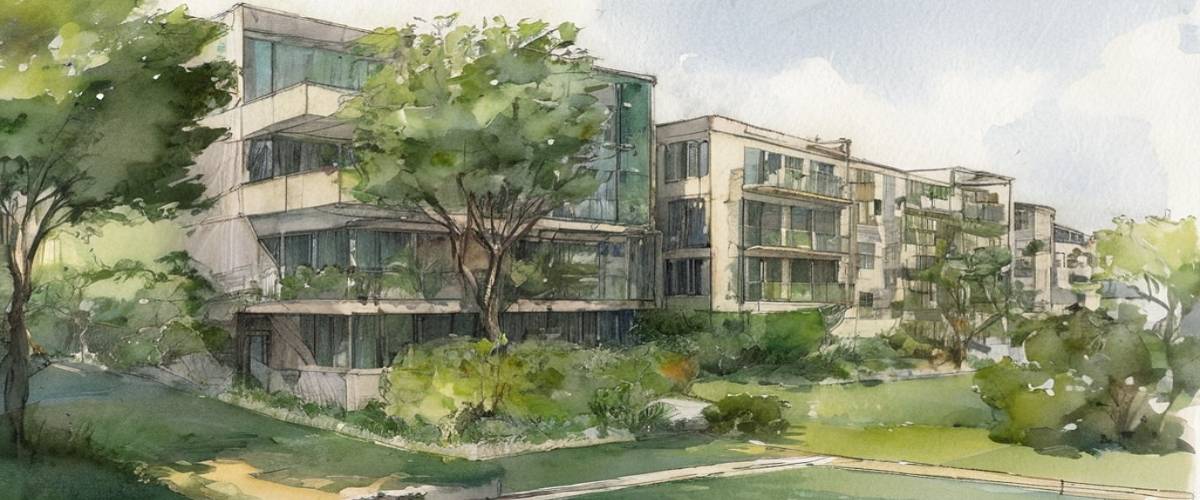
Embodied Carbon Regulation as a Transformative Force
The regulation of embodied carbon in construction materials constitutes the most disruptive regulatory trend of the coming decade. Until 2020, building regulations focused exclusively on operational emissions (heating, cooling, lighting), but embodied carbon represents between 30% and 70% of total life cycle emissions for a high-energy-efficiency building, according to a study by Röck et al. (2020) published in Nature Sustainability that analyzed LCA data from 650 buildings in 64 countries. Denmark was the first European country to establish mandatory embodied carbon limits (12 kg CO₂eq/m²·year for new buildings from January 2023), followed by France with the RE2020 (a limit of 640 kg CO₂eq/m² for housing and 740 kg CO₂eq/m² for offices, referring to module A1-A5, in effect since January 2022) and the Netherlands with the MPG (a limit of 0.5 EUR/m²·year in environmental cost based on monetized impact, in effect since 2018 with progressive tightening). The new European EPBD (2024) requires all member states to calculate and report the global warming potential of the life cycle of new buildings larger than 1,000 m² from 2028 and of all new buildings from 2030.
The impact of these regulations on design is profound and quantifiable. The first 2 years of implementation of the RE2020 in France have caused a 35% increase in the use of timber-frame construction in residential buildings up to 7 stories and an 18% reduction in the clinker content of concrete used in foundations, according to data from the Centre Scientifique et Technique du Bâtiment (CSTB, 2024). In Denmark, developers have responded to the embodied carbon limit by adopting optimized foundations that reduce concrete volume by 25-40% through parametric design, and by substituting aluminum and glass facades with timber and fiber cement systems achieving an average 55% reduction in the embodied carbon of the envelope (Dansk Byggeri, 2024). In Spain, the planned modification of the CTE to include embodied carbon limits, with an estimated entry into force of 2026-2027, will require the sector to incorporate LCA as a design tool and to replace high-impact materials. A study by the Green Building Council España (GBCe, 2023) estimated that 78% of current new housing projects in Spain would not meet a limit of 500 kg CO₂eq/m² without significant modifications in the selection of structural and envelope materials.
Biogenic Materials and Low-Carbon Concrete at Industrial Scale
Engineered timber, especially cross-laminated timber (CLT), emerges as the most mature alternative for reducing embodied carbon in the structure of medium- and high-rise buildings. Global CLT production grew from 680,000 m³ in 2015 to 2,500,000 m³ in 2023, with a forecast of 5,000,000 m³ by 2028 (WoodWorks, 2024). Tall timber buildings are breaking through scale barriers: the Mjøstårnet in Brumunddal (Norway), standing at 85.4 m and 18 stories, uses a glued-laminated timber structure that stores 1,600 t CO₂ of biogenic carbon, while an equivalent reinforced concrete structure would have emitted 2,100 t CO₂eq, resulting in a differential balance of 3,700 t CO₂eq in favor of timber (Abrahamsen & Malo, 2014; updated by Ringsaker Kommune, 2019). In Spain, current regulations allow timber buildings up to 5 residential stories under the CTE DB SI (with fire safety engineering justification), and the planned amendment for 2025-2026 will raise this limit to 8 stories, aligning with Germany, Austria, and the Nordic countries. Other biogenic materials are gaining presence: wood fiber insulation reached 12% of the European insulation market in 2023 (up from 4% in 2015), and hempcrete blocks with a thermal conductivity of 0.06-0.09 W/m·K and negative embodied carbon of -35 to -110 kg CO₂eq/m³ are already used in more than 5,000 buildings across Europe.
The concrete industry, responsible for 8% of global CO₂ emissions, is developing low-carbon alternatives with the potential to reduce its impact by 30% to 70%. Alkali-activated slag cements (geopolymers) have an embodied carbon of 40-100 kg CO₂eq/t, compared to 600-900 kg CO₂eq/t for conventional Portland cement, but their global market share does not exceed 0.5% due to limitations in raw material availability and incomplete standardization. Concrete with partial clinker replacement using slag, fly ash, silica fume, and limestone achieves reductions of 25-50% in embodied carbon and is already used in 35% of European civil works projects (ERMCO, 2023). The CO₂ curing technology developed by CarbonCure has been installed in more than 750 concrete plants in 30 countries and sequesters 4-16 kg CO₂ per cubic meter of concrete. Heidelberg Materials inaugurated in 2024 the first industrial-scale carbon capture and storage plant in Brevik (Norway), with a capacity to capture 400,000 t CO₂/year, equivalent to 50% of the plant's emissions, at an estimated cost of 80-120 EUR/t CO₂.
Regenerative Design and Energy-Positive Buildings
The regenerative design paradigm moves beyond the logic of "minimizing harm" to propose buildings that generate a net positive impact on the environment and communities. The Living Building Challenge (LBC) certification from the International Living Future Institute, the most demanding in the world, requires buildings to produce more renewable energy than they consume (a minimum of 105% measured over 12 months of actual operation), manage the entirety of their wastewater on-site, and use exclusively materials that comply with a restrictive list excluding more than 800 toxic substances. Through 2024, 41 buildings in 8 countries have obtained full LBC certification (ILFI, 2024). The Bullitt Center in Seattle (USA), spanning 4,830 m² and LBC-certified in 2015, produces 230 MWh/year of solar photovoltaic energy versus a consumption of 185 MWh/year, treats 100% of its wastewater through a biodigestion system, and has recorded an energy consumption of 38 kWh/m²·year, which is 75% lower than the average for Seattle office buildings (150 kWh/m²·year).
Energy-positive buildings (Energy Plus Buildings) are consolidating as a verified design trend beyond demonstration projects. France has required since 2022, through the RE2020, that new dwellings achieve a positive primary energy balance (Bbio indicator ≤ values that force renewable production). Norway has built 9 pilot energy-positive buildings within the ZEB (Zero Emission Buildings) program, including the Powerhouse Brattørkaia building in Trondheim (2019, 18,200 m²), which produces 500 MWh/year of solar photovoltaic energy integrated into the inclined facade, exceeding its operational consumption of 420 MWh/year and offsetting the embodied carbon from its construction within a calculated period of 16 years. In Spain, the energy-positive building concept has significant potential: a study by Manzano-Agugliaro et al. (2015), published in Renewable and Sustainable Energy Reviews, calculated that a 4-story residential building in Almeria with a photovoltaic roof and south-facing facade (280 m² of panels at 22% efficiency) can produce 95 MWh/year versus a consumption of 72 MWh/year, achieving a positive balance of 132% in one of Europe's highest irradiation zones (1,900 kWh/m²·year).
Convergence of Health, Biophilia, and Sustainability
The integration of health and well-being criteria in sustainable design is a consolidated trend that redefines the goals of architectural design. The WELL v2 certification, which evaluates 10 health concepts (air, water, nourishment, light, movement, thermal comfort, sound, materials, mind, and community) with 110 quantified indicators, has certified more than 5,200 projects representing 52 million m² in 60 countries (IWBI, 2024). Biophilic design, which incorporates natural elements and biological patterns into the built environment, has demonstrated quantifiable benefits: a meta-analysis by Zhong et al. (2022), published in Building and Environment and based on 57 empirical studies, documented that the presence of indoor vegetation reduces perceived stress by 15%, exposure to natural light improves productivity by 6-12%, and views of nature reduce sick leave days by 10%. Companies occupying WELL-certified buildings report a 30% reduction in absenteeism and an 11% increase in job satisfaction, according to aggregated data from the International WELL Building Institute (IWBI, 2023).
The convergence between environmental sustainability and human health is evident in materials and systems. The selection of low-toxicity materials, measured through the transparency of their components via Health Product Declarations (HPDs) and Declare Labels, is a shared requirement of the WELL, LBC, and LEED v4.1 certifications. The number of construction products with HPDs grew from 800 in 2018 to 5,400 in 2024, and products with Declare Labels from 1,200 to 4,800 in the same period (HPD Collaborative, 2024). Green roofs and walls combine thermal insulation benefits (roof thermal transmittance reduction of 0.3-0.8 W/m²·K), stormwater management (retention of 50-80% of annual precipitation), urban biodiversity, and the psychological well-being of occupants. The global area of green roofs grew by 17% annually between 2019 and 2023, reaching a cumulative installed area of 340 million m² (EFB, 2024). The outlook is that the next generation of green certifications will integrate health indicators as prerequisites rather than optional credits, consolidating the fusion of environmental sustainability and human well-being as the dominant paradigm of architectural design for the coming decade.
References
- [1]Embodied GHG Emissions of Buildings — The Hidden Challenge for Effective Climate Change MitigationApplied Energy, 258, 114107.
- [2]Green Building Materials Market by Type, Application, and End User: Global Opportunity Analysis and Industry Forecast, 2022-2027Allied Market Research.
- [3]Biophilic Design in Architecture and its Contributions to Health, Well-being, and Sustainability: A Critical ReviewFrontiers of Architectural Research, 11(1), 114-141.
- [4]Living Building Challenge 4.1: A Visionary Path to a Regenerative FutureILFI.
- [5]Bilan des Deux Premières Années de la RE2020: Impacts sur les Pratiques ConstructivesCSTB Rapport Technique.


Comments 0
No comments yet. Be the first!
Leave a comment