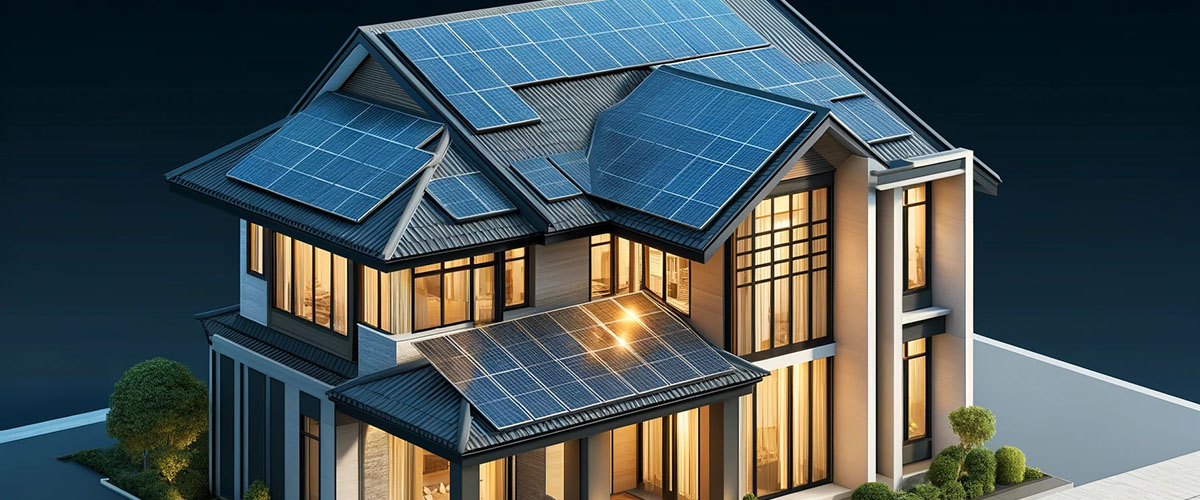
Roof-integrated BIPV: when the roof produces energy
The rise of solar tiles responds to a convergent demand: the obligation for nearly zero-energy buildings (nZEB) under the EPBD recast 2024, the aesthetic resistance to conventional photovoltaic panels on residential and heritage roofs, and the technological maturation of building-integrated photovoltaics (BIPV). Unlike conventional solar panels (BAPV, Building Applied Photovoltaics) that are mounted on top of the existing roof, solar tiles replace the roofing material (ceramic tile, slate, asphalt shingle), simultaneously fulfilling the functions of waterproofing, insulation, and electricity generation. The global BIPV roofing market reached 3,500 million USD in 2023, with projections of 12,000 million USD by 2030 (BloombergNEF), growing at 19% per year. This growth trajectory reflects not merely a niche product gaining traction but a fundamental rethinking of the roof as a multifunctional building component.
The economic advantage of BIPV over BAPV activates when the solar tile cost is comparable to the combined cost of conventional roofing plus solar panels. In new construction, the premium for solar tiles over conventional ceramic tiles is 40-80% on the roofing chapter alone, but by eliminating the subsequent panel installation (mounting structure, fixings, additional cabling), the net premium on the combined "roof plus energy" system drops to 10-25%, with payback periods of 8-14 years from electricity savings (IEA PVPS, 2023). For re-roofing projects, where the existing covering must be replaced regardless, the incremental cost is even lower, limited to the difference between conventional and active tiles rather than the full system cost.
Tesla Solar Roof: the tile that popularised the concept
The Tesla Solar Roof (V3, launched in 2019; V4 announced in 2024) is the product that brought solar tiles to mainstream attention. It combines active photovoltaic tiles (with monocrystalline cells at 19-22% efficiency, generating 60-72 W/m2) with inert tiles (same appearance but without cells) to cover the entire roof surface with a uniform aesthetic. The installable capacity varies with the ratio of active to inert tiles: a 100 m2 roof with 60% active tiles generates 3.6-4.3 kWp, producing 4,500-5,500 kWh/year at mid-latitudes (Madrid: 1,500 kWh/kWp per year; London: 900 kWh/kWp per year). The system's modular design allows architects and homeowners to balance energy output against budget by adjusting the active-to-inert tile ratio without compromising the visual coherence of the roof.
The cost of Tesla Solar Roof in the United States is 250-350 USD/m2 installed (2024), compared with 150-200 USD/m2 for an asphalt shingle roof plus equivalent BAPV system. The warranty covers 25 years of electrical production (at least 80% of nominal power) and a lifetime tile warranty for weather protection. Limitations include restricted availability outside the United States (nascent European presence), extended installation time (2-3 weeks for a single-family dwelling, versus 1-2 days for conventional BAPV), and a minimum roof pitch of 14 degrees (25%) to ensure water-tightness. The aesthetic result is the product's strongest attribute: the tiles are virtually indistinguishable from natural slate or flat ceramic tiles when viewed from street level, addressing the objection that has historically limited photovoltaic adoption in architecturally sensitive neighbourhoods.
Established alternatives: CertainTeed, BMI, GAF, and Solarstone
The solar tile market has diversified well beyond Tesla. CertainTeed Apollo II (Saint-Gobain, USA) is an asphalt shingle with an integrated monocrystalline cell: 18-19% efficiency, generation of 55-60 W/m2, installable by conventional roofers (no specialist electricians needed for mechanical mounting), with 25 years of electrical warranty and 15 years of roofing warranty. Its price (180-250 USD/m2 installed) positions it as the most cost-competitive option on the American market. The product's appeal lies in its compatibility with existing roofing installation practices, dramatically lowering the barrier to entry for contractors unfamiliar with photovoltaic systems.
In Europe, BMI Group (including Braas and Monier) offers the InDaX system: an integration of photovoltaic modules into the roof plane that replaces ceramic tiles, with 20-21% efficiency and output of 180-200 Wp per module of 1.0 x 0.5 m. Solarstone (Estonia) has developed a glass-glass solar tile that mimics the appearance of concrete roof tiles, with 20% efficiency, IEC 61215/61730 certification, and a presence in 12 European countries. GAF Energy (USA, a subsidiary of Standard Industries) launched the Timberline Solar in 2022: a tile installed with a standard pneumatic nail gun (identical to any asphalt shingle), eliminating the specialised installation barrier entirely. All of these alternatives demonstrate that aesthetics and efficiency in a single package are no longer the monopoly of a single brand but a competitive product category with diversified supply chains.
Energy performance, return on investment, and regulatory drivers
The energy yield of solar tiles depends on roof orientation and pitch (optimum: south-facing at 30-35 degrees in latitudes 35-45 degrees N), active surface proportion, shading conditions, temperature (thermal coefficient: -0.3 to -0.4% per degree C), and cell efficiency. An analysis by IEA PVPS Task 15 (2023) covering 42 BIPV roof installations across 8 countries documented average production of 65-85 kWh/m2 per year in northern Europe and 110-140 kWh/m2 per year in the south, with annual degradation of 0.4-0.6% (comparable to conventional BAPV). Direct self-consumption reaches 30-50% of production without a battery and 60-80% with a domestic battery of 10-13.5 kWh (Tesla Powerwall, BYD, Sonnen). The return on investment (ROI) varies significantly by regulation and electricity price: in Spain (domestic tariff: 0.15-0.20 EUR/kWh, surplus compensation: 0.05-0.10 EUR/kWh), the payback on the BIPV premium is 10-14 years; in Germany (0.30-0.35 EUR/kWh), 7-10 years; in California (0.25-0.40 USD/kWh), 6-9 years. With a service life of 25-30 years, the solar tile delivers a net return of 1.5-3.0 times the additional investment.
European regulation is accelerating adoption: the EPBD recast (2024) requires nZEB performance with on-site renewable production, and the Renewable Energy Directive (RED III) simplifies permits for rooftop installations under 50 kWp. Solar tiles offer a unique advantage in heritage protection zones: their integrated appearance typically secures approval from heritage commissions where conventional panels are rejected. In Italy, the Soprintendenza (heritage authority) has authorised solar tiles in historic centres of Florence, Siena, and Bologna where BAPV panels were prohibited. Adoption barriers remain, including elevated upfront cost (though declining), limited availability of qualified installers (BIPV training requires both roofing and photovoltaic electrical competencies), and product standards still under development (IEC 63092 for BIPV is being consolidated, whereas BAPV modules benefit from the mature IEC 61215/61730). The rise of solar tiles is an irreversible trend, propelled by the confluence of climate regulation, technological maturity, and demand for architectural integration, and the coming decade will see energy-producing roofs normalised as a construction standard rather than a technological exception.
References
- [1]Task 15: Enabling Framework for the Development of BIPV — Performance Analysis of 42 Roof BIPV InstallationsInternational Energy Agency Photovoltaic Power Systems Programme.
- [2]Building-Integrated Photovoltaics Market Outlook 2023-2030Bloomberg New Energy Finance.
- [3]Solar Roof V3/V4: Technical Specifications and Warranty TermsTesla Energy.
- [4]Recent advancement in BIPV product technologies: A reviewEnergy and Buildings, 140, 188-195.
- [5]Building Integrated Photovoltaics (BIPV): Review, Potentials, Barriers and MythsGreen, 3(2), 125-156.
- [6]Directive (EU) 2024/… on the Energy Performance of Buildings (recast) — EPBDOfficial Journal of the European Union.



Comments 0
No comments yet. Be the first!
Leave a comment