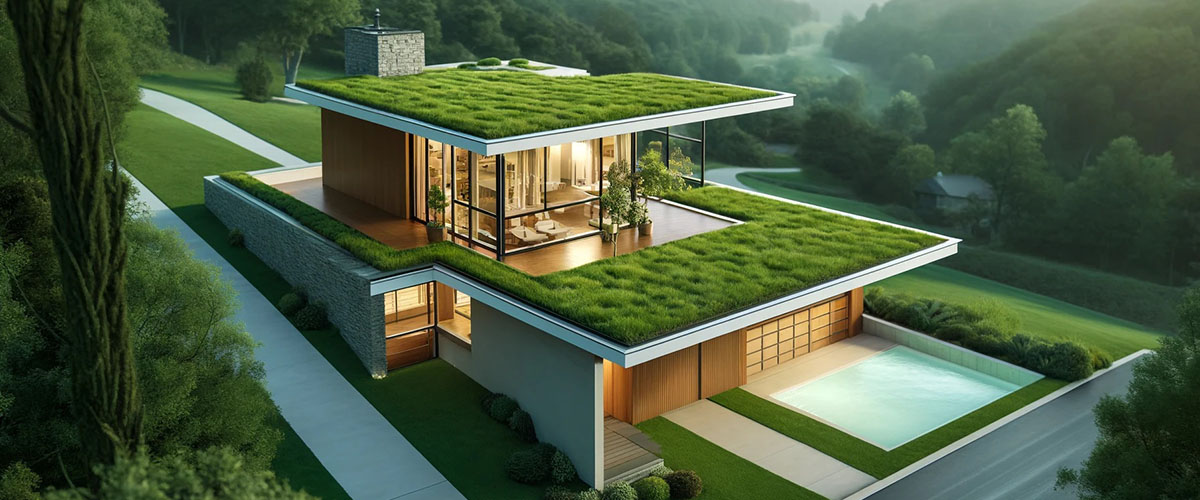
The global expansion of green rooftops: scale and policies
The rise of green rooftops has transformed the urban landscape of the world's major cities over the past two decades. The cumulative area of green roofs in Europe exceeds 100 million m², led by Germany (50+ million m², with more than 8 million m² installed annually), followed by Austria, Switzerland, France and the Scandinavian countries (EFB, European Federation of Green Roof Associations, 2023). In North America, the green rooftop market reached 850 million USD in 2023, with an annual growth rate of 12% (Grand View Research, 2024). This rise is not spontaneous but driven by public policies recognizing benefits beyond aesthetics: Germany has more than 85 municipalities that offer fiscal incentives for green roofs (deductions of 30-100% on the stormwater fee); Copenhagen has required since 2010 that all new buildings with slopes below 30% install a green roof; Toronto mandates green roofs on at least 20-60% of the roof area of buildings with more than 2,000 m² of floor plate.
In Spain, the rise of green rooftops is more recent but accelerating. Barcelona incorporated in its Green and Biodiversity Plan 2020 the target of 1 m² of green space for every m² of new construction, including roofs and facades. Vitoria-Gasteiz, European Green Capital 2012, has more than 15,000 m² of municipal green roofs. Madrid published in 2020 its Green Infrastructure Guide with technical specifications for green roofs. The energy renovation sector, driven by Next Generation EU funding, includes green roofs as a subsidized measure with amounts of 40-120 EUR/m². The Barcelona Urban Ecology Agency estimates that 70% of the city's flat roofs (12.5 million m²) are technically suitable for supporting vegetation, with a transformation potential that would multiply the city's green surface by 4. Green rooftops have evolved from a landscaping curiosity to a tool of urban policy with measurable climate resilience objectives.
Thermal and energy benefits: monitoring data
The thermal benefits of green rooftops constitute the strongest argument beyond aesthetics. The combination of shading by vegetation, substrate insulation and evapotranspirative cooling reduces the surface temperature of the roof membrane by 20°C to 40°C compared to a conventional dark roof on summer days. Measurements from the Green Roof Energy Calculator project (Portland State University) across 12 green roofs documented maximum surface temperatures of 30-38°C beneath the substrate versus 65-80°C on adjacent asphalt roofs. This reduction translates into cooling energy savings of 15-45% for the floor immediately below the roof, equivalent to 3-15 kWh/m²·year depending on substrate depth and climate zone (Sailor, 2008). In winter, the insulating effect of saturated substrate (conductivity 0.4-0.8 W/m·K, lower than concrete: 1.5-2.0 W/m·K) reduces heating losses by 5% to 15%.
At the urban scale, green rooftops mitigate the urban heat island effect. Simulation models from the Lawrence Berkeley National Laboratory estimated that converting 50% of a typical city's rooftops to green or reflective roofs would reduce average air temperatures by 0.3-1.0°C (Santamouris, 2014). A study in Chicago measured air temperature reductions of 0.5-3°C above green roofs compared to surrounding non-vegetated areas (Smith & Roeber, 2011). In Madrid, with summer temperatures exceeding 40°C and a nighttime heat island effect of 5-8°C, large-scale green rooftop deployment constitutes a climate adaptation strategy with measurable impact. Evapotranspiration from an extensive green roof dissipates between 300 and 700 kWh/m²·year of latent heat, energy that on a conventional roof would be transmitted to the building interior and urban air as sensible heat. The thermal benefits generate direct economic returns: the reduction in energy bills pays back the green roof premium in 8-15 years in hot climates, where cooling savings are greatest.
Hydrological, ecological and air quality benefits
Green rooftops function as distributed stormwater retention infrastructure. An extensive green roof with 10 cm of substrate retains between 40% and 60% of annual precipitation in temperate climates, and between 60% and 80% in climates with moderate and well-distributed rainfall (Berndtsson, 2010). Per-event retention varies with intensity: for light storms (< 10 mm), retention reaches 80-100%; for intense storms (> 30 mm), it drops to 20-40%, but the peak runoff delay (30-120 minutes) reduces the peak flow reaching the sewer network by 50-80%, alleviating the risk of flooding and combined sewer overflows (CSOs). The quality of green roof effluent improves compared to runoff from conventional roofs: 70-95% reduction in suspended solids, 60-90% in heavy metals (through substrate adsorption) and 50-80% in hydrocarbons. These hydrological benefits justify the sewerage fee reductions applied by cities such as Hamburg (50%), Berlin (50%) and Portland (35%).
The ecological benefits of green rooftops beyond aesthetics include habitat creation for urban fauna and connectivity between fragmented green spaces. Studies by ETH Zurich and the University of Basel documented between 30 and 120 invertebrate species (spiders, beetles, hymenoptera, lepidoptera) on extensive Sedum roofs in Swiss cities, including 5-15 rare or threatened species (Brenneisen, 2006). Roofs with greater plant diversity (mixes of 15-30 species including grasses, perennial herbs and seed plants) support 50-100% more invertebrates than single-species Sedum roofs. The incorporation of microhabitats — substrate mounds, logs, stones, areas of deeper substrate — multiplies biodiversity. Regarding air quality, green roofs capture 1.5-3.5 kg of PM10 particles/m²·year and absorb gaseous pollutants: 2-5 g NO₂/m²·year, 3-8 g SO₂/m²·year and 1-2 kg CO₂/m²·year through photosynthetic fixation. Although these figures are modest per square meter, their cumulative effect at the city scale is significant.
Economic, social benefits and growth prospects
The economic analysis of green rooftops across their life cycle reveals a profitable investment when all benefits are accounted for. A study by the GSA (General Services Administration, 2011) of the United States government evaluated 6 federal buildings with green roofs and documented a net present value of benefits (over 50 years) of 24-40 USD/m² greater than conventional roofs, including: energy savings (3-8 USD/m²), extended waterproofing service life (8-15 USD/m²), stormwater retention (5-12 USD/m²), air quality (1-3 USD/m²) and heat island reduction (2-5 USD/m²). Property value increases range from 3% to 15% according to valuation studies in German and American cities (Ichihara & Cohen, 2011), with rental premiums of 2-7% for dwellings with access to a communal green rooftop.
Social benefits include improved psychological well-being for residents (15-30% reduction in perceived stress levels according to cortisol measurements in occupants of buildings with visual access to green roofs, University of Melbourne, 2015), creation of urban agriculture spaces (roofs with substrate > 30 cm allow productive vegetable gardens yielding 2-4 kg of produce/m²·year) and airborne noise reduction (5-15 dB improvement in roof acoustic insulation from substrate mass). Growth prospects point to a global green rooftop surface area of 500 million m² by 2030, driven by increasingly demanding urban regulations, integration with photovoltaics (solar modules on green roofs produce 3-6% more electricity due to the cooling effect of evapotranspiration) and climate finance programs. The rise of green rooftops demonstrates that the benefits beyond aesthetics — thermal, hydrological, ecological, economic and social — justify their adoption as a construction standard in 21st-century cities.
References
- [1]A Green Roof Model for Building Energy Simulation ProgramsEnergy and Buildings, 40(8), 1466-1478.
- [2]Green Roof Performance Towards Management of Runoff Water Quantity and Quality: A ReviewEcological Engineering, 36(4), 351-360.
- [3]Space for Urban Wildlife: Designing Green Roofs as Habitats in SwitzerlandUrban Habitats, 4(1), 27-36.
- [4]The Benefits and Challenges of Green Roofs on Public and Commercial BuildingsU.S. General Services Administration.
- [5]New York City Property Values: What Is the Impact of Green Roofs on Rental Pricing?Letters in Spatial and Resource Sciences, 4(1), 21-30.
- [6]Cooling the Cities — A Review of Reflective and Green Roof Mitigation Technologies to Fight Heat Island and Improve Comfort in Urban EnvironmentsSolar Energy, 103, 682-703.

Comments 0
No comments yet. Be the first!
Leave a comment