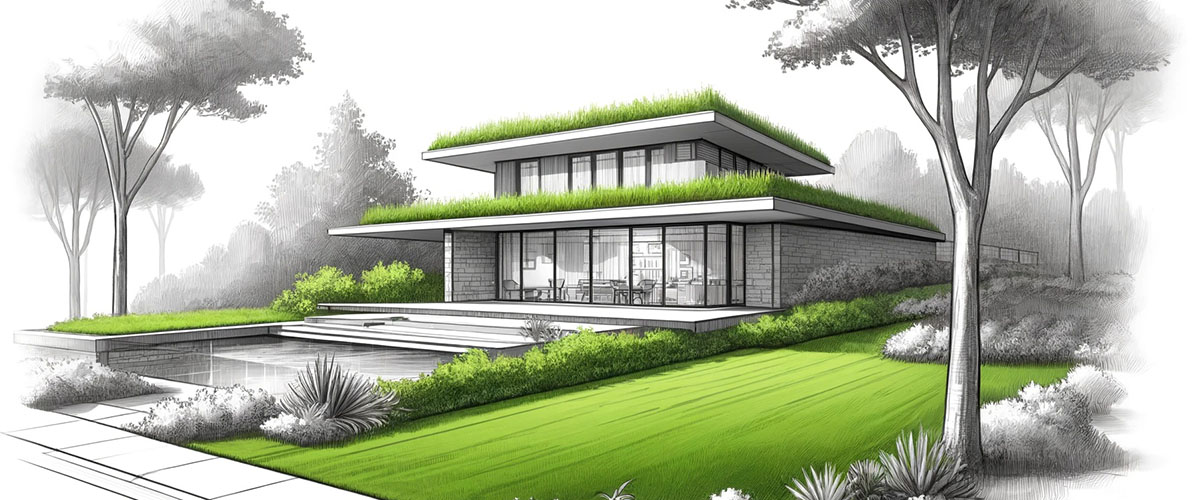
Vegetated roofs: green infrastructure with quantifiable benefits
Green roofs, building rooftops covered with vegetation planted over a system of engineered layers, have evolved from ornamental features into strategic urban infrastructure with hydrological, thermal, and ecological benefits verified through more than 30 years of research and monitoring. The European green roof market surpassed 80 million m2 of cumulative installed area by 2023 (European Federation of Green Roof and Wall Associations, EFB), with Germany as the leader (8-10 million m2/year of new installation, representing 10% of new flat roofs). Green roofs contribute to water management and energy efficiency in measurable ways, justifying their mandatory inclusion in municipal ordinances across more than 50 European cities (Hamburg, Copenhagen, Basel, Barcelona, Vitoria-Gasteiz). This regulatory momentum reflects accumulated evidence that green roofs deliver infrastructure-level returns that conventional roof surfaces cannot match.
The basic classification distinguishes extensive green roofs (substrate depth 60-150 mm, saturated weight 80-180 kg/m2, vegetation of Sedum, mosses, and grasses, minimal maintenance of 1-2 visits/year, cost 25-60 EUR/m2) from intensive green roofs (substrate depth exceeding 200 mm, saturated weight 250-1,000+ kg/m2, shrub or tree vegetation, regular maintenance, cost 80-200 EUR/m2). Semi-intensive systems (120-250 mm of substrate) combine plant diversity with moderate weight. In all cases, the layer build-up typically includes: a root barrier membrane (EN 13948), a drainage layer (HDPE nodules or volcanic gravel), a filter mat (geotextile), substrate (mineral-organic mix per FLL guidelines), and vegetation. Each layer performs a specific hydraulic and structural function, and the system's performance depends on correct specification of all components working in concert.
Water management: stormwater retention and runoff attenuation
Green roofs function as sustainable urban drainage systems (SuDS) by retaining, storing, and evapotranspiring a significant fraction of precipitation. Annual retention varies with substrate thickness and climate: extensive green roofs (80-120 mm) retain 40-60% of annual precipitation in Atlantic climates (Copenhagen, London) and 25-40% in Mediterranean climates (Barcelona, Rome). Intensive green roofs (200+ mm) achieve 60-80% retention. For individual rainfall events, peak attenuation is even more pronounced: an extensive green roof reduces peak runoff flow by 50-80% for moderate rainfall (10-20 mm/h) and by 30-50% for intense rainfall (30-50 mm/h), delaying the runoff peak by 15 to 60 minutes (Mentens et al., 2006). This temporal shift is as important as the volume reduction, because it decouples roof discharge from the critical peak loading period of combined sewer systems.
This effect is critical for urban flood management: impervious surfaces in cities (roofs, roads, car parks) generate instantaneous runoff that overwhelms storm drains. A study by the University of Sheffield (2012) demonstrated that converting 50% of the flat roofs in Manchester's city centre to green roofs would reduce storm runoff by 17-20% for 2-year return-period events and by 8-12% for 30-year events. The city of Hamburg has required green roofs on all new flat-roof construction since 2020 (Grundachstrategie), estimating drainage infrastructure savings of 50-100 million euros over 20 years. These city-scale projections transform green roofs from an individual building improvement into a distributed infrastructure investment, comparable in cost-effectiveness to conventional grey infrastructure upgrades but delivering a wider spectrum of co-benefits.
Energy efficiency: thermal insulation and passive cooling
Green roofs improve building energy performance through three mechanisms: additional thermal insulation (the substrate and vegetation add a thermal resistance of 0.3-1.5 m2K/W depending on depth), evapotranspiration (water evaporated by plants consumes 2,450 kJ/kg of latent heat, cooling the roof surface), and shading (vegetation reduces absorption of direct solar radiation). The combined effect is dramatic: the surface temperature of a conventional dark roof can reach 70-80 degrees C in summer, while the surface of an extensive green roof remains at 25-35 degrees C, a difference of 35-45 degrees C (Alexandri and Jones, 2008). This temperature suppression translates directly into reduced heat flux through the roof assembly and lower cooling loads for the spaces below.
Documented energy savings include: a 25-50% reduction in cooling demand for the top floor (the roof being the envelope surface most exposed to solar radiation in low-rise buildings), a 5-10% reduction in heating demand (the insulating effect is smaller in winter as evapotranspiration decreases), and a 2-5% reduction in city-wide air-conditioning consumption through urban heat island mitigation. A meta-analysis by Saadatian et al. (2013) covering 35 studies of green roofs across 15 countries concluded an average energy saving of 25-35% in cooling and 3-8% in heating for the floor immediately below the roof. In single-storey buildings (industrial warehouses, retail centres), where the roof constitutes the principal envelope surface, savings can reach 40-60%, making the green roof one of the most cost-effective passive cooling strategies available for large-footprint, low-rise typologies.
Life-cycle cost, durability, and urban ecosystem services
Life-cycle cost analysis (LCCA) of green roofs reveals long-term advantages that compensate for the higher initial investment. Installation cost for an extensive green roof is 25-60 EUR/m2 (over the waterproofed roof), versus a marginal cost of 0 EUR/m2 for a bare roof. However, the green roof doubles the waterproofing membrane lifespan by protecting it from UV radiation, thermal cycling (daily temperature swing reduced from 60 degrees C to 15-20 degrees C), and mechanical damage: service life extends from 20-25 years (exposed membrane) to 40-60 years (membrane under green roof), based on monitoring data spanning over 35 years in Germany (FLL, 2018). The savings from deferred membrane replacement (30-60 EUR/m2 per cycle) and accumulated energy savings (2-5 EUR/m2 per year) mean that the LCCA over 40 years for a green roof is 10-30% lower than for a conventional roof in climates with significant cooling demand.
Green roofs also deliver measurable urban ecosystem services: an extensive roof with a mix of Sedum and grasses supports 50-100 arthropod species (spiders, beetles, hymenoptera) and 20-40 plant species when designed with substrate diversity and microhabitats. An intensive green roof of 1,000 m2 captures 20-40 kg/year of PM10 particulates and 1-3 kg/year of NOx (Currie and Bass, 2008), provides acoustic attenuation of 8-12 dB at frequencies above 1,000 Hz, and contributes to urban heat island mitigation (a simulation for Toronto by Bass et al., 2003, showed that greening 50% of flat roofs would reduce mean urban air temperature by 0.5-2.0 degrees C). Maintenance of extensive systems is minimal: 1-2 annual inspections (checking singular points, removing invasive vegetation, verifying drainage) at a cost of 2-5 EUR/m2 per year. Irrigation is unnecessary in Atlantic and northern European climates; in Mediterranean climates, supplementary watering of 2-5 L/m2 per week during 3-4 summer months maintains Sedum vegetation with an annual consumption of 25-60 L/m2. Green roofs are an investment in resilient infrastructure with multiple returns: hydrological, energetic, ecological, economic, and urban quality of life.
References
- [1]Green roofs as a tool for solving the rainwater runoff problem in the urbanized 21st century?Landscape and Urban Planning, 77(3), 217-226.
- [2]Temperature decreases in an urban canyon due to green walls and green roofs in diverse climatesBuilding and Environment, 43(4), 480-493.
- [3]A review of energy aspects of green roofsRenewable and Sustainable Energy Reviews, 23, 155-168.
- [4]Guidelines for the Planning, Construction and Maintenance of Green Roofing (2018 Edition)FLL. ISBN: 978-3-940122-58-8
- [5]Estimates of air pollution mitigation with green plants and green roofs using the UFORE modelUrban Ecosystems, 11, 409-422.
- [6]State of Green Roofs in Europe 2023 — Market Size, Policy and StandardsEFB.

Comments 0
No comments yet. Be the first!
Leave a comment